 Published 1994, Volume 3, POSITIVE NEWS
This is dedicated to American fathers, the ideals they hand down to their kids, and children who have ever lost a dad.
Tessa was nine in 1969 when her father, film legend Robert Taylor, died after battling lung cancer. Her brother, Terry, was fourteen. A man known during Hollywood's heyday as, "The Man With The Perfect Face" was to Tessa and Terry, simply, "Daddy."
"Erasers." Tessa Taylor related her first memories. "In his study at our ranch he wrote letters on this big green manual typewriter--the pounding kind heard a mile away. Each afternoon he typed and used those round erasers with wheel and brush. I sat on his lap and he typed around me."
Even now, all these years after her dad's death, Tessa draws comfort from memories. "If I'm in the kitchen with the TV on in the other room, and I hear his voice, I automatically think, 'Hi, Daddy!' It's comforting. He's always with me." Tessa still deeply feels his impression on her life, and a teary catch in her voice indicates how she often thinks what it would've been like had he lived. As an actress, she's learned to utilize memories to add deeper meaning to her abruptly-aborted relationship with her dad.
"We had an afternoon ritual," Tessa continued. "He had a pouch in his desk, given him when he went in the service. Inside, there was a religious medallion, a four-leaf clover, a capsule with Jesus in it, a 1942 penny, and more. I'd open it and pour everything out. He patiently explained each piece."
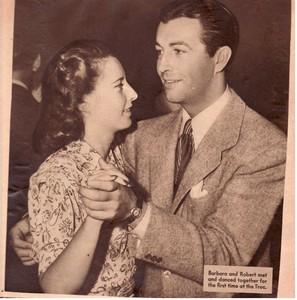
Robert Taylor, as father and teacher, is a vast difference in image from that of a pretty face, or a fair actor who'd not have lasted without his physical beauty. Another public recollection of Taylor was that of him as Barbara Stanwyck's ex-husband, a part of his life long before the birth of Tessa and her brother.
Taylor's divorce from Stanwyck came after painful soul-searching. He tried to understand their rocky thirteen-year marriage but, ultimately, was unable to sustain the relationship. His confusion led to meaningless affairs designed, it seems, to numb the dissatisfaction and pain over his marriage.
Taylor filmed QUO VADIS in Italy in 1951. Stanwyck flew there to challenge him over an indiscretion. As a scare tactic, she demanded divorce, which she didn't really want. He shocked her, and himself, and agreed. This may've begun the first true emotional happiness Taylor ever knew, after which he met Ursula Theiss, an actress and model. They married, and Terry and Tessa were born in the 1950s.
Chad Everett, a friend, described Bob and Ursula as "hand-holders." He said of Taylor's long-lasting appeal, "There was never a point in Bob's career when he wasn't a star. He was always a legend." He considered Taylor an excellent actor typecast as a "pretty boy" -- a term Taylor hated.
When asked about her father's good looks, Tessa, carrying on the famous profile, laughed again. "They say he was the perfect face. I remember his face with lines in it. I saw," another laugh, "goofy Daddy!" Terry, her brother, looks strikingly like his dad.
Tessa went on. "One night he tickled me on his study floor. I laughed so hard I couldn't stop. Mother said, 'You'll give her a stomach ache!' He did." Tessa remembered the physical "pain" with delight, re-experiencing the joy of having her father's undivided attention.
Robert Taylor, "The Man With The Perfect Face," was known to millioins of filmgoers as a heartthrob, and film legend. To only two people very special to him was he known as, simply yet intimately, "Daddy."
|




Connie Jackosn
to see that he was once and always, not only a gentleman but a great
dad. Hope that you see this Tessa! Diane Bell.
wha could be convincing in historical,westerns.modern ,subjects .
with fine speaking voice ,he made it look easy ,he was superb as the unsympathetic 'charles gilson' in The last hunt' we still remember him .to his family if they see this best wishes