Economic Facts v Fiction
Let’s say you are a billionaire worth $10 billion. You would have a lot of company. There are 536 billionaires in the U.S. and nearly 2000 around the world. Like Donald Trump it is unlikely that any of them know how much they are worth, or care. And why not? The reason is because the numbers are too big to grasp, and there is no need to do so. But let’s say that a tremor of some kind rippled through the financial markets, and afterward you are worth $9 billion. How would your life change? It wouldn’t. You would still be wealthy beyond the knowledge or reason of everyone, and you could still do anything, go anywhere, and own whatever tickled your fancy, in spite of the fact that you just lost $1 billion of net worth.
Conversely, if you were worth $10,000, and lost $1,000, you would know it, you would feel it, and it would not be pleasant. Why the difference?
The difference is called the “diminishing marginal utility of money.” It means that money must first satisfy very intense human needs such as food, and shelter, and other physical needs. As incomes rise, they start to satisfy less and less intense needs, and more and more of very distant needs. When you purchase your 10th personal residence, for example, how much utility does that 10th house bring you? If you changed your sleeping arrangements every day, it would still satisfy just 1/10th of that need.
It is this diminishing marginal utility concept that justifies a progressive income tax. The wealthier you are, the more you can afford to pay in terms of a higher percentage. A few years ago Ray Dalio, a hedge fund manager, earned $4 billion. He paid just 15 percent of that in federal income taxes, the same rate as someone who earns $15,000. Dalio could easily have afforded to pay 50 percent of his income, and he would still have had $2 billion left over. Nothing about his lifestyle would have changed.
But write him and ask him if he is willing to pay 50 percent of his income in taxes. Or you can do the same for any of those other 535 billionaires, and you will almost certainly get the same answer—“Go f**k yourself!”
OK, I am using street language because I remember my past too well. So I will back off a little.
Let’s say that we asked all very wealthy U.S. residents to pay a one-time tax of just 17 percent of their wealth. The amount collected would not be felt by any of them. Yet our entire public debt of $13.8 trillion dollars would disappear. That’s right. All our budget deficits, that immense total touted so long and incorrectly by many politicians, would be gone.
Now let’s go one step farther. Suppose we upped the one-time tax to 25 percent of their net worth, and collected $20 trillion from them. Now we could pay off the public debt, make college and trade schools free for everyone, fix our infrastructure (bridges, highways, railways, seaports, airports, and all interconnecting links), and restore the solvency of Social Security and Medicare.
The wealthy would see their wealth drop from $80 trillion to $60 trillion. That is not a drop in the bucket, but not a one of them would feel it.
But let’s continue even more.
The rise in wealth since 2009 comes to just over $30 trillion. And that new wealth was the result of the Fed adding $4 trillion to the banking system that bankers moved directly or indirectly into stocks, bonds, real estate, and commodities.
But what if bankers had directed that new money into the economy? The average turnover rate (number of times each dollar is spent in one year) since 2009 was 7.5, and 7.5 times $4 trillion equals $30 trillion in new GDP (money in circulation times turnover = GDP). That amount of production translates into $21 trillion in new incomes, $4.5 trillion in new federal tax revenues. Those numbers also would have meant full employment, plus a pay raise of $14,500 for everyone in the workforce.
Opportunity Costs. The preceding numbers represent “opportunity costs,” or what we give up for what we get. In this example, we gave up eliminating poverty in America, we gave up all deficit spending by the federal government, we gave up most of the ravages of poverty as we know it, we gave up college educations for those who wanted it, we gave up home ownerships for several millions; and we gave up new automobiles, new furniture, or new savings of at least $2 trillion for everyone.
The preceding paragraph contains data and estimates based on economic facts and data that persist and have persisted for the last 10 years or so. No economist worthy of that descriptor would dare challenge them.
We also know this: 90 percent of all new wealth comes from us, the American workforce, the same group of people who received only a tiny fraction of the wealth they created, nor did we get those new jobs, all that new income, and all the rest of the examples in that same paragraph.
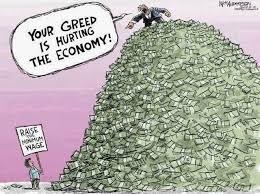
We also know that we merely stacked another $30 trillion top of the wealth heap of the very wealthy—who could not feel, did not feel it, and did not need it.
I will end with another question: “Do you think (believe, guess, surmise) that the wealthy would be willing to give back—not the entire $30 trillion that they did nothing to earn—but just $20 trillion of that total that they did even less to acquire, but that they find in their wealth accounts?



Unfortunately, as you so aptly have pointed out and I have found to be verified by my personal observation and those of a small shop proprietor that I know. It seems that the wealthier people get the stingier they get (a miser complex?). While they may give away huge sums of money (once again, as you pointed out, of marginal utility to them) these sums often go to charitable foundations simply designed to avoid taxes and increase their wealth. These charitable acts are also directed to their own personal desires and do not benefit the general public like government services paid for by taxes. This leaves huge gaps of need, unfilled, and unpublicized.
Ron