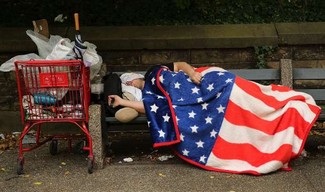
As 4th of July, the birth of America approaches, a critical offering of Leo Tolstoys' short story "How Much Land Does a Man Need?" in relation to the ideology of pursuing the American Dream & its ensuing pittfalls.
"The richest man is not who has the most, but who needs the least." Anonymous
There once was a man from Haiti, we’ll call him Francois to protect his identity, who came to the United States; to pursue economic liberty.
Now most of us are aware of what coming to a new country means. It means, in case you’re not aware, having to start all over again. For example, if you used to live in a house of great magnitude in your country, in this country one might have to start out by being a border in somebody else’s apartment. This particular man started out with nothing. He had no car, money or a place of his own. He lived with his sister at the time and was in the process of looking for some type of employment. Now this man, at the beginning, was content with just being in the States. Material possessions like cars, fashionable clothing, expensive furniture and home entertainment systems were not his priority.
Then a few years later, things started to change. By that time he had gotten a job, and was paying his sister some rent. His ambition, however, was to use most of his money to buy home entertainment systems, new clothes and ultimately a car. Now keep in mind that this man has only been in this country for three years and could barely speak English. He figured that if he had all of these things, he could write to his family in Haiti to tell them how he had attained instant success. He wanted all things that he never had back in his country and was willing to do anything to get them and get them fast. He figured that if he was empowered by material things, then nothing else could touch him. The devil, with all his temptations, then makes his grand entrance into his life and wreaked havoc.
This brings me to Leo Tolstoy’s revealing story, “How Much Land Does a Man Need?” This particular story was written more than a century ago. The situation described in the previous paragraph took place in today’s world however the similarities are uncanny.
In Tolstoy’s story, he describes a land owner who can never get enough land. A few acres more always appear to be more attractive and at the time the one thing that he ‘thought’ would make him happy. The paradox in that though is the more land he has, the more he is unhappy because he is too busy thinking about getting more land to really enjoy the land he already has. Pakhom, the landowner, asserts that, “If I had all the land I wanted; I wouldn’t fear the Devil himself!” It was at that point that he inadvertently, like Francois, beckons the devil himself with all his temptations.
Francois ended up purchasing a new car, signed a contract for a membership at a popular health club and had by that time accumulated all kinds of bills and was feeling like a “big man.” His friends in this case played the devil’s advocate in encouraging him to do all of these things. They told him that having all these things meant that he would look like he has money, which meant that he could then have all the women he wanted. Then all of a sudden, he lost his job. Since he didn’t have any skills or speak any English, he could not find one soon enough. Apparently, the money he was spending on material things, he should have invested in an education. He was forced to sell his car, his entertainment system and was reduced to buying second hand clothes, all contrary to his previous illusionary status. He could not be extricated from his contract at the gym, so they submitted his name to a collection agency which would stain his future credit report. Hence in the end, how many material possessions did Francois really need? He probably needed just enough to be comfortable and content. What he shouldn’t have wanted was to be overly comfortable yet highly stressed; which would only bring inevitable misery.
In Pakhom’s case, we see him succumbing to the same situation at the end of the story. So like Pakhom, Francois lost his priorities along the way. He confused what he needed for what he wanted and in the end it was what he wanted that finally destroyed him.
Pakhom, in “How Much Land Does a Man Need?” towards the end surrenders to the devil’s temptations, this time in the shape of an older land owner. The land owner tells him that he can own as much land as he can walk in a day, but the catch is that he has to return to the place where he started from before sundown. Pakhom sees this as a great opportunity to acquire more land and thought that he was going to walk on as much land as possible, but carefully so he wouldn’t bite more than he could chew. He then, however, succumbed to the devil’s wishes by walking on more land than he’s able to walk back. He barely made it to the spot where he started, and when he did he fell right onto that spot and had a heart attack!
How much land would one say Pakhom needed? Just enough to bury him in, which is about six feet. Pakhom, like Francois, lost site of his priorities. He confused what he needed for what he wanted and what he wanted ended up destroying him.
The biggest mistake that people make in contemporary consumerist society, among all the surrounding temptations, is failing to differentiate between necessity and luxury. There is an axiom that “God never gives you more than you can handle.” So whatever you have now is probably what you “need” to survive. The epiphany I had after reading Toltoy’s story was don’t chase somebody else’s waterfall, when you have a nice fountain in your own backyard.
|








Your article applies to more than just immigrants from poor countries to the United States. In a broader sense, it covers why many Americans can't seem to make it in a "trickle-down" economy--stuff.
During my doctoral studies, I learned about a study by Bandura. He came up with a satisfaction scale. Many of our obsessions, like Tolstoy wrote, result from misplaced understanding of what it means to be happy. Material wealth, and even wage increases, are like lunch, he described. We eat lunch one day, but by the next day, we are hungry again, unsatisfied, and have to eat lunch again. We may even want to increase the quantity or quality of the next lunch. Still unsatisfied the next day when we still need to eat lunch.
I grew up in the fabulous 50s in America when depression and war depressed people sought to leave their depression behind with prosperity and stuff. My mother was very conservative coming from a poor, farming subsistence. My father always wanted the latest things and bought them for us along with many cars, making us "car poor", only because he had relatively good work as a truck driver.
I chose my mother's approach to careful spending and saving what I made, investing it in a college education. I bought $100 used cars and no more than I could carry in my car until I was in my mid-20s and then, bought land and a house even though I didn't furnish it because it came furnished with old (antique?) furniture and appliances. Serviceable but not fashionable. I still have that furniture, buying very little with no need to keep up with the trends.
I came in contact with many students from many countries. For the most part, their educations got them good jobs and they spent their money wisely. Many obtained wealth in one generation--very laudable. However, recently, listening to my partner, I have found that some immigrants found wealth very quickly through hard work. But then, they overindulged in luxuries, got hooked on drugs or gambling, or became dependent upon a wealthy spouse for their excess. Invariably, these people have little or no education to fall back on.
Ron