The Search for Extraterrestrial Intelligence
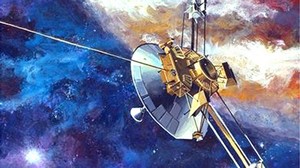
Back in the 1960s astrophysicists began the serious discussion of the possibility of finding intelligent life elsewhere in our galaxy. Most notable among the early participants was Dr. Frank Drake. He was associated with SETI (the Search for Extraterrestrial Intelligence) and the Drake Equation. He was joined by Carl Sagan, and together, they designed the famous plaque that is mounted on the Pioneer 10 spacecraft, the only man made object to pierce the outer region of our solar system. Today it travels “out there” where no object has gone before, perhaps until the end of time.
I once fiddled with the Drake Equation, just to see how my crude calculations matched up with those of space scientists. This equation posits 7 variables that must be met in order for sentient life to exist in our galaxy. Here it is:
N = R* • fp • ne • fl • fi • fc • L
Where:
· N = The number of civilizations in the Milky Way galaxy whose electromagnetic emissions are detectable.
· R* =The rate of formation of stars suitable for the development of intelligent life.
· fp = The fraction of those stars with planetary systems.
· ne = The number of planets, per solar system, with an environment suitable for life.
· fl = The fraction of suitable planets on which life actually appears.
· fi = The fraction of life bearing planets on which intelligent life emerges.
· fc = The fraction of civilizations that develop a technology that releases detectable signs of their existence into space.
· L = The length of time such civilizations release detectable signals into space.
The scientists’ guesses came down to 2 planets for the Milky Way. But if this galaxy is typical, then the number of inhabitable planets like Earth soars to 400 billion such planets extant our own given the current estimate of 200 billion galaxies in the universe.
Now, if there is but one other planet like ours in our galaxy, and if it is half way across, then it is still 50,000 light years away. And that distance, alone, suggests that we could never propel ourselves to it, nor could they ever reach us—unless we cheated and traveled through a worm hole. All of which suggests that the entire discussion amounts to so much pie in the sky.
Or does it?
We still face the almost certain need at some future date to find another habitable place on which to live knowing that our sun will burn itself out; or that our galaxy will be gobbled up in a collision with the Andromeda galaxy; or we could face extinction tomorrow from a collision with an object hurtling our way from within our own little solar system.
And that points the discussion into another realm of mystery—are we worthy of being saved, or have we progressed far enough to even think of ourselves as worthy candidates for saving?
These questions have many practical dimensions. First, we are still killing each other by the thousands every day in wars of enormous stupidity. And there appears to be no end in sight in those clashes other than the inevitable misuse of nuclear weapons that could bring about our extinction in a matter of months. And we appear to be hastening that day of reckoning by our insistence in allowing tyrants to rise up and take power—here, there, and everywhere. Or we elect leaders with not enough human intelligence to even understand the concept of good moral decisions, or with an appreciation for our own history, to say nothing of our destiny.
We might also ask: Are there are good reasons to surmise that other inhabitants on other worlds in other galaxies are doing any better than we are? And would we welcome each other to join in our mutual frays—even if we could?
Let’s project our minds away into other dimensions and take the “God view.” Would any person, place, or thing have made us for the purpose of finding the shortest path to our own extinction? That seems like a contradiction.
Therefore, the only questions that make any sense for resolving are not whether there is intelligent life elsewhere, but is there is intelligent life here that is worth saving? And if the answer is “yes,” then do we have enough moral clarity to stop killing each other? And do we have enough practical wisdom to change the way we govern ourselves?
And if the answers to those questions are all “yes,” only then do we dare ask “Are we worthy of seeking new places in which to add more longevity to our lives with the possibility of finding redemption in a universe that really does not need us?”





I explored these ideas in my first two novels. For any of us to look up and see the stars at night, we are curious. This curiosity leads us to learn more. Your premise that we need to find intelligent life and save it right here is both noble and desired. But, by reaching outward to the stars, we are learning much more about ourselves and our fragile planet as well. As more of us continue to get "out there" and look back, more and more of us will want to take better care of our home. The only one we have.
DARPA has funded the 100 Year Starship (100yss.org) to seek ways to launch a starship within 100 years. Science fiction is welcome there.
Ron