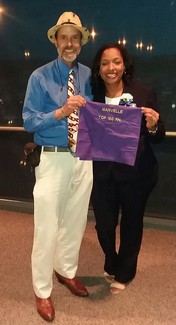
With all the negative media that one may have heard in the recent past about the VA's leadership concerns, this is a great example of a "metanoia" taking place in the VA culture, as well as a wonderful and transformational "esprit de corps" being experienced by all VA staffing involved, which has greatly benefited our hero customers: Veterans and their families who deserve only the best - Veterans, after all, who everyday put their lives on the line for all of us!
Marvelle was honored in July 2014 with a Patriot Award in recognition of her extraordinary support of its employees serving in the Guard and Reserve. http://www.esgr.mil/News-Events/ESGR-In-The-News/articleType/ArticleView/articleId/3213/Southeast-Louisiana-Veterans-Healthcare-System-honored-by-Department-of-Defense-for-extraordinary-support-of-employees-serving-in-the-Guard-and-Reserve.aspx (includes pic).
My boss, Mrs. Marvelle L. Williams-Perrin, RN, BSN, MSN, CCM, is the ultimate Non-MicroManager! She motivates us in such a “nonchalantly NON-micro-managerial” way to be autonomous, risk-taking, self-directive, change-agents for our clients - Veterans receiving home care!
Last month, Marvelle was recognized as one of the Great 100 Nurses in Louisiana (Pic with me)!
In the past, I had nominated Marvelle for Dale Dauten's (Dale Dauten, Author and Publisher - www.dauten.com,) ”One Cool Thing, Brilliant Boss” Edition, a free publication that gives examples of creative leadership:
“Marvelle is One Cool Brilliant Boss, Who Empowers All Without Loss!”
Like me, Marvelle has to be a leader for us in a very structured and bureaucratic system, the VA, which like all well-intention-ed and usually effective and efficient results-oriented “chains of command,” it can, at times, reveal broken, dysfunctional and stressed links.
In such a sometimes very controlling and restrictive work environment, Marvelle embodies MBO (“Management By Objective”) with a twist - “Mindfulness / Being / Open!”
Marvelle encouraged us to this openness in our everyday tasks - as was well noted by Shunryu Suzuki in his classic book, Zen Mind, Beginner's Mind: “In the beginner’s mind there are many possibilities, but in the expert’s there are few.”
Marvelle's realistic understanding to the “Yin and the Yang” of work situations is balanced by an overriding emphasis on living out The Golden Rule of “doing unto others (clients and staff) as we would have them do unto us.”
And her approach to leadership is very much attuned to my professional “modus operandi:” Social Work 101: always start where the client (employee) is in the here and now!
While boundaries in our work orientation with clientele and staff certainly have to be established, kept and revised as needed, Marvelle nonchalantly demonstrated to us on a daily basis how not to become silos but IEDs (“Improvised Explosive Devices”) as change-agents when needed – even with the pain that they may cause!
Here is One example of MBBS ("Marvelle's Brilliant Boss Strategy"):
1. When an administrative measure of employee weekly work progress was out of whack for some staff, instead of just "writing up" the involved individuals, Marvelle let the subordinate staff directly and without micro-management use "referent leadership / power"*** to persuade the non-compliant folks to get "in line" and complete their needed TEAM roles, so that everyone had "their ducks in a row," which enabled the overall process to be completed with flying colors and credit given to all - and most importantly, Veterans (customers) were (and are) getting high quality and up-to-date home care service / treatment!!!
***Referent
Referent power comes from being trusted and respected. We can gain referent power when others trust what we do and respect us for how we handle situations. For example, the Human Resource Associate who is known for ensuring employees are treated fairly and coming to the rescue of those who are not.
2. Another example of MBBS: Many home-care companies have enabled employees to "work from home" with little actual "reporting to the office," except for team building, mandatory reporting and other networking purposes. When our own staffing started last year to see if that could apply to us in our work with home-care Veterans, Marvelle encouraged a "put up or shut up" type demonstration / documentation of our work efforts.
In other words, if we could demonstrate to management for a reasonable amount of time that we were compliant with varying agreed upon measures of our work objectives (caseload, treatment plans, etc.) in the closed arena of going to and from the workplace every day, then we could prove to be disciplined enough to be able to work from the home setting.
To entice us to further for our own desire for this benefit to work from home, Marvelle provided to us the technical and "I-T" wherewithal computer training for us to have the ability to properly and safely transmit our clinical information, as well as how to access government vehicles still for our work.
What we can learn from Marvelle:
1. Micro-management is insidious, breeding mistrust in employees and not encouraging empowerment.
2. Like kids with their parents, employees (all of us) WANT boundaries from their employers - however much we may not say that, but also like kids, we more-so, as employees, like and thrive on adventure and need to be given the freedom to explore "the best practice models" ("evidence based practice") in our work arenas.
3. Mindfulness (living in the present) translates to healthier and happier employees and, most importantly, better served customers!
With our faithful Veterans, I wholeheartedly SALUTE Marvelle!
Keith John Paul Horcasitas, LCSW, MHA, 1133 Knollhaven Drive, BRLA 70810, khorcasitas.yahoo.com, November 4, 2018.
|


Your article seems to be filled with jargon from the trade. Unfortunately, caregiving sometimes seems to be tied up in "clinical" strategies rather than the personal care needed for an individual to get through each day. Everyone is different. Since I'm not a veteran, I'm not plagued with memories of horrible things that caused my particular need for caregiving.
If we can eliminate the need to go to war over silly differences, we can eliminate a lot of the need for caregiving our veterans because we'll have fewer of them.
Ron