The Nazi dream of an invasion of the Western Hemisphere was realized in the spring of 1943—but was blasted in its early stages by U. S. Army bombers and a Coast Guard task force.
The German invasion consisted of a hidden weather station on the desolate coast of Greenland. It is believed to have existed for about two months, supplying weather information to U-boats and the Luftwaffe, before being destroyed by U. S. forces.
The presence of the Nazi invaders was first discovered by three members of the Greenland Sledge Patrol, a unique branch of the U. S. armed forces composed of free Danish citizens, who, subsisting mainly on game they shoot and trap themselves, keep a constant watch for Nazi intrusions in that cold, lonely country.
The Danes were patrolling the coastal areas and fjords along the east coast of Greenland. Approaching the northern outpost station on a routine patrol, they saw two strange men emerge from the station's hut and disappear into the hills. When they entered the empty station they discovered two sleeping bags, a green uniform bearing the German eagle and swastika, two Nazi daggers and some provisions. They hurriedly returned southward with the news and, because they were almost certain to be followed, prepared defenses as best they could.
A few nights later, one of the guards heard footsteps approaching the station. When he challenged, the Germans opened up with automatic rifles and machine guns. Realizing they were outnumbered, the Danes abandoned the station and fled south. Later, another member of the patrol, a Dane named Eli Knudsen, was killed as he came near a rest hut occupied by the Germans. Mushing through an Arctic snowstorm with his head swathed in furs, Knudsen did not hear the command to halt and continued on. When the Germans killed his dogs, Knudsen reached for his rifle but was mortally wounded before he could get it into action.
The next day, Marius Jensen, another patrolman, mistaking the Germans' dogs for Knudsen’s, walked into a trap and was captured. The Nazis decided to destroy the patrol station at a nearby island and asked Jensen to guide them there over the shortest route. Persuading the German lieutenant that travel would be faster in two parties, Jensen sent one group off on a long roundabout route and set out himself with the leader of the Nazi expedition. At the first opportunity, Jensen managed to over-power the German, seize his rifle and take him prisoner. After a journey of more than 300 miles over icy waters, the Dane brought his captive into an Army outpost.
When word of the Nazi expedition reached the main U. S. northern base, organization of a task force was immediately begun. While Army bombers attacked the German-captured base from the air, tons of supplies and ammunition were poured into the holds of two Coast Guard cutters, the Northland and North Star. Specially trained Coast Guard landing forces and Army Ranger-type troops readied themselves for any action that might be necessary.
The start of the expedition was decidedly inauspicious. Shortly after sailing, the cutters became caught in a huge ice pack and valuable days were lost before they succeeded in freeing themselves. The North Star, famous for its peacetime as well as wartime iceberg activities, nearly fought its last battle with the ice on this occasion. One huge berg came smashing through the pack, moving steadily down on the cutter which was held fast in its path. Chancing the lesser of the two evils, the cutter's skipper threw full power on the ice- choked propeller. The ship was driven into the pack and escaped the berg, but suffered a mashed bow. When a shifting wind opened up the pack, the second cutter, the Northland, was forced to turn back and escort her injured sister to an Allied naval base for repairs.
In an attempt to dodge another pack, the Northland altered her course so that she had to go quite close to the coast of North Europe. A twin-engine Nazi patrol bomber, skimming the sea, spotted the cutter and came over for a closer look. But when shrapnel from the Northland's guns began bursting uncomfortably close to its nose, the Junkers broke off its run and skidded off to the horizon.
Several days later the Northland again became locked in another ice pack and it was necessary to blast a path through the ice with half-pound TNT blocks, some of them exploding only six feet from the side of the cutter. The Northland finally made open water but with steam lines and lighting equipment thrown out of kilter by the TNT's concussions.
The U. S. force now approached the Nazi camp. On schedule and according to plan, Army bombers appeared and blasted the camp thoroughly. Word was flashed from the planes that there was no sign of life on the island or at the burned-out Danish station 30 miles to the south. Thrusting her way through swirling ice floes, the cutter stood into the beach. The burned-out station was without a sign of life. When the Landing Party hit the beach, it discovered that the Army bombers had done a thorough job. Not a building was left standing. Frozen into the ice were bits of wreckage, life jackets and the splintered ribs of a lifeboat. Frozen- over bomb craters pitted the ice so that the surface resembled a close-up picture of the craters of the moon. Every- where were clusters of .50-caliber ammunition. The 20-mm. shrapnel much in evidence showed that the Germans had at least made a show of defending their base.
What the bombers hadn't destroyed, the surviving Germans had. Every building on the island was charred rubble. In one burned pile were fire-ruined lugers, tools and all the various gadgets needed to operate a weather station. The Landing Party was puzzled at first by the fact that, although most of the base equipment was destroyed, other material was undisturbed. A careful search uncovered full uniforms, cold-weather clothing and metal boxes of food, including Danish butter. A checkup on the generators and motors disclosed that, although they appeared to have been rendered useless, a good electrician could put them back in working order in a short time. Apparently, the Germans had hoped that reconnaissance planes or a small landing force would believe the base to be a complete ruin and leave without further investigation.
At the end of the first day the Landing Party returned to the Northland, but Captain С. C. von Paulsen, uscg, commander of the task force, elected to remain on the beach for the night with two men to continue the search. Searching conditions were excellent, it being the season of the midnight sun with light for the entire 24 hours of the day. But the three Coast Guards- men little knew, as they groped among the rocks and poked into the frozen tundra, that they came close to death during the night.
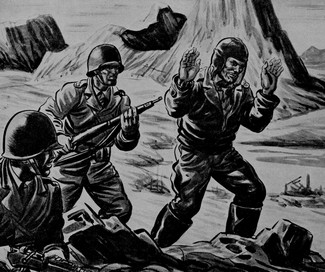
Late next day a patrol was startled to hear an ancient phonograph scratching out a song in German. Investigating, it discovered a single German officer—the physician of the party, Dr. Rudolph Sennse—seated unconcernedly on a rock, tending the phonograph and holding a hand "potato-masher" type grenade in his lap.
After surrendering, Dr. Sennse told his captors that he had lost his dog team and sledge in an ice crevice and had returned to his camp only to see American tents on the beach. Enraged, he had sought a weapon to "strike one last blow for the Fatherland" but could only find one grenade. He never had the opportunity to use it, since Captain von Paulsen and his men fortunately always remained far enough apart to offer no single target.
Before the task force left the wrecked base, additional evidence was discovered to strengthen the belief that some of the German invaders were still alive. A Coast Guardsman scouting the beach found a rubber life raft and a steel suitcase containing hand grenades. On a piece of the cardboard packing was a message in German, apparently to Dr. Sennse. It said, "You'll know where we've gone." Then followed a detailed chart of caches of food, ammunition and other gear.
Another day was spent digging out these hidden supplies, which included radios, hand grenades by the score, rifle and pistol ammunition, tinned food and warm clothing. The North- land's scout plane searched the area within its range thoroughly but, if the Germans were still around, they managed to keep well hidden.
All the time the U. S. forces remained at the base, German planes, although apparently not in sufficient force to attack, hovered about. One afternoon a huge black Junkers dropped down from the clouds and made for the ship but was evidently discouraged from bombing by the cutter's gunfire. About the same time, the North Star, some 35 miles at sea, reported that a large three-motored Blohm Voss flying boat had attacked her with machine gun fire but had been driven off.
The Americans remained at the base until the cutter's food ran low and it was necessary for them to leave.
The cutters then began their return trip. But once again the ice closed in on them. The Northland's propeller crashed against the ice and was twisted upward, reducing her speed by three-quarters. With the cutter held inexorably in its grip, the ice pack drifted for several days while the vessel tried ineffectually to free herself. It was decided to try blasting again, although the betting was that the ship wouldn't take it, since it was now necessary to use 54-pound wrecking mines because of the thickness of the ice. Sometimes an hour's dynamiting won only a few yards through the ice, but slowly the cutter smashed her way out to safety.
Meanwhile, the North Star had also smashed a rudder but with the help of a jury rudder and a providential wind she managed to reach open water.
When the ships finally docked a relieved soldier was heard to say, "Well that ends that." But the crews' only comment was "E-mo-gah"— Greenlandic for "maybe
[This article originally appeared in INFORMATION BULLETIN, Bureau Of Nava Personnel, February 1944]










And the heroic efforts of the two US Coast Guard cutters that braved killer ice flows to get to the site and help neutralize it. Good stuff. Unfortunately, there were many typos that hampered reading a bit. Cleaning those up would be nice. I constantly find them creeping into my work as well.
Ron