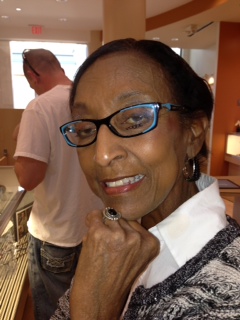
Juanita Lawson-Haith, click
here to update your pages on AuthorsDen.
Blogs by Juanita Lawson-Haith
D'Nile Ain't Just a River in Egypt 2/1/2015 1:14:46 PM
Denial is way more than a river in Egypt. It can be a whole way of coping with some of life’s greatest challenges. My own life is a long story of the triumph of determination and positive thinking –and some denial -- over unbelievable odds. I began high school at an early age. I had always been a good student, never wanting to miss school and looking forward to each new day. As the year progressed however, I began to feel sick, suffering severe cramps, the “trots” as we called it then, and a loss of appetite. I went as long as I could without overtly complaining but my mother noticed my lack of energy, my listless behavior, and my yellowing eyes. She badgered me until I described the pains I was suffering. I felt like someone had tied a red hot chain around my insides and he tightened it every 30 minutes or so. The pain was excruciating. I was throwing up and losing weight and feeling so bad that I actually stayed home from school. Then my lower limbs developed painful swellings that were hot to the touch.
That was enough for my parents who took me to our family doctor. He took one look at me and referred me to the Duke University Medical Center Clinic. I was admitted to the pediatric ward because I was only 13 and treated for intestinal bleeding. The swellings were diagnosed with some exotic name and I was sent home two weeks later, much improved and taking a mild dose of what I later learned were steroids.
Nine months later, I was sick again. I had the same symptoms only worse. This time the doctors cautiously diagnosed me with ulcerative colitis – cautiously because at that time, it was thought that the condition was specific to Jewish people. Honestly, that was stated in my hearing: people of color (or colored people) do not suffer from this condition.
The recommended treatment for the condition was the removal of the large intestine and rectum and the creation of an opening in the abdominal wall for the elimination of waste. My father was adamant that I would not be having that surgery as a young teenager. He saved my social life, perhaps, but over the next 23 years, I suffered bout after bout of ulcerative colitis and my colon continued to erode.`
Imagine if you can the life I led. Whenever I went out, I located the restroom immediately knowing I would need to find it in a hurry. At the beach I always wanted to put down the blanket fairly close to the changing facilities and outdoor events meant that I had to find the porta-potty early on.
During those two decades, I spent many weeks in various hospitals. My disease was progressive but as long as I could function I refused to even consider the corrective surgery. Finally, in 1984 my doctor spoke very candidly with me. He was concerned with the levels of drugs that I needed to function and advised me to move forward with the surgery to remove my large intestine. I still resisted, insisting that I really did not feel all that sick. To this he replied, “It’s been so long since you actually felt good, I doubt if you can even remember the feeling.” He concluded by telling me that if I did not go forward, I would not see my 40th birthday. I was 38 at the time.
I went ahead with the surgery on September 20, 1984. (I made one last attempt to escape even after being admitted to St. Luke’s Roosevelt Hospital). I asked my doctor one last time if I really had to go through with this because, honestly I did not feel that bad. He did not even entertain my question, but he told me, “It’s too late now because I have your clothes.”
Surgery was long (20 plus hours) but all went well. Recovery took several weeks but the doctor had been so right about feeling good after the fact. After the procedure, I felt like a new person. No longer in pain, I could do all kinds of things, my complexion cleared up, I no longer got upset about minor things, and I became a saner, calmer human being. BUT, waiting 23 years was a costly delay. During all the years that I suffered with ulcerative colitis, the disease was slowly destroying my liver.
In the early 1990’s I began to suffer from several annoying but seemingly unrelated ailments. I was tired a lot and again losing weight and my eyes were yellow. I also began to suffer some mental confusion, finding it difficult to concentrate. This time, the doctors diagnosed liver failure, most likely brought on by 25 years of chronic bowel disease. It seems that all the bad stuff from all those years of ulcerative colitis had leached into my liver. I was told that I had schlerosing cholangitis, a condition that narrows the bile ducts in the liver, thereby keeping bile in the organ itself. This in turn had caused massive scarring of my liver. The treatment: transplantation.
At the time, I felt like this had to be a mistake. After all that I had been through with my earlier disease, I still needed more major surgery. The prospect of a transplant seemed like something out of a sci fi novel.
I was referred to the Medical College of Virginia (MCV) hospital in Richmond VA in April 1996. I underwent a series of tests and evaluations (stress test, mental tests, etc) to determine if I was a good candidate for transplantation. I did well and was told to get prepared for the procedure.
My husband and I left Richmond on a Thursday afternoon. Before going home, we went out for dinner at our favorite seafood restaurant. Soon after we were served, I began to feel light headed. We asked that our dinner be packed to go headed home. Upon arriving at home, I used the bathroom and when I emptied my ostomy pouch it was filled with bright red blood. This scared me to death.
My wonderful spouse telephoned MCV immediately. He was told to take me to the emergency of the local hospital, get me stabilized and then bring me back to Richmond as soon as possible.
On the following Saturday, I was transferred via special ambulance from Greensboro NC back to Richmond. I was admitted to the transplant unit to await a suitable liver. While all this was going on, we were in the process of buying a house and so while I waited for life saving news, my husband was dealing with mortgage paper work.
At the hospital I talked with a variety of specialists who told me that the possibility of matching liver for me were slim because the hospital had not had an O blood type organ in several years. The interim solution was a stent to relieve the pressure on the liver. I was also told that my mental abilities seemed to be too sharp for the advanced disease that the blood tests were showing. In any event, I was scheduled for the stent to be placed on Friday, May 3, 1996. By now I was terrified of my chances and confessed to my spouse that he might reconsider the house since it looked like I would not live to move in! His response was to dare me to die because he had worked too hard to make our dream home a reality.
Friday May 3, I was taken to one of the OR’s at MCV. Was being prepped for the surgery and set to receive the anesthesia. Someone came into the room and announced that a liver had been found for me and I would be transplanted on the following day: May 4.
I remember giving my wedding ring to my husband for safe keeping and receiving the initial sedative in my hospital room. My next memory was waking up in the ICU surrounded by my family. My older brother was asking if I was awake and ok. I could not speak because my throat was sore from the breathing tube. My husband, ever the comic, said, “Good. Maybe I can get a word in.” My progress was amazing and I was discharged from the hospital on May 11. We had so stay in Richmond for the next few weeks because the transplant team was monitoring me closely. By the end of the month, I was allowed to go home, in time to celebrate my 50th birthday.
There was one complication in the month of July. My body was rejecting the new organ. I had to be re-hospitalized for almost 3 weeks during which time my medications were changed and all seemed perfect. I took two –anti-rejection drugs and life was good – at least for a while. My life totally changed in the year 1998. My wonderful husband died and I began to consider my life and career choices. Soon after he passed, I had to give up a job I loved because an old health problem (hepatitis C) kicked in again in 2000. I had to stay home, rest, and give myself injections Ugh!
Since I was off, I called by best friend and we took a short vacation trip to the US Virgin Islands. We had been once before in 1989 and this would be our first solo outing as friends since that time. The vacation was restful and the island gave me some ideas about what to do with the rest of my life.
By the fall of 2002, I was strong enough to work again and I accepted a job that I soon found to be disappointing. The mission of the organization was an admirable one but it seemed to me that internal politics were negatively impacting the overall success. I felt ham strung and that my own skills were not being put to use. At this point in my life, I felt that going to work should be rewarding so I left the agency and did free lance work for several months. Then, one day while looking at fund raising jobs on line, I saw one with my name on it: in the US Virgin Islands. I got the job, and moved with my 8 month old puppy to the beautiful island of St. Croix.
YET ANOTHER TRANSPLANT:
Sand, sun and sea are great for the soul but in 2003, I began to experience several urinary problems. My doctor referred me to a nephrologist. He measured my kidney function (it was at 60%). His diagnosis: eventual kidney failure bought on by high blood pressure which was a result of the immune suppressing drugs I had to take to retain my new liver.
So I now had to undergo evaluation for a kidney transplant. The process was the same and the likelihood of getting a transplant were actually quite good since cadaver organs and live donor organs can be more readily obtained than in the case of a liver. My prospects were excellent however, since I now lived in the Virgin Islands, there was a geographical challenge.. My body was older and not as strong as at the time of my first two surgeries and I had developed some narrowing of the blood vessels in my lower body.
I began hemodialysis in July 2007 and went forward with the transplant work up. I was advised that I should have my native kidneys removed in order to present the base situation for transplantation as they were seriously diseased and might impact the success of any new organ.
Here again, denial came into play. I still had some kidney function (I could still make urine), I was tolerating dialysis well enough to continue to work full time, and life was still good. But the denial voyage was about to come to an end. In 2013, I was hospitalized with severe kidney stones. According to the surgeons, my left kidney was just a mass of stones (calcification) and the right one was not much better. Immediate removal of both kidneys was now essential before going forward.
WHERE ARE WE NOW
I went ahead with the bi-lateral nephrectomy in October 2013. Now have two live donors who are being worked up for donation. I am now trying to get my system in order so that I can withstand the transplant. I need to gain weight, get my blood flow to the lower extremities improved and then get with the program. I have the most supportive network of family and friends imaginable. With luck I should be transplanted and recovered enough to visit the Virgin Islands come summer of 2014.
SOME THOUGHTS ON ORGAN TRANSPLANTATION IN GENERAL
Since becoming a transplant recipient, I pay special attention to any information about the process. Some things that really stand out:
There are way many more people who need organs than there are organs available. Some of this is caused by fear, some by cultural attitudes. Often people are reluctant to agree to donate a loved one’s organs for fear that greedy doctors will kill off the patient to get at the organs. This is a baseless fear because successful organ donation requires the correct set of circumstances.
Efficient and timely harvesting of donated organs:
Timely delivery of donated organs to recipients.
Ready availability of transplant facilities and surgeons.
Financial resources to pay for transplantation and follow up medical care, especially the cost of immune suppressant medications.
MISCELLANEOUS THOUGHTS
People who live in rural areas and places that are medically underserved are more likely to die before receiving an organ just because of physical and geographical constraints.
Kidney transplants can be paid for by Medicare, however, Medicare only covers the cost of immune suppressants for about 3 years. There are individuals who received transplants that worked well but who lost the transplanted organ because they could no longer afford the anti-rejection medication. This is a situation that should be addressed because these kinds of patients go back into dialysis which is more costly than the anti-rejection drugs.
ILLEGAL ORGAN TRAFFICKING
There is an alarming growth in illegal organ trafficking. Wealthy individuals can afford to outright buy a kidney from people who see the immediate money as an answer to their prayers.
Sometimes unscrupulous medical practicioners convince poor patients to sell an organ. A kidney is an easy sell since everyone has two. The donor gets some money (typically $5,000), the medical person gets a finder’s fee and person with the big check book gets a new organ. The donor does not get on-going health care. When the $5000 (sometimes less because donors are often cheated!) is gone, his/her family may have to care for the now compromised individual.
There are reported instances of young people selling their organs to buy electronic devices.
Totalitarian nations are rumoured to routinely harvest organs from convicted criminals (or political prisoners) for use by powerful individuals or even for sale on the black market.