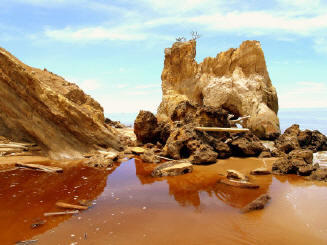
AQUIFERS AND FERRIC SPRING DEPOSITS SOUTH OF MIRI, SARAWAK: IMPACT ON FACIES CHARACTERISATION OF COASTAL SEDIMENTS
1 Franz L. Kessler and 2Eswaran Padmanabhan
1SHELL TECHNOLOGY INDIA PRIVATE LTD
RMZ Centennial - Campus B
No. 8B, Kundanahalli Main Road
Bangalore - 560 048, India
2CURTIN UNIVERSITY OF TECHNOLOGY
SARAWAK CAMPUS
CDT 250, 98009
MIRI, SARAWAK, MALAYSIA
ABSTRACT
Observations on artesian water springs have indicated the presence of at least three groundwater bodies that are chemically distinct. Artesian springs are observed from both high and low iron-content ground waters. Fe2+ rich groundwater is rapidly oxidized at surfaces, and orange deposits of Fe3+ minerals are precipitated. These are either parallel-layered, or form concentric ferric conglomerates in coastal caves. Once eroded, Fe-coated pebbles are scattered along the coast and embedded in recent sediments. Similar deposits are also seen in the Late Miocene Lambir and Miri formations


 Share
Share Save
Save