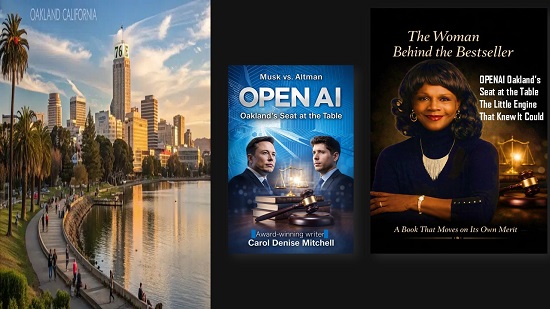
OPENAI Oakland’s Seat at the Table
The Little Engine That Knew It Could
Oakland became the venue for the Musk v. Altman trial due to a singular procedural detail: Judge Yvonne Gonzalez Rogers presides in Oakland. That is the sole reason. The national media chose not to attend, as they were reluctant to travel to Oakland. Not during that month. Not amidst that crime wave. Not during that spike in homicides. Not during that time of unrest. While Oakland was witnessing a general decline in crime rates, there was concurrently a significant and undeniable increase in homicides. The violence showed no signs of abating, no breaks, no relief. The city’s crime reports indicated ongoing incidents of robbery, theft, assault, vandalism — and a homicide clearance rate that fell below fifty percent.
To national outlets, it looked like this: “Why send reporters into a city with unpredictable crime patterns for a trial that wasn’t supposed to be sensational?”
So, they didn’t.
None of that stopped a seventy‑year‑old woman in a broken wheelchair from showing up to represent the little engine that knew it could — a woman who had seen burning cities before and had long ago learned that fear is no reason to stay home.
Elon Musk filed in San Francisco Superior Court on February 29, 2024. He refiled in federal court on August 5, 2024. The case entered the Northern District of California. NDCA randomly assigns cases to judges. Judge Gonzalez Rogers was assigned. Her courtroom is in the Ronald V. Dellums Federal Building, at 1301 Clay Street, in Oakland, California.
And that is how the biggest AI trial in U.S. history landed in a city the national press refused to cover.
How Did Oakland Get the Case?
Elon Musk first filed his claims against Sam Altman, Greg Brockman, OpenAI, and Microsoft on February 29, 2024, in San Francisco Superior Court. Five months later, on August 5, 2024, he refiled the case in federal court, placing it under the jurisdiction of the U.S. District Court for the Northern District of California. That district spans San Francisco, San Jose, and Oakland. Once the case entered federal jurisdiction, it was assigned to Judge Yvonne Gonzalez Rogers — and Judge Gonzalez Rogers sits in the Ronald V. Dellums Federal Building and U.S. Courthouse in downtown Oakland. That assignment alone determined the location of the trial. The law placed the case here, and the judge’s chambers made Oakland the venue.
The trial began with jury selection on April 27. Musk took the stand the next morning. For three weeks, the world’s attention turned to a city most people only knew through headlines about violence and decline. The absence of local media required that I be consistent in my trial attendance and cover both street and court angles. This was no easy task, but when I read the glowing reviews of the book today, I know it was well worth the effort. And on May 18, after ninety minutes of deliberation, a nine‑person Oakland jury delivered its advisory verdict: Musk’s surviving claims were time‑barred under California’s statutes of limitations. Judge Gonzalez Rogers accepted the verdict and dismissed the remaining claims, closing the case.
These are the foundational facts. This is how Oakland got the trial.
The biggest AI trial in U.S. history unfolded in a city that was hurting — and still carried the weight of federal responsibility.
As I mentioned previously, readers nationwide are taken aback by this disparity, which underscores the importance of my presence at this trial in the absence of local media from Oakland. They are realizing that the city, often associated solely with crime headlines, also houses one of the most significant federal courthouses in the Western United States; and they are appreciating how one elderly woman cherished the city enough to make it the focal point of the OpenAI show. They are discovering that Oakland's federal presence surpasses its reputation. They are recognizing that the city's importance extends beyond its challenges, and for these reasons, I chose to represent Oakland and provide it with the proverbial seat at the Musk V. Altman Trial's Table. I empathize with their response, as my life has been influenced by two cities: Los Angeles and Oakland.
I was born in Los Angeles — specifically in Compton and Watts — which is five hundred miles south of the courthouse where the Musk v. Altman trial took place. Growing up, I was not intimidated by urban challenges and conflicts. At the age of ten, I witnessed the Watts riots, so the issues in Oakland during this trial did not frighten me. The flames I observed during the Watts riots of 1965 profoundly influenced my perception of community, injustice, and truth, teaching me that even a city in turmoil requires individuals to stand up for it. This is precisely what I did in Oakland, California. At the age of twenty-two, I arrived in Oakland, and the city welcomed me. I, in turn, embraced Oakland without fear, without concern for how I would be perceived while covering a trial that no other reporters were willing to attend. At seventy-one, as I landed at the federal courthouse to report on the Musk v. Altman trial, I looked around and did not see Chuck Johnson, Chauncey Bailey, or Dr. Yusef Bey. However, I could hear their voices, urging me on. The voices of Oakland's journalists, activists, and truth-tellers who had shaped the city's narrative long before artificial intelligence became a prominent topic. Although they were not physically there, their legacy was palpable. It inspired me and my memories of working alongside giants encouraged me to once again represent Oakland.
Yesterday, I visited Marcus Book Stores located at 3900 Martin Luther King Jr. Way — the oldest Black-owned bookstore in the nation — to leave copies of OpenAI Oakland’s Seat at the Table on consignment. The Oakland Library had already cataloged the work in their history section. Feeling fatigued from promoting my new book, I entered the store in a wheelchair, having received 30 five-star reviews for OpenAI Oakland’s Seat at the Table across various platforms. I approached this historic institution with the same resolve I had at twenty-four, when Blanche Richardson recognized my potential as a young writer and provided me with an opportunity to promote my early work, What Happened to Suzy. Blanche stood up for me against the esteemed writer Stanley Crouch, insisting that he respect her writers, which elicited my youthful laughter. In that moment, she instilled in me a sense of confidence, a passion, and a belief that my voice held significance. Nearly fifty years later, I signed a copy of my new book for Blanche, while her daughter stood flipping through the pages of my beautiful novel. Returning to that store was not just a visit; it was the fulfillment of a young woman’s aspiration. An aspiration that persisted through decades, triumphed over loss, transcended age, confronted disability, and maneuvered through every challenge that Oakland presented to me. This is the reason I attended that trial. Not due to Silicon Valley. Not because of the AI craze. Not because of fame. I was present because I am a writer/journalist from Oakland. I was there because I have dedicated fifty years to documenting the truth. I was there because the echoes of Oakland’s history summoned me back. I was there because Marcus Book Stores had faith in me before anyone else. I was there because Oakland deserved representation. And now, the world is taking notice. OpenAI Oakland’s Seat at the Table is experiencing remarkable success — not due to marketing strategies, not because of accolades, not because of hype, but because readers are uncovering a truth they never anticipated: the city they believed they understood is far more profound than they ever realized. This is the essence of Oakland; California and I am proud to have written this book featuring her in the Musk v. Altman trial.








 Share
Share Save
Save