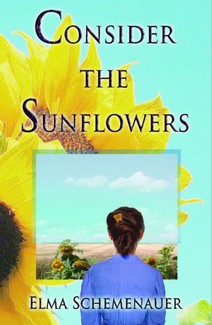
Consider the Sunflowers (Book) - 3/29/2015 12:04:19 PM
Tina’s father wants her to follow Mennonite tradition. He also wants her to marry Roland, a rich man, but she’s in love with Frank, a half-Gypsy who doesn’t share her faith. The novel pulled me right in with an extremely visual opening scene. Tina, her father Obrom, and Roland are trapped in a snow storm when their truck gets stuck in a ditch. This in 1940 Canada, and winters are brutal. Not far from there, however, is Frank’s farm -- Frank, the half-Gypsy Tina is in love with -- and after much effort the trio makes their way to the farm.
By alternating the chapters from Tina’s viewpoint to Frank’s, the author offers glimpses inside the love they share as well as the obstacles standing in their way. For example: what would Obrom do if Frank asked for Tina’s hand? Get very mad. Also, Tina wants to follow tradition Frank is not keen on following. Aware of this, he wants to break it all off, as he and Tina weren't that good together. Too many rules, angry words, accusations.
The author does a masterful job describing time and place. When Tina moves to Vancouver to work as a secretary, we see through her perusal of the Vancouver Sun, that Hitler still threatens to invade Norway. Germany and Italy to form alliance against UK. America remains neutral but for how long?
Also, in Vancouver, Victor Graft, a carpenter, enters the story. While Tina corresponds with Victor and sees him, her heart remains with Frank, the half-Gypsy back home.
Eventually, Tina and Frank find their way back to each other when she returns to Dayspring. The author’s descriptions of place and character are beautiful, with lines like: Frank with eyes so brown. She could lose herself in those eyes, follow their promises to the ends of the earth.
Theirs is not an easy relationship, and that is what captivates. Frank is an interesting but complex character. Having lost his mother as a child, he carries a certain burden with him, a situation complicated by the fact that he’d rather associate with Scandinavian and British than Mennonites in Tina’s community.
When they do become a couple, the tension only intensifies. We see Tina struggle to accept life on Frank’s farm as she hopes that even though he doesn’t accept her faith he will change. Later, we see her suffer a close and personal loss, a serious test of faith.
The author leaves us with a sense of hope, beautifully accentuated by artistic descriptions. Be sure to read the timeline at the very end. It summarizes the history of Mennonites who emigrated from Russia to North America as well as those who came from Switzerland and Germany.
I very much enjoyed reading this novel and highly recommend it.
Consider the Sunflowers can be ordered from Chapters Indigo http://tinyurl.com/nsylp5j or the publisher, Borealis Press http://tinyurl.com/lfdo9pf . E-book coming later. More information is at http://elmams.wix.com/sflwrs.
Consider the Sunflowers (Book) - 2/14/2015 1:44:26 PM
What a hoot. Review by Marian Schraeder
I loved your opening line – feeling
like liverwurst in a sandwich – who wouldn't want to keep reading?
The book was full of suspense.
Many times I chuckled at the Plaudietsch (Low German) expressions, nicht, shteefmuttachye, (I really had to study that one) and the characters, Obrom, Adeline, Lottie and more. What a hoot.
I particularly liked the way you closed your book; with an invitation for salvation. Here is the opportunity for any reader to make that commitment. God bless you for that.
This is the first time I can say that I know the author of the book I have read, outside of The Bible, of course.
Consider the Sunflowers (Book) - 1/2/2015 10:20:45 AM
Tina Janz, her father, Obrom, and Roland Fast, the man Tina’s father wants her to marry, are caught in a Saskatchewan blizzard. My senses are so piqued as I jump into the first scene of the story that I shiver in the biting wind, the pelting snow, fearful of the disappearing fence posts that are supposed to lead these people to safety. An apt beginning to a book about troubled relationships and, ironically, hope.
Tina does not want to marry “rich, boring Roland Fast,” because she is in love with dark, handsome Frank Warkentin, a half-Mennonite, half-Gypsy much maligned in the Mennonite community of Dayspring, Municipality of Coyote, Saskatchewan in 1940. Tina’s parents only want the best for her, but she has a mind of her own. She’s sure that if she can marry Frank, he will fulfill her purpose in life.
Frank is attracted to Tina partly because she is proper, something he secretly aspires to be. Haunted by his mother’s desertion in childhood, he reacts with distrust and anger to the meanness of those around him. This burden proves a considerable obstacle to his happiness and the achievement of his inner goals, both in his own life and in his marriage.
Consider the Sunflowers involves many intricate relationships including love triangles, childhood abandonment, societal insecurities, spiritual hypocrisy, peer friendships, to highlight a few. Characters are realistic, portrayed with both strengths and weaknesses, acting/reacting in plausible ways. Settings mirror the dreary isolation Tina feels on the treeless prairie of southern Saskatchewan, yet also offer a hint of hope for something better ahead. The book is hard to put down, with tension-filled chapter endings and well-crafted flashbacks, as well as a tightly wound plot.
Elma Schemenauer, seasoned author and editor of more than seventy books, enriches this difficult story with figurative language apropos of the farming community of the 1940s: “Sunlight was spilling across the snowdrifts like broken egg yolks,” and “more wide awake than a pig the day before a sausagemaking festival.” The people of Dayspring still remember much of their homeland in Russia before immigrating to Canada, and “Hitler’s War” is constantly in the news. Consequently, the Mennonites are suspicious of outsiders and remain resistant to infiltration by “English” people.
Schemenauer has included an impressive, comprehensive Mennonite timeline at the end of the story as well as a study guide for readers. An excellent work worthy of recommendation.
Paperback 299 pages $19.95, ISBN 978-0-88887-575-4, AVAILABLE FROM THE PUBLISHER, Borealis Press http://tinyurl.com/lfdo9pf . Also available online at Chapters Indigo http://tinyurl.com/nsylp5j by about November 15. E-book coming in 2015. For more information, please visit http://elmams.wix.com/sflwrs