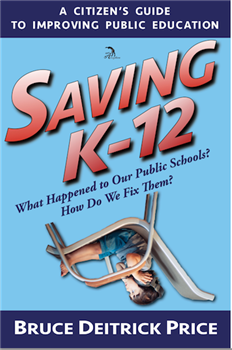
Saving K-12-- What happened to our public schools? How do we fix them? (Book) - 12/5/2018 4:54:23 PM
Not by me, this is one of my favorite reviews of "Saving K-12." Short but complete. I found it on the Internet, a distributor named Better World Books.
Review by viennamax:
"I call this one an important book. Because it puts the emphasis on the aspect of social engineering that is so flagrant in public schools all over the Western World. The volume is very easy to digest, even a bit over-redundant. However, inside are the right triggers for criticizing an institution which is [on] the downward-path for more than 80 years: our public schools. And, inherent in that, the condemnation of millions of young souls to illiteracy. So, if you're prone to a better learning set-up: read this book!"
Review by viennamax
(LibraryThing)
Review found on Better World Books
What Type Of Sci-Fi Do You Like? (Article) - 8/22/2022 3:02:11 PM
Review 2: prompted by La Belle Rouge's comment.
In the months since Frankie was published, I've had a change of heart about genres in general. Each one requires its identifying traits. Author and readers are locked in.
I now think that Frankie is mystery, suspense, speculative, robot, romance, academic, thriller, and maybe some others. The summation is Literary. I now think that Frankie is not that good considered as example of one particular genre. Fans of any particular genre might be disappointed. Frankie has too much space, too much irony, too much originality, too much quirkiness. Those are qualities we want, traditionally, in the novel.
Here's how I recommend the book now. If you go into a bookstore asking for whatever is new and different, please consider Frankie.
For more info, visit Frankie.zone
...
What Type Of Sci-Fi Do You Like? (Article) - 8/22/2022 6:18:04 AM
I'm with you, Bruce. I find it very hard to focus on a book that has a whole foreign world. I enjoy ScFi that seems so real it could actually happen. Enjoyed the article. I've written only one SciFi novel and it takes place in familiar territory. Your book looks impressive.
What Type Of Sci-Fi Do You Like? (Article) - 5/14/2022 9:47:55 AM
An interesting way to sell your book. I have often considered "hard" science fiction as a kind of science fiction that is closely related to reality, scientific progress, and theory. But you call that "soft" science fiction. Whatever the nomenclature, I would consider world building to be mostly fantasy unless the author is very serious about the world(s) he or she is describing, like you referred to. For example, spaceships capable of traveling a distance between stars cannot be made of metal. And if they are made of metal, like in the movies, they emit no sound while traveling through space, because sound only travels through an atmosphere to human ears.
In 1972, while doing my doctoral dissertation, I wrote a computer program that had a database of philosophical statements that were self improving as the database was used. In other words, new statements could be entered by users of the program, better than the originals, and statements that were never used or meant anything to the users, would be eventually discarded.
My idea of a self learning program is what is referred to as AI today. I still find that most of the robot programs I encounter when calling companies, while they have pleasant voices, are really stupid when it comes to helping like a human would at a help desk.
BTW. I write all kinds of science fiction. And every once in a while drop in a little bit of fantasy. But I don't create fantastical worlds that never will be. For example, in the recent anthology, Escape from Reality, I entered two stories. The first one was a guy like Elon Musk creating a much smarter clone of himself, and the second was a semi-realistic explanation for Bigfoot.
Ron
What went wrong in our K-12 (Article) - 12/6/2019 11:32:20 AM
I am not an education expert like you, but I did my doctorate in educational philosophy and have found that Dewey pragmatism is only one of the philosophies that educators out there advocate. There are at least three of four others that have merit.
I agree that there is something wrong with education and certainly, it continues to be dumbing down. In higher education, I have seen grade inflation where the letter, F, has nearly disappeared, along with the letter, D. However, 50 years ago, when I attended an elite school that has created more billionaires, than perhaps even Harvard--Stanford--many of the courses gave grades of "satisfactory," or "unsatisfactory." All those graduates 50 years ago under that progressive grading system, seem to have done quite well. I guess it was their basic education like I got, memorizing tables and words, rather than learning to learn. As I recall my undergraduate classmates in my undergraduate technical and teacher's college, over 50% were functionally illiterate and they were becoming teachers with good jobs and good benefits. Taxpayers and lawmakers no longer value public education, thanks to the likes of you, and therefore, teachers no longer earn salaries worthy of going into teaching. For professors, it's even worse. Over 50% of all college teachers are now adjunct with low, by the course , and no benefits.
I will agree that education is changing. Conservatives would like to separate "good," students and put them in competitive, profit-making schools from the functionally illiterate so they can continue the trend towards the rich becoming richer and more controlling and the poor getting trickle-down leftovers. No amount of pointing out the danger in this will get the conservative ear. They are hell-bent on their own destruction. The results of charter and other private schools has been discouraging.
I know of two teachers who come from the right stuff teaching in public schools. My niece teaching high school science with a degree and experience in environmental science from a top university, and my brother's wife who recently retired from teaching the fourth grade to continue teaching the sixth grade in a new location they have moved to for retirement.
Ron
Who will read your books if no one can read? (Article) - 11/19/2019 11:32:12 AM
with sadness I read your article,
so often the eager Little Reader in my classroom who loved being read to and reading doing DEAR ….drop everything and read, period, who carried home books to read with family each
I watched in later grades, as they vowed their hatred for reading
could it be that 'education' has moved tests grades, and killed the love for reading
Never stop writing
m
How To Start An Intellectual Fire (Article) - 9/7/2019 2:17:05 PM
Responding to two reviews----
Adding a link has been impossible for five days. I hope everyone curious about this issue will look at this article: "The Crusade Against Knowledge":
http://www.improve-education.org/id70.html
Dewey and his bunch were not primarily interested in academic achievement. They were interested in social engineering. Knowledge got in their way. So they were always looking for ways to prejudice people against facts. I get that part. What's disturbing for me is that so many educated people were eager to jump on the bandwagon.
Bruce Price
How To Start An Intellectual Fire (Article) - 9/7/2019 12:39:46 AM
This is an excellent article, Bruce. But the issue goes beyond facts: It includes how to think creatively about facts. Our kids also need to learn how to analyze, synthesize, and evaluate facts into coherent new information. I recall one professor who claimed to have asked his class "Which is worse ignorance or apathy?" To which one of his students replied: "I don't know, and I don't care!"
How To Start An Intellectual Fire (Article) - 9/3/2019 8:33:39 AM
Just yesterday, I watched an episode of the Alaska Bush People, self schooled and now living in the lower 48 and not in Alaska, but still interesting. Anyway, to build a "castle," they went to a junkyard and tore apart a concrete block building so they could get the "cinderblocks," needed for their castle. When you write about specitivity and facts, there is a difference between blocks made from cinders and those made of concrete.
I was looking for your qualifications as an educational expert. I see that you do not have any advanced degrees but mention professors in education in your bio and in your discussion as though you are familiar with them. But then, as a member of Mensa, I can see that you probably found traditional education rather boring and are self-taught. That's okay, but doesn't hold up in highly credentialed fields if you want to be an expert.
I have a doctorate in education, and am very proud of what I studied during my dissertation: philosophy, educational philosophy, computer science, and testing. But I'm not proud of my degree that has been tarnished by the watered-down coursework that is required for anyone entering teaching and worse, still watered down for higher degrees in teaching and education. At least I have my masters Internet management. Degree in industrial engineering to fall back on.
Yours is a common lament. But I don't see it the way you see it. I don't think memorizing so-called facts, makes much difference in a world where those facts can easily be looked up from cyberspace in a nanosecond. Why clutter your brain with encyclopedic facts like those kids who can spell every word in the dictionary? My twin brother required his daughter to learn the multiplication tables. She completed her degree in zoology, but has had a career in pharmaceutical sales management. She uses a whole different skill set in management. Her science degree just got her foot in the door.
I have no kids and little knowledge of what goes on in grade schools. But my undergraduate school was a teacher's college and I found that most of the students going into teaching were mediocre students looking to settle down with a husband/wife they found in college and some little homey town with a guaranteed lifelong occupation, healthcare, and good pension, allowing them to retire in their fifties. They did poorly on math and science and therefore, avoided those courses with hard information. They are the ones who are teaching our kids, progressive or not. They just are of lower intellect than you and therefore can't impart wisdom and knowledge the way that you can and wants them all to.
BTW, besides the 3Rs, my grade school was filled with historical myths like how George Washington was so honest and strong enough to throw a coin across the Potomac. Jim Crow and other travesties done to the Native Americans wasn't discussed in our history hours. Just patriotic bull.
Ron
Words of War (Article) - 5/12/2019 9:25:56 PM
Interesting aticle!
Never stop writing!
m
Words of War (Article) - 4/26/2019 2:48:29 PM
In reply to Ron Hull, this little article is clearly about medieval warfare, war before long bow and rifle. Imagine a thousand years ago or many thousands of years ago. The armies lined up close to each other, then the soldiers hacked away.
This was not prompted by writing historical fiction. Rather as a poet I love odd words. As a technologist, I am fascinated by the endless variations of what we now consider very primitive weapons. At every year in history, there was always an arms race.
As you see in the art (soon to be posted), the combatants are almost elbow to elbow. That's the part that fascinates me.
Words of War (Article) - 4/23/2019 10:55:46 AM
Interesting information. But when writing historical fiction, one may need to use more current terms (unless one uses a glossary or defines the word, like you did in the text) in order to not slow the reader to have to Google it. In World War I and II hand-to-hand combat was no less brutal, conducted with bayonets, pistols and knives. I have found the most hideous close range weapon to be the flamethrower. To be on the receiving end of that must've been such a torturous death, or if not killed immediately, worse.
Ron
Why I'm Passionate About Education Reform – by Bruce Deitrick Price (Article) - 12/14/2017 12:47:53 PM
Response to Ron,
You need to know that K-12 is a convenient blanket term for all of public education from kindergarten to the end of high school.
This huge entity is getting dumber by the month; my book is devoted to saving public education.
I do not address privatizing one way or another. I address the ideologues who have taken over the schools and made them dumber. That they do this is a fascinating story. How they do this is my particular specialty. They teach children to read for many years; at the end of this time the children cannot read. Ditto arithmetic. Ditto history science, etc.
Thanks for commenting.
Bruce Price
Why I'm Passionate About Education Reform – by Bruce Deitrick Price (Article) - 12/14/2017 10:31:21 AM
I agree that we should teach each child to his/her potential. I am not familiar with K-12, but I have seen teachers of the year being the "easy" higher education teachers who are responsible for much of the grade inflation over the years.
I don't think that privatizing schools changes anything. Once you make education a moneymaking business, it only caters to the rich. The current way that public schools are funded, is a disgrace for the very reason that the rich benefit even in public schools with better funded districts.
I do see that the Internet and websites like Khan Academy are rapidly changing the way education is delivered. In the future, the high cost of bricks and mortar, as well as teachers, may be moot.
Ron
Reading Is Easy (short video) (Article) - 11/4/2017 8:57:27 AM
Since it's been a long time since I had anything to do with elementary education, it's hard for me to evaluate your article except you seem to refer in one case to the word, "progressive," as being somehow, bad. But then, as I read, you and your organization seem to be progressive and against the conservatism that has crept into schools, seeming to make it easier (memorization) and turning out idiots with little comprehension who can answer multiple guess questions by rote but can't write an essay at all.
I learned reading so easily, I forgot how. I know that I started before I got to school at six. I never use a dictionary and my phonetic spelling was atrocious, but it got me through a doctorate and awards and kudos for my writing even though I did poorly on standardized tests in English and literature. Probably because I didn't memorize very much.
I don't like rap very much but have a hard time figuring out how rappers memorize such long strings of words in their rapidfire delivery. I have to read my poems because I find it hard to memorize them.
I like the video. It's simple and direct, while getting the message across.
Ron
Reading Is Easy (short video) (Article) - 11/4/2017 1:55:56 AM
interesting article, the teacher in me, K-1 almost 4 decades, drat the cat who threw me to the floor and ended my plan, but that is another story.
I agree in large part with your thinking, while sight vocab is important, knowing how to figger out what the sounds in the words are and what they say and etc is often half the battle.
good luck with your book, may you have lots of success
Most teachers with whom I taught, agreed fully with Rudolph Flesch
Never stop writing!
m
The Joy of Learning (video) (Article) - 7/5/2017 6:09:16 AM
I watched the video. It is very well done. I agree with the premise to a point, but not entirely. For example, I agree that facts and knowledge are important and the basis for all that we do. I believe that children are curious and have an unlimited joy in learning. But learning is more than memorizing the dictionary from cover to cover (spelling wizards) or other memory tricks that allow people to win quiz shows.
And I agree that schooling is a problem. The focus on pedagogy rather than subject matter has led to classroom rituals that get in the way of children's curiosity and prevent them from moving ahead at their own pace, unlike individualized, online learning that is rapidly taking the place of classroom learning, to the alarm of educators who will go the way of buggy whip manufacturers with schools like Khan Academy making school buildings and people obsolete except for socialization activities like playgrounds and projects that develop teamwork and teams in physical settings.
Teachers and teaching, while still having some of the best benefits while not the best pay have been devalued over other, far less important, professions like accounting and pharmacy. My observation is that this has led to a lowering of standards and general grade inflation, as well as teaching teaching rather than process necessary for life in today's rapidly changing world. Most teachers in schools these days are what I used to call, "C", students--now getting As. Probably the reason why some people think that private, more expensive profit-making, schools are better. Everyone is teaching to the test.
I don't believe in testing, quizzing or the fascination with filling one's brain with facts for money or otherwise. I'm much more in favor of higher-level comprehension and critical thinking that comes from developing processes that allow one to discern fact from all the other information and misinformation that's out there. If I want a fact, I can easily find it on my smart phone these days. Even though memorizing addition and multiplication tables is useful for doing work "off the grid," it becomes unnecessary when one learns how to use powerful tools like Excel so that you don't have to clutter your mind with stuff.
Why do I say this? Because during my long years in higher education I often ran into other students who seemed to have the ability to score high on tests and had nearly photographic memories concerning facts, but did poorly in school and in their personal lives, probably because they were distracted all the time and sidetracking on creative but, unimportant, things.
The ones that succeed, the very few, drive our civilization forward.
Ron
The Rules of Poetry (Poetry) - 7/21/2018 5:03:58 PM
I really like this and I agree.
The Rules of Poetry (Poetry) - 5/26/2018 4:01:20 AM
much to ponder
enjoyed the read
NEVER STOP WRITING
m
The Rules of Poetry (Poetry) - 5/25/2018 11:37:39 AM
Thanks for the reviews. You'd have to read that article "The plight of poetry" to understand my irritations. Basically the Universities started putting money into literary magazines, workshops, and graduate programs, so you had a lot of dull academics, all trying to build a career. And they tended to enforce their vision that poetry should be somewhat austere, formal, somewhat difficult, an esoteric realm. But I think all the great poetry over the centuries was accessible and even fun.
There was a Roman guy named Catullus. He was witty and weird and passionate. Most of his poems from 20 centuries ago are more lively than what our academics write Basically, one thing I want from a poem is that it surprises me. I don't want same old, same old.
As for rap I'm comfortable with it because it's wild, rambunctious and doesn't obey many rules. On the other hand, if one rap song sounds like another rap song then I'm bored again.
The Rules of Poetry (Poetry) - 5/25/2018 9:03:31 AM
Thanks for the education in poetry. Your verses are truly well thought out and hit home hard about what poetry should be. And, what it is. I enjoyed your jousting with McLeish over what a poem really is. The only problem is, most millennials understand the poetic form of rap very well, while I don't. And, they may not know who Alfred Hitchcock was, or even Archibald MacLeish.
I'm glad you used rhyme to emphasize your words. To me, both meter and rhyme count because they resonate with our natural processes like breathing and heartbeat. Why the beating of drums is so primal. I also believe that if a poem is not understood by the reader, it is not a very good poem.
Ron
The Rules of Poetry (Poetry) - 5/25/2018 6:49:00 AM
The mountains and valleys and deserts are filled with unique wildflowers. But not all people like all wildflowers. A suggestion for writers and poets: "Don't be too preoccupied with impressing, with being relevant, or with sounding profound. As each flower of the field, and every other living thing in nature, has its own color and shape and fragrance, so does the heart of a poet. When you write from your source, with all your heart and mind and soul, you will touch those that you are meant to touch." rlc... Your last sentence I fully agree with. No one, and no group, is the full bottle on anything when it comes to the arts, poetry, and writing. Thanks for sharing... r
The Rules of Poetry (Poetry) - 5/24/2018 3:43:09 PM
Love this! This is inspiring! Thank you!
Sandie
Fireman (Poetry) - 8/4/2017 10:08:51 AM
poignant read
Fireman (Poetry) - 8/2/2017 10:32:27 AM
It certainly could've worked out the other way around. We don't hear the stories like this as much as the ones that miraculously turn out very good over time.
My great uncle was a Fire Chief in a medium-sized. His third wife told me that he had a kind of "black lung" from fighting fires. Still, he managed to live well in retirement right up until he died at 98. Most folks would like that kind of black lung.
On the other hand, my sister-in-law's father was a fireman in our hometown. Shortly after he retired around 65, he needed a lung and heart transplant, but didn't get one and didn't last very long. His wife is still alive in her 90s.
Ron
Fireman (Poetry) - 8/2/2017 5:21:20 AM
He did the right thing. We are not fortune tellers.
Fireman (Poetry) - 8/1/2017 1:15:21 PM
If we could decipher what lay ahead of us and the people (infants) around us, there would be a lot of poor little babies not rescued from a burning hell.
Mr. Allen's UFO (Poetry) - 7/16/2017 3:33:05 PM
If you decide you don't want to go, next time, send them my way, I am always up for an adventure & I might even just want to with them stay...:) -e-
Mr. Allen's UFO (Poetry) - 7/16/2017 3:40:18 AM
They're out there all right, but what exactly are they? greys, blues, greens, nordics, in-betweens, inter-dimensionals?
Mr. Allen's UFO (Poetry) - 7/2/2017 6:39:52 AM
You are certainly telling the story that I've heard in the (fake?) news. As a student of these things from a scientific viewpoint. I find this stuff like the New Guinea tribes people who worshiped gods they saw in the sky. It was simply ignorance. The same is true of most abductions stories. They are probably just dreams--I have some wild ones--or even the result of a bad hallucinogenic trip. Most of the stories are as ignorant as those tribes peoples' misunderstanding. I long for something better.
Ron
Mr. Allen's UFO (Poetry) - 7/2/2017 1:46:49 AM
intriguing read, holds reader interest
well done
m
Mr. Allen's UFO (Poetry) - 7/2/2017 1:24:26 AM
This is fascinating to the very least. I am intrigued and want to read more of your poems, thank you for sharing xo