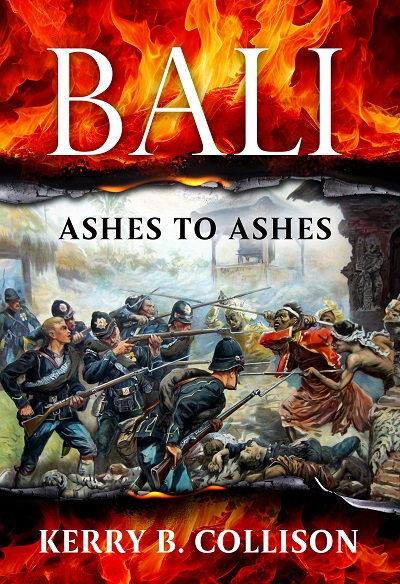
BALI - Ashes to Ashes (Book) - 9/11/2023 2:22:49 PM
Review by Washington’s Defense and Strategic Affairs
Collison, himself a former Australian intelligence officer who spent the "years of living dangerously" in Indonesia, has written extensively on sensitive political topics in Indonesia, avoiding punitive legal action by couching detailed historical facts in works of dramatic fiction. His newest work, Bali: Ashes to Ashes, reveals much about the origins of modern Indonesia and why the political and strategic landscape is the way it is, through colonialism, the internal kingdoms and their religious-cultural differences, and deeper modern and ancient history.
His earlier works are, like Bali, total immersions in the various cultures and languages of Indonesia, giving an understanding, too, of the political leaders and their heirs who have emerged and are, even today, influential.
Bali: Ashes to Ashes is a compelling multi-generational family saga which begins in 1904, but which introduces the important prelude of the work of the world's first multi-national corporation, the Vereenigde Oostindische Compangnie (VOC), founded in 1602: the Dutch East India Company. The VOC had colonized much of what is now Indonesia, but had hesitated for more than 200 years to conquer the many kingdoms of the island of Bali, with its impenetrable jungles, perilous reefs, and unique culture of Balinese Hinduism.
Most of the Javanese empire - which is what modern Indonesia is - is Muslim, with the notable exceptions of Bali and West Papua, where there are profound differences to the rest of Indonesia. But a reading of Collison's Bali gives a better understanding of why, even today, Bali has a disproportionate influence on Indonesian politics..
The reader of Bali, apart from being entertained on a level of escapism which sends tremors of guilt into the professional intelligence analysts who read it, emerges with a sober understanding that the island, though eternally beautiful, is not and was not the idyllic and tranquil tourist destination it is today. Many tens of thousands of Balinese died, both at the hands of their own wars or at the hands of the Dutch and during the anti-communist civil war which saw the end of the Sukarno era.
Indonesia remains profoundly important, strategically, today, and is being wooed by the West - particularly the AUKUS powers of Australia, the United Kingdom, and the US - as well as the People's Republic of China, Russia, and India. Its straits control a disproportionate volume of global trade. Reading this "novel" is profoundly satisfying, but it is also profoundly important.
SID HARTA PUBLISHERS
23 Stirling Crescent
Glen Waverley, Victoria 3150
Crescent Moon Rising (Book) - 8/1/2005 4:00:46 PM
“Crescent Moon Rising” is partly a work of fiction, influenced by indisputable historical fact, tempered with not-so-imaginary characters created to enhance the story’s delivery.
Indonesian Gold (Book) - 8/3/2004 11:15:25 PM
Yesterday as I was walking in Kuala Lumpur, I noticed a bookshop and I stopped
by to have a look at their recent acquisitions> I found your book ` Indonesian
Gold` and, as I enjoyed tremendously two previous books of yours `Merdeka
Square` and `Jakarta`, I purchased Indonesian Gold and I have started to read
it last night. As usual it is fascinating> I guess you have the knack to make
use of history to write a novel. So your books are historical novels as Walter
Scott wrote on medieval Britain and Pramoedya Ananta Toer wrote on 19th century
Java or even before, you have chosen contemporary Indonesia. Excellent choice!
Could I make a further suggestion? Would you think of writing a novel on the
events which lead to the bo;bings in Bali on 12-10-2002? I have seen, in Paris,
a beautiful documentary made by an Australian on the aftermarth of Bali but i
believe a novel would be very useful to understand what happened there.
I have also lived long in Southeast Asia so your novels have a real meaning for
me.
All the best
Laurent Metzger
Professor of Indonesian in France, at present in Malaysia