Poetry
Reviewed by Richard Cederberg
September 22, 2026
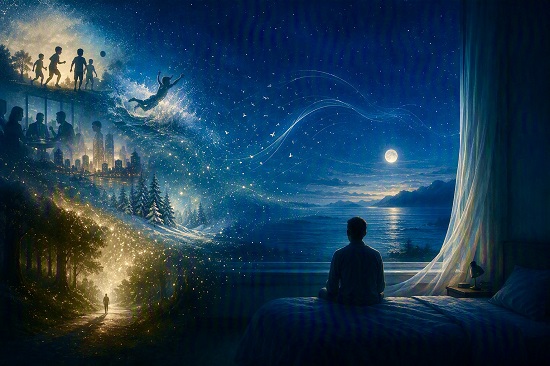
Less noise in life.... an admirable goal. Brought to mind Simon and Garfunkel's fantastic 1964 song: "Sounds of Silence." For some of us finding peace in silence is a deliberate choice. It's not about escaping life, but more about engaging with it from a place of clarity and calm. Silence is a place that Michele and I are very familiar with. An interesting insight, Kent, with images worth pondering. Enjoyed. Peace. r
Silence is golden. It gives time to think that is the fastest way to go to sleep.
But when age brings deafness. Communication with loved ones can be strained. Ron
The shark, even while hunting, is at least an 'honest' predator.
One that is recognisable and induces a suitable reaction.
And the reversed contrast between family and stranger speaks volumes here.
R
Undoubtedly, there are those who reach a certain point in their lives where they feel they have all the answers they need and never progress further.
But you and I know that for every question answered, multiple new questions are raised. We can never know enough.
What we used to call research, can now be found by a simple request of an AI agent. But I am told that we need to go back to the original sources to verify what the AI agent has brought us.
AI is great for finding answers from the past, and for projecting the future using trends from the past, but so far, unable to discern future events that always have happened without any understanding beforehand that they would.
Ron
Poetry
Reviewed by John Herlihy
September 20, 2026
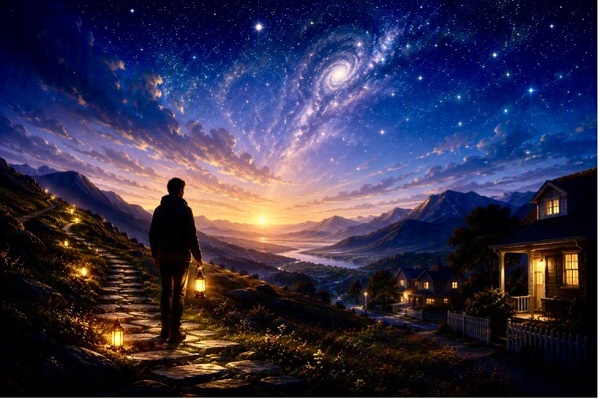
A fine topic to explore, one that we all need to come to terms with. The mystery is with us, and it is here to stay. The overwhelming question remains: how do we address, speak to, unfold, come to terms with this mystery. No doubt everyone will come up with their own answer, as you have done here.
Each stanza widens the horizon rather than closing it. You frame unanswered questions not as failures of understanding but as companions that stay with us, shaping our inner landscape. That IMO is exactly how it should be. I also have written about this idea of mystery many times, never being fully satisfied with the result. The image of truths becoming familiar neighbors whose names we never quite learn deepens the question surrounding mystery. A thoughtful piece, full of mystery
Poetry
Reviewed by John Herlihy
September 18, 2026
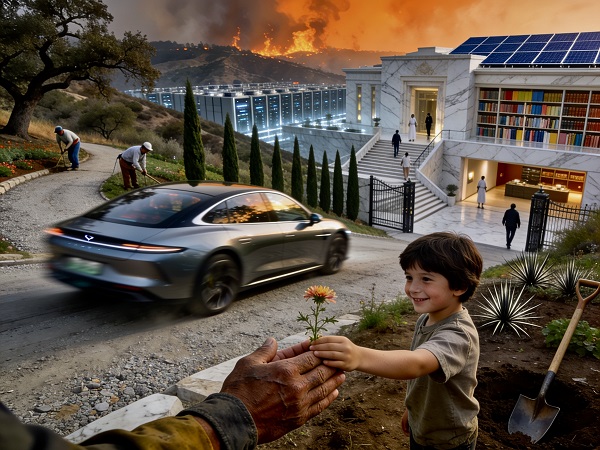
This piece unfolds like a slow descent into a carefully selected unreality, where wealth engineers its own atmosphere and the world below is left to breathe the smoke. Your images are vivid and unsettling — the silent luxury car, the marble that reflects only itself, the unopened books arranged as décor rather than wisdom. Then the powerful counterpoint: that small, unpurchased moment between child and worker. It’s a reminder that reality still flickers in human gestures even as systems try to overwrite it. The closing lines land exactly where they should — on the rare, fragile realness most people talk about but rarely see.
A tree is on the increasing chasm between our people as the rich focus on wealth and pleasure, while the poor scramble for for the growing remnants of what used to be government services to dwindling every year as the problems in the heartland start to show like cracks in a pending earthquake.
The rich will blame the poor for not preparing and doing the right thing with their practices, while the poor will blame the rich, rightly so, for their indifference.
The vivid images in your writing here came through starkly real. I hope it's not too late to do something about it.
Ron
Poetry
Reviewed by John Herlihy
September 14, 2026
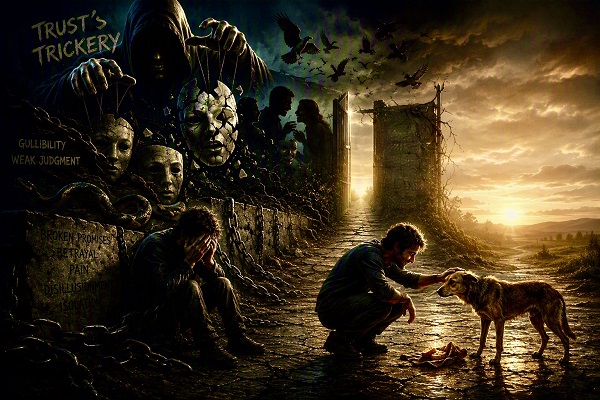
trust is one of the issues of our times, or perhaps the lack of trust. Trust no one, as they say nowadays, especially as you lay out the lack of trust in this poem and how it shakes us to the roots.. The stray dog a metaphor for the blessed return of confidence, a small creature accepting bread and offering presence. There's plenty of trust in that to go around. Fine work.
Poetry
Reviewed by Richard Cederberg
September 14, 2026
This piece is easily construed as a metaphor for the human journey towards trusting; whether with animals, people, or even ourselves. That's a big one. Trusting self can be a can of worms. Trust, in my experiences, is always built through consistency, empathy, and the willingness to allow ourselves to be vulnerable with others, all lineaments that animals regularly embody in ways that humans sometimes forget. Trust is never built on a single interaction, but on repeated, patient, and consistent engagement. As it's been proffered: " Until one has loved an animal, a part of ones soul remains unawakened." Appreciated your thoughts. Peace. r
Poetry
Reviewed by John Herlihy
September 13, 2026
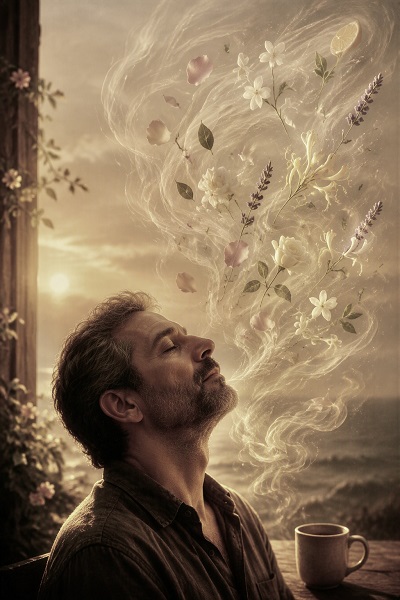
This poem unfolds like a beautiful flowering garden of recollection, each scent rising with its own quiet truth. Interesting how the perfumes "climb the fences of memory" to establish themselves in their own right. A fine use of perfumes to stimulate the memories of your readers.
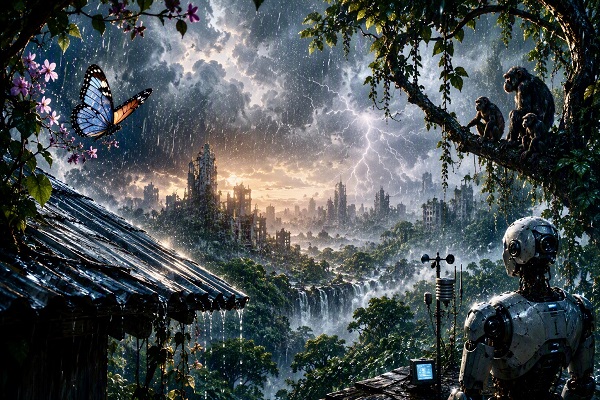
Thoughts on the demise of humans brought on by ourselves. The warning that was given was meant to scare us into behaving well.
AI cannot go berserk, even though it can learn faster and faster as well as do things previously thought unattainable, all AI is under the control of humans. Good humans and bad humans.
You painted an idyllic scene with your poetry of the rain. More likely, the end of humans will bring with it destruction of the environment, it will take thousands of years to recover unless it is a bio agent. That would leave most of the biosphere intact and thriving on the rain.
The primates indicating a possibility of starting over.
Ron
Poetry
Reviewed by Richard Cederberg
September 8, 2026
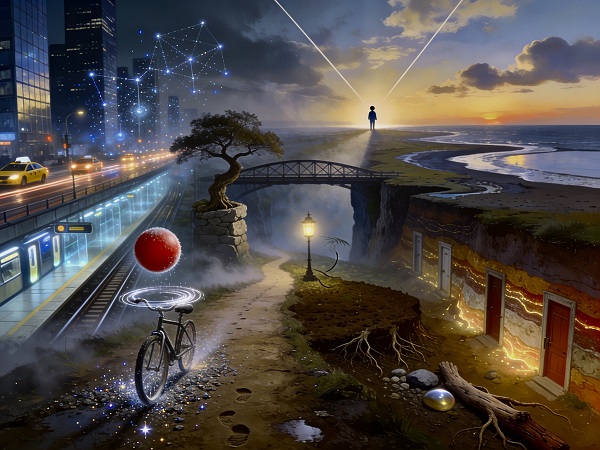
No... we are not born completed. Becoming ourselves is not a single event, but a continuous process shaped by experience, self-knowledge, courage, balance, and wisdom. Each degree of authenticity we reach brings us closer to living in harmony with each of our true natures. Even though some aspects of our lives are beyond our control, (of which I will attest wholeheartedly) it's imperative that we work with our destiny, circumstances, fate, kismet, whatever you want to call it, with conscious choices, wise actions, and always in alignment with our spiritual beliefs and values. Another thought-provoking piece, Kent. Thanks. Hope you're well. Peace. r
In the Islamic tradition, the soul has seven stations ranging from the blameworthy soul at the bottom to the enlightened (full of light) soul at the top of the range. The soul is a reflective plate representing the essence of who the person is at any given time, the good with the bad, the shadow with the light.
Your presentation of destiny is similarly a fusion of wounds, wonders, refusals, welcomes—forming a kind of inner architecture of soul. That idea of becoming “by degrees” offers persistent hope, as though the soul is always in negotiation with the world and always capable of further refinement. Such food for thought and further reflection.
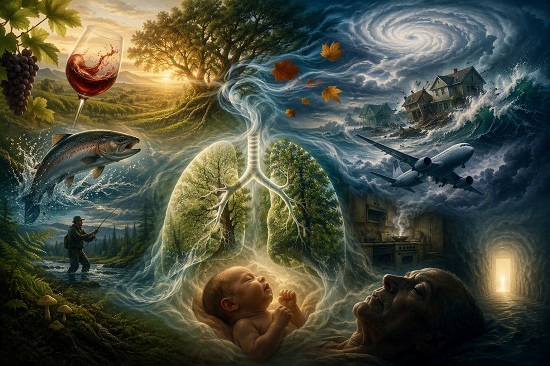
You have graciously traced the oxygen cycle that creates our wonderful, oxygen rich atmosphere. How we take it for granted until we find ourselves gasping for a breath and need it.
In the end you have informed us that the tragedy that is happening to our ecosystem may be a way for us to change in a more sustainable direction. I certainly hope so, if the power of poetry about great change.
Ron
Not perhaps, the poetry of air does know! ! Without air there would be no wind, no breath, no soul, and no spirit. Your poem on air feels like a slow, indrawn enriching breath—one that moves from the intimate to the planet with ease. I like how you let the green world rise and fall like a living breathing chest/ "What comes next, after the breathing ends?: Perhaps a different kind of breath, more enriching that we could ever imagine.
Poetry
Reviewed by Sandie May Joyce (Sandie Angel)
September 5, 2026
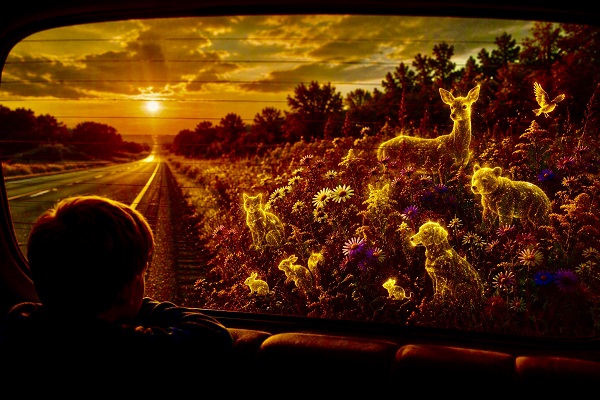
Oh, those poor animals! Your words offer powerful image of each roadkill animal, and I kept seeing each of them in my head.
Towards the end of the poem you brought the child into the poem, and as seen from the child's innocent eyes, the dead animals were offered flowers and it immediately eased the pain I felt for the dead animals.
Great job, Odin!!!
~ Sandie
Roadkill takes a tremendous number of wildlife species every year. Your work is a poignant tribute to their loss. Especially with the children quickly refocusing on the beauty along the highway rather than the dead. Children are like that… More so than adults.
Animal (and human) overpasses over heavily traveled roads like I 280 would help those animals you have to move to find new territory or migrate. Butterflies and birds, on the other hand tend to find our windshields and radiators.
I recall two stories like that. One was in one of those canteen adventure magazines about greedy teenagers who took great pleasure in running down animals on a beautiful road past small lakes. They ended up going off the road into deep water and they all died.
The second story was true. In our hometown a young man had a very successful sporting goods store. I remember going there and buying arrows to go late season deer hunting. He was an avid hunter who also liked to hunt with bow and arrow.
In the early morning on his way to go hunting deer, he either hit or try to avoid hitting a deer, rolled over, I believe in his new convertible, and his head was crushed. Road
A treatise adeptly handled on a very harsh subject. You catalogue each fallen creature with such precise, humane imagery — the squirrel like a worn glove, the robin like spilled chokecherries — giving dignity to what most people refuse to see. The heart of the poem is the child: the one who still notices, still counts, still asks the questions adults have forgotten how to ask. Your closing sums it all up in the wildflowers along the shoulder as a kind of blessing and the child’s whisper that the animals “get flowers like we do in the cemetery" as a moving reminder that compassion still often survives in some who don't look away.
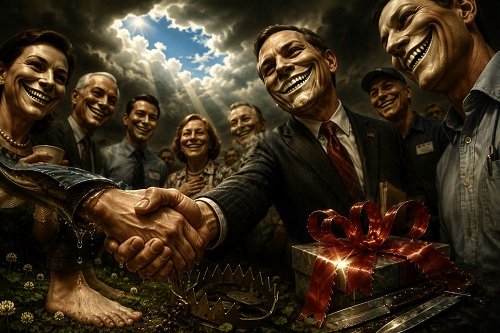
Oh what hidden treachery lies behind everyday smiles "folded neatly over hidden edges." The contrast you draw between human duplicity and the shark’s honest instinct is a notable apt image— the real danger isn’t in the deep, but in the familiar faces carrying hidden teeth. A sharp, unsettling, and beautifully crafted poem reflecting on the importance of trust while keeping vigilant of "swimming with the sharks.".