I am now retired from a professional career that included many interesting and often complementary, occasionally overlapping fields of endeavor. One of them is cardiovascular medicine. Four decades of that sort of work has frequently found me in cardiac surgery suites and cardiac catheterization labs, scrubbed-in on various procedures next to the invasive cardiologist and and co-functioning as a perfusionist. Needless to say, I am used to working on the ‘the other side of the bedrail’ as we were prone to word our clinical and hospital involvement with cardiac patients.
As you might imagine, those decades of work often involved involvement with acute cardiac emergencies (codes, or cardiac arrest situations), and it was often up to me to ‘ZAP’ the arresting patient with a defibrillator. No matter how many times you see this done, whether in real time and proximity to a coding patient or portrayed in some medical television drama, it can’t help but endanger a feeling of empathy for the poor patient who has to be shocked out of a cardiac arrhythmia with a charge delivered by a DC (direct current) defibrillator. Back in the day, we started out using AC (alternating current) units, which pose certain safety risks that resulted in the less potentially harmful DC iterations coming into common use.
But regardless of all that, the sight of someone grotesquely jerking spasmodically up and off an operating table due to receiving a cardiac shock is still something that gives pause to all! I recall always being relieved that I had myself never had to undergo cardiac resuscitation (nor did I ever expect to have to, given my lifelong running and dedication to personal fitness).
I must have defibrillated well over a hundred or more patients myself, in that 40+ year history of working in the above areas of medicine. It took a long time and a considerable distance down the road of life before I was finally given some insight as to what it was like to be on the receiving end of those paddles. But let me explain. I wrote what follows below to a friend a few years ago and reproduce it here largely without any alterations. I’ve never before publicly revealed any of this to anyone else, simply owing to inexplicable embarrassment over the thought that ‘the zapper’ finally had to be zapped!
---------------------------------------
Interesting story, this. I am reminded of an experience I had, back in 2017. It helps to be aware that what I am saying here is based upon having been a perfusionist in cardiac surgeries for more than 30 years in the variegated career I had prior to retirement. Translate that to mean: I am quite experienced and familiar with cariological medicine, particularly what we call ‘invasive’ cardiovascular work.
At any rate, as an aspiring word-slinger, I had decided to take a writer’s sabbatical to a friend’s property along the Orgon South Coast in beautiful, quaint Gold Beach, OR (not far north of Brookings), where he has an outlying small cabin higher up on the hillside where their own home is located.
I was ecstatic over the beauty that this sylvan setting offered, as well as the perfect privacy and aesthetic insularity the place provided me in which I could write, unfettered by all the quotidian cares and concerns that routinely plague all of us in our modern world. The cottage was surrounded on three sides by a forest of beautiful pines and commanded a spectacular view of the ever-changing moods of the Pacific Ocean on its western most aspect. It was truly a perfect refuge from the pressures of our modern world for anyone who just wanted to be left alone to write creatively!
At any rate, there I was, settled in among the scented coastal pines and drifting fog, about 30,000 (out of an anticipated 150,000 total) words into what I call a ‘wartime romance’, and it was a typically beautiful, coastal Oregon morning when, after I had finished my usual single strong cup of French Roast coffee, I suddenly reflected that I somehow felt a bit ‘strange’. Nothing I could really put a finger on, really, and not characterizable by any particular symptoms…just ‘strange’…a bit odd.
Being acutely mindful of the broad range of subtle cardiac symptoms that cardiovascular anomalies can present and ever-mindful of a whole range of possible cardiac anomalies, my immediate thought was that I should probably go into town and visit the ER to have them evaluate this ‘strangeness’…whatever the hell it was.
Long story short, Gold Beach’s long awaited and brand-spanking-new county hospital had just opened for business and after listening to my remarks, the ER receptionist took me in to the examining room and called in the ER doc-on-call to begin an evaluation. As a perfectly healthy, fit and trained cardiovascular technologist, I was shocked to have the ER doc tell me (after running a 12-lead EKG) that I appeared to be in what we call ‘Atrial Flutter’, a heart rhythm anomaly that is best characterised by an abnormally rapid heart rate; in my case a rate of 166 beats/min at rest. Cardiac arrythmias like this are similar in certain aspects to your own cited SVT. [My friend had recently experienced and been treated for an episode of SVT, or Supra Ventricular Tachycardia.]
Frankly, I must admit that despite (or perhaps because of) all my cardiological experiences and knowledge, I was scared absolutely s*hitless! This couldn’t possibly be happening to me!? It was cold in that ER (as it always seems to be in ERs everywhere) but I was shaking like a leaf, as much due to anxiety as to the chilly ambient room temp! In fact, just writing about this, I have a distinct chill! It was truly frightening to find myself on that exam table, even for someone like me who had been an Air Force medic during the Vietnam war.
The ER doc casually informed me that they had to bring me out of that flutter, since unless something was done to ‘break’ it, further, much more serious complications could arise (not exactly news to me, of course). The first remedy to try was performing a series of Valsalva Maneuvers, somewhat the same effect as that we go through when having a bowel movement (or birthing a child). That is, bearing down with some isometric abdominal force. Fighter pilots use the Valsalva Maneuver to help cope with high positive-G forces, anecdotally (they call this ‘G-grunting’). This can sometimes also interrupt an atrial fibrillation or flutter episode, restoring Normal Sinus Rhythm (i.e. a regular pulse rate).
I spent a minute or two trying this, all to no avail. “No sweat” said the ER doc. “We’ll try some Adenosine.”
Adenosine is very likely the drug they used on you, John [my friend], for your SVT and it is a frequent remedial medication used to disrupt and convert abnormal heart rhythms. And without going into needless detail here, suffice it to say that in simple terms it does indeed ‘stop your heart’, functionally speaking. The effects of the drug are, at the usual dosages, quite transitory however, seldom lasting for more than a second or a few seconds before a normal rate returns (AKA: NSR or Normal Sinus Rhythm). And it usually works.
It didn’t, in my case. Perplexed, the doctor repeated the Adenosine injection several times, each time increasing the dosage until finally his concern began to show clearly. No dice! “Wow!” he said, accidentally giving exclamatory vent to his growing exasperation, “That just doesn’t make sense!” [You NEVER, ever say ‘Wow!’ or ‘Will ya look at that!’ or, worst of all, ‘Oops!’ in an acute medical setting with a fully conscious and alert patient listening!]
I should explain here that contrary to your relatively gentle experience with Adenosine, in many cases one experiences a pending sense of panicky doom as the drug enters the circulation. In my case, it was absolutely frightening. I could (all in the span of a mere second) feel my limbs suddenly go lifeless…dead…as your normal circulation suddenly stops completely, all effects I could easily imagine would be what ‘death’ would entail, if stretched out over a few seconds! [Of course, as a writer, I have an excessively keen imagination…GAAK!...which doesn’t help at such times.] In short, it was one of the most terrifying experiences of my life, being deliberately ‘removed’ from life (even if for the merest brief moment)! But, true to expectations, after a few seconds, I fully regained all my normal sensations of control over my movements.
This failure of even high doses of Adenosine to break me out of my atrial flutter is MOST unusual and left only one final recourse: cardioversion with a defibrillator. That is to say, getting ‘zapped’ with your own personal mini-lightning bolt.
Now, mind you, I’ve personally been involved in cardiac arrest situations requiring defibrillation perhaps several thousand times over the course of my career in heart medicine and it’s never a fun thing either to carry out or to witness the effects it has on patients; but I never dreamed that it would ever be used on me! And whereas most often cardioversion (breaking anomalous arrythmias so as to allow the resumption of NSR) is carried out after a patient has gone into far more dangerous ventricular fibrillation, a state which induces a semi or completely unconscious torpor, in my case I was fully conscious and completely alert when they used the paddles on me! Trust me, this is not something you want to experience under those conditions!
To reduce the trauma, the doc had used a small amount of Fentanyl (yes, THAT Fentanyl that’s so often in the headlines, these days, associated with juvenile drug overdosing situations) before I was zapped, which is supposed to take the edge off cardioversion while conscious, but I can say without any exaggeration whatsoever that when that initial jolt (probably only about 50 Joules, a ‘starter’ jolt) hit me, it was like being struck by a lightning bolt!
I suddenly jerked bolt upright on the gurney and yelled “S*it!” It must have scared everyone in that ER room, since they all stepped back for a second’s pause to gauge the effect of that charge on my persistent atrial flutter, with bemused looks!
Fortunately, that ‘come-to-Jesus’ moment resolved my pernicious arrythmia and after another EKG confirmed the results, I was removed to the ICU for observation. After several more days of IV therapy (I was somewhat dehydrated, strangely, with a low magnesium titer) and some Metoprolol Succinate therapy, they released me.
That experience, however (I was ‘only’ 72 years old, and as I earlier remarked, in excellent overall health, otherwise), considerably altered my previously unconcerned life and normally carefree life, and it also effectively torpedoed that promising ‘war romance’ novel (which to this day remains incomplete) I had been making such great progress on.
And yes, it certainly did give me considerable pause to reflect on life, in a manner I would imagine was somewhat similar to yours, given the similarities described in this personal experience of mine with your own.
I like to think that truly reflective, broadly aware individuals do not need to undergo such moments catalytic trauma to attain a circumspect and more sagacious state of consciousness, John, but there’s no arguing the old admonishments about ‘near-death experiences’ heightening human understanding of life-priorities, and from what I discern in reading your story, we have both shared a similar ‘wake-up’ moment!
Thanks, as always, for sharing your wise and valuable insights into the human experience with us, John. Deeper reflective thought often acts as a catalyst to synergise meaningful awarenesses and your own experience definitely provides that!
-------------------------
PS:
After several years of trying to figure out what the hell had caused my atrial flutter situation, I finally figured out that I had somehow become inadvertently dehydrated, thanks partly to quaffing a huge 16 oz or so glass of Rhône wine after dinner each evening and having not drunk enough water to keep myself fully hydrated each day. That, plus a low level of magnesium, had probably conspired to instigate the whole unfortunatre incident!
A good lesson here: don’t ignore vitamin/mineral supplements (despite all the controversy about their efficaciousness or lack of it, unless taken in natural food form) and always stay fully hydrated! I now take daily multivitamin/mineral supplements that keep my magnesium quotient right smack in the WNL (Within Normal Limits) range and have never had a recurrence of arrhythmias after that single 2017 event…knock on wood!
If you out there who are reading this now take anything away from the above personal experience, let it be this: Stay adequately hydrated (ingest lots of water instead of other types of drink), try to ease off or do away entirely with ETOH (alcohol), eat proper, nutritious, heart healthy foods, get plenty of exercise daily (walking the dog can help hugely in this), and remember that our personal health is the most important asset any of us will ever have (2nd best asset is good, close friends and loving family…money doesn’t even enter the ratings!).
It is especially important for those with a prior history of cardiac arrhythmias (whether ventricular or atrial) to NOT DRINK alcoholic beverages, since the most recent studies (2022) have lately demonstrated a significant increase in risk for arrythmias among those who drink even as little as one drink/day. This is especially important for anyone with a pre-existing history of arrhythmias.
Sorry, wine lovers and oenophiles, but them’s the basic facts! You choose! I know that, with regard to myself, I shall greatly miss my excellent Swiss and French red wines, but it’s truly a matter of life or death, after all….
-----------------------------------
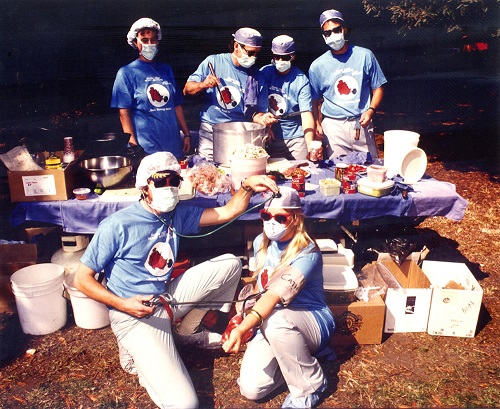
PS: In case anyone is wondering about the photograph that I used to start off this piece, it shows the Santa Cruz Heart Institute''s famous, crack Chili-Team in action, at a late 1980s Gilroy Garlic Festival event (we won a prize, but I forget which one...probably the Booby Prize). Dominican Santa Cruz DIDN''T enter a team (our competition), which is fine, since we had the very best Coronary Bypass stats, between the two facilities (despite Sister Julie Heyer''s best PR efforts, LoL!). [That''s me, measuring our nurse''s cranial blood pressure...in the front row, left]





 This is a true story, pretty much descriptive of how the tables suddenly turned on a practitioner of health care who least expected to be the patient instead of the 'healer'. Interestingly, when we are very young, we tend to unconsciously feel we are indestructible; 'death' is therefore a remote and almost totally alien concept. Once, however, that we've put far more miles on the odometer of life and find ourselves closer to the end of life than the beginning, the possibility of death assumes a far greater significance in our awarenesses. The following anecdote hopefully illustrates that, somewhat. [I won't state here that an Australian doctor might be referred to as a 'Queensland Heeler', to spare you any funny-bone contusions...]
At approximately 60 years of age, he had a massive heart attack. He told me, "They thought I was dead and had to zap me 10 times before I came to." And then, later, I was told that it his heart had "healed itself." He stopped smoking, but continued to drink heavily. Developed emphysema and was on an oxygen tank for about five years until he died young.
My twin brother, about five years ago, felt strange while out walking and when he went to the doctor was diagnosed, like you, with atrial fibrillation. I don't recall exactly the details and I don't know if he was zapped, but it took at least two tries before his heart rate returned to normal.
When I was paralyzed during spinal exploratory surgery, my blood pressure dropped while sitting up in a frame during the operation to the point that I was going into cardiac arrest. My neurosurgeon quickly stitched the wound shut to stop the bleeding, laid me down, basically treating me for shock until my blood pressure returned to normal. He then woke me up on the operating table and asked me how I was I replied, "I'm fine, Doc." Woke up in my hospital bed paralyzed from the neck down.
I had four workups by major medical centers to see if anything could be done to stop the insidious loss of function similar to post polio syndrome. But when I was at the Mayo Clinic in Minnesota, remembering how cold it was in that cavernous building in below zero January, while psychiatrists probed me to see if it was, "all in my head." I was also given a thorough part examination coming up like they always did with, "some abnormal heart nerve function."
The last heart work up other than the continual EEGs I get routinely, was when I was 62 and my left arm was sore from being in the wrong place all night. My rehab physician said, "Wake up call!" I was given a chemical stress test and a complete CT scan of my entire cardiovascular system, showing it to be in good health. Something I attribute to my diet and exercise.
But I feel strange all the time. I have autonomic dysreflexia that raises my blood pressure quite high whenever I urinate about 20 times a day and sometimes, sweating profusely if urination is blocked in any way. I consider this momentary high blood pressure to be good exercise for my heart.
Occasionally I have something similar to a grand mal seizure. It starts in my limbs and moves up to my brain leaving me paralyzed totally and in fear of death. Fortunately, it usually subsides as soon as it comes and it only occurs two or three times a year, generally when I'm down because it is of sickness or whatever. Lately, I've found that lowering my head or tilting my wheelchair up so that my feet are higher than my head seems to cause the condition to subside to great relief. So I'm thinking that it may be extreme low blood pressure. And it may be related to dehydration.
I'm not drinking as much as I should but I drink a lot to urinate 20 times a day. I'm taking a magnesium supplement in addition to my multivitamin that I've taken since 1998 when a doctor told me to because he thought I wasn't getting enough to eat. I still enjoy my cheap Rhine wine and I'm not giving it up!
Ron
PS. While I had battery powered 90 V stinging zaps to my muscles on my atrophied arms for six months after the surgery they didn't do anything for the muscles and were stopped. However, while being helped to try to give sperm that I could easily have done at home. When a vibrator did not do the job, a guy came in with a cattle prod and said that it would work if they stuck it up you know where. As soon as they did, I did not yell, "Ship!" But I screamed loud enough, that they backed off. ;-)
Sandie