Eight Pennies for Five Cocks
Author © Scott D. Zachary
Industrious. A wellspring of ambition. In fourth grade, I decided that I would be the paperboy for the town of Shadeville, Ohio.
I had been mowing lawns for many of the elderly ladies in town for a couple of years. They knew how much I liked lemonade and would bring me big glasses of it on ice. They were lonely for company, and we’d talk about flowers, laundry, grandchildren, church, or anything else that occurred to them. During our conversations, all of them told me how displeased they were with their current newspaper boy, a local high school kid who frequently forgot to deliver their papers. And when he did deliver them, the papers would often be wet or blown all over their yards.
I always went all out mowing and trimming the ladies’ yards. Several of them said something like: “Why don’t you do it, Scotty? I know you would do a Gipper job as our paperboy, and you’d never forget us.”
They knew they could count on me. I had proven myself since the age of seven. By nine, all the elderly ladies in the neighborhood had adopted this “sweetheart.” (It’s a shame that I veered off that track pursuing alcoholism at the tender age of eleven and forgot all about those precious, white-haired ladies.)
I was confident that it was purely a matter of time before somebody would take over the job of paperboy for Shadeville. With stiff encouragement, I decided that it would be me. I called Mr. Ellis, the District Manager for the Columbus Dispatch, and informed him that all the sweet old ladies in town were unhappy with their current newspaper boy and that I would do a super top-notch job as the next paperboy. I asked him to call me when the job became available.
Mr. Ellis came to visit me a couple of weeks later. I distinctly remember his first question when he saw my little frame. He peered at me with a wrinkled forehead. “How old are you, Scott?”
“Nine, sir, and I work like a man.” (And I did.)
“I’m sorry, Scott,” he chuckled. “I’m sure you would do a super job, but the newspaper has a strict rule that paperboys must be at least eleven.”
I have no doubt that he could see the fire in my eyes as I said, “I’ve been mowing half the lawns in Shadeville since I was seven. I have a big list of honest references. For starters, you need to talk to Mrs. Egbert, Mrs. Lombardi, Mrs. Anderson, and the Caylor sisters. They’ve been coaxing me to take over this job for quite a while now. They know the quality of my work. They will tell you how rock-solid dependable I am.” I stared straight into his eyes, unflinchingly. “You’ll make a whopper of a mistake, sir, if you don’t make an exception in my case.”
Mr. Ellis took a deep breath, smiled, and laughed. “Well... I don’t think I have a choice here. I never hear that kind of determination from anyone—boy or man. You’ve got the job, Scott. Don’t let me down.”
“There’s no chance of that happening, sir.”
“I suspect not.”
And I didn’t let him down. In my two years as the newspaper boy for the town of Shadeville, I received several awards for excellence as well as an all-expenses-paid trip to Cedar Point Amusement Park. I did miss two papers on my route of over a hundred customers during that time, but that was because I had several boys help me deliver the Sunday papers after they had slept over at my house on a Saturday night. I should’ve delivered them myself.
I rode my bicycle delivering papers for many, many miles, seven days a week. When there was snow or ice on the ground, I lugged a canvas bag filled with newspapers all over town. There were no wet papers and no papers blowing in the wind. It was another era—many of my customers even left a door unlocked so I could toss their paper inside.
A nice benefit of being the newspaper boy in Shadeville during that time was the frequency in which I found old coins in the change that people gave me. You’ll likely chuckle when I tell you how much it cost for a newspaper at that time—25¢ for a Sunday paper and 7¢ for a daily paper. I often received Mercury dimes, Indian Head pennies, Buffalo nickels, wartime steel pennies, Liberty quarters, Franklin half dollars, and an occasional real silver dollar or silver certificate dollar bill. When Mr. Ellis came by every Wednesday evening to pick up my collection money, he always let me scan through thousands of dollars’ worth of coins searching for additions to my collection as there were lots of old and rare coins in circulation then. The old ladies knew I had been a coin collector for years, and since I was such a “sweetheart,” they gave me rare coins for my Christmas bonuses. During my two years as their paperboy, the Caylor sisters (there were three of them) gave me eight Draped Bust large cents dated in the mid-1800s. They were in Very Fine condition!
I retired from the newspaper business three months before I turned twelve and shifted my focus to picking up night crawlers and throwing knives. On rainy nights, I picked up night crawlers and sold them for two to three dollars per quart. For you city folks, night crawlers are big worms that slither out of the ground to mate on rainy nights. I spent many hours crawling on my hands and knees in Walter Brown’s muddy racehorse pastures, flashlight clamped in my mouth, easing those fat juicy worms out of their holes and tossing them into my bucket.
Knife throwing was my primary focus during that summer of ‘68. Growing up, Jim Bowie had been mine and my best friend Keith’s hero along with Davy Crockett, Sam Houston, Daniel Boone, and Kit Carson. When we played make-believe, I always insisted on being Colonel Jim Bowie while sporting my handy Bowie knives. By this time, I had collected an extensive assortment of knives and had already become quite good at throwing them.
Knife throwing became my sparkle. I spent hundreds of hours becoming an expert. I practiced from sun-up to sun-down every day, ignoring the pain in my upper arm. I stepped off between five and twenty paces from the apple tree behind our house, pivoted, and threw. That poor old crab apple tree was a good two feet in diameter before I started using it for target practice in May. Come September, it fell.
Somebody—I don’t remember who—gave me three wooden-handled throwing knives for my birthday that August. I had become precise enough to throw one and stick it at twenty feet, throw another and stick it in the handle of the first one, and then stick the third knife into the handle of the second one. The handles on those knives didn’t last long.
My stepfather gave me his survival knife when he returned from Vietnam at the end of that summer. The handle on that knife weighed roughly five times as much as the blade. It was a difficult knife to master, but I did.
Sometime during the fall of 1968, I was at the chicken fights in the hills of eastern Kentucky with my best friend Keith and his dad. Word had gotten around about how good I was at throwing knives. Furl Meade was skeptical. I should give you a little background on Furl. He was bad, period. Nobody messed with Furl Meade—NOBODY! He had a reputation for getting drunk and taking on bars full of big construction worker types and being the only one left standing. He was well known for biting a big chunk out of his beer glass, chewing it up, swallowing it, and asking for another. I never heard of any bartenders complaining.
While we were waiting for the next cockfight to start, Furl Meade walked up to me and baited, “I hear you’re pretty good throwing a knife, Scotty.”
“You heard right.” I was too smart-alecky for my own good back then.
“Want to put some money on it, boy?” dared Furl, as he twirled a sharply-pointed, foot-and-a-half-long spike in his hand.
“Sure!” I grinned.
Furl had been showing off his brand-new alligator-skin cowboy boots to anyone and everyone that day. He had already shown them to Keith and me, but he pulled the leg of his jeans up and bragged on them again. He was proud of those boots—very proud.
Furl stated the rules of a knife game that he had in mind and declared, “I’ll go first.” He tossed the spike, sticking it in the packed dirt several inches from my toe. “Now you go, Scotty.”
That’s piss poor! You see, I completely misunderstood Furl’s instructions about how to play this game. I thought the objective was to see how close to the person’s toe you could stick the knife—or stake in this case. Bear in mind, too, that I hated being called “Scotty” by anyone. I had kicked one of Mom’s boyfriends hard in the shin for calling me that. I was smart enough not to do that to Furl, though. But I was going to show him how to throw a knife! As one cute young gal named Lisa declared four decades later, “You always make a point of everything you do, Scott!” This knife game was no different.
I estimated six paces between Furl and me as I balanced the stake in my hands for a few seconds to get the feel of the weight and length. In one fluid movement, I drew the stake back and threw it with all my might, intending to bury it in the packed dirt snug against the toe of Furl Meade’s brand-new alligator-skin cowboy boot.
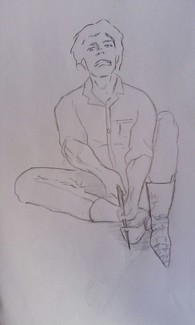
I was a little off. My blunder owed to never throwing at the ground and from putting way too much shoulder into my throw. That sharp stake left my hand, rotated twice, and made a distinct “Thunk!” as it skewered the tip of Furl Meade’s brand-new alligator-skin cowboy boot!!!
Furl’s expression mutated in a matter of seconds from instant horror as he beheld the stake protruding clean through the tip of his brand-new alligator-skin cowboy boot... into a look of total bewilderment that implored WHY?... into a cataclysm of fiery rage coming after me!
Furl had me cornered! No way to escape! My throw had nailed the toe of Furl’s left cowboy boot to the ground. The more Furl kept trying to jerk his boot free, the harder everyone laughed. Furl got madder and madder. Nobody ever laughed at Furl Meade, and he was going to take that out on me, too! I tried to dash past him, but his big hand latched onto my arm. He grappled my skinny neck with his other hand and flung me across the barn some twenty feet or more. I landed in a pile of straw and manure.
Like a wise little mouse being chased by a ferocious predator, I didn’t waste any time scurrying through a small opening under the bleachers. The hole was barely big enough for my wiry little frame to wriggle through, so I knew Furl couldn’t come in after me. He finally got loose from my errant stake and was glaring at me through the bleachers. Fortunately for me, he wasn’t able to talk the 30 to 40 people sitting on the bleachers into getting off so he could close them on me!
I stayed put for quite a while before Furl calmed down and left. Keith and I laughed about that little incident for years and years. It wouldn’t have been funny at all, though, if Furl Meade had had his way with me right after I staked his brand-new alligator-skin cowboy boot to the ground.
* * * * * * * * * * * * * * * * * * * * * *
One of the last cockfights that day was a match between a red quill and a gray. The red quill belonged to Bill Daugherty, Keith’s cousin. Bill’s rooster got hit by a lucky gaff (steel spur) after a couple of quick flurries and ran for the hills. During both pittings (similar to a boxing round), Keith pumped, “Man, did you see how fast Bill’s red quill was?! Did you see the way he landed on that gray?!”
After the fight, Bill kicked his dead rooster and vented his resolve to dump the other red quills that he had bought. Keith whispered in my ear, “We need to buy these red quills. Bill’s got five more just like that one—faster than light! That was a lucky hit. His cock was pitifully game, but he still should’ve won that fight. Bill doesn’t know what he has.”
“I don’t have any money, Keith, but I do have eight large pennies dated in the eighteen hundreds that Bill wants. He’s a coin collector, and he knows how much they’re worth. Are you sure this is a good idea?”
“If the other five cocks are as fast as that one, they don’t need to be game to the last breath, Scott. They’ll kill the other rooster before he knows what hit him. Let’s buy ‘em!”
Keith and I walked over to Bill where he stewed over his rooster losing that cockfight so fast.
“We’ll take the other five red quills off your hands, Bill,” Keith seeded.
Bill narrowed his eyes. “What do you want with them?”
“We’re going to use them to spar with some game roosters,” Keith turned sideways and winked at me.
“You don’t have enough money, Keith.”
“We don’t have any money,” I interrupted, “but I do have something you want, Bill.”
“Huh? What’s that?”
“Eight pennies.”
Bill stared at me for a moment. “Three cocks for your eight pennies.”
“Eight pennies for five cocks.” I stared back. “Otherwise, you keep your chickens.”
I bit down on my tongue as Bill studied my unreadable mask.
“Deal,” he said. We shook hands.
* * * * * * * * * * * * * * * * * * * * * *
We decided to keep the red quills at my house. Keith had grown up around his dad’s gamecocks and knew how to care for them. I was anxious to learn, and Keith taught me everything he knew. I remember Keith saying, “First thing we need to do is get them out of those cages that Bill keeps them in. We need to tether them so they can scratch, exercise, and flap their wings. If you’re serious about learning, Scott, I’ll show you how to increase their odds of winning big time.”
“I’m dead serious, Keith.”
“Okay. I’ll show you how to make these red quills work the way a coach presses a boxer to work his muscles and reflexes. I’ll show you how to feed them—only the best grain, cracked corn, vegetable supplements, and vitamins. Bill feeds them way too much—you don’t see fat boxers winning fights, do you?”
“Nope.”
“We’re going to win some cockfights, Scott.”
“I like the sound of that,” my eyes glimmering.
And we did. Keith and I built chicken houses behind my house for each of the five red quills. He showed me how to exercise our red quills on a bench in my shed, maneuvering them back and forth, back and forth, back and forth for hours and hours. I tossed our roosters into the air thousands of times to strengthen their wings and followed Keith’s feeding instructions precisely.
For those of you who might be squeamish at the thought of fighting gamecocks, I’ll spare you all the details and cut to the chase. Keith was right; these red quills were as fast as light. All of their winning matches were over in seconds. We had difficulty getting anyone to fight our roosters after people saw and heard about their lightning-fast killer instinct. Out of the five cocks, we had two three-time winners, one five-time winner, and our favorite from the start that we named Ace, a nine-time winner. Keith and I retired Ace on a remote farm in southern Ohio. We gave him nine beautiful Miner Blue pullets to serve as his harem. Roosters don’t show affection, but when I set Ace down on the ground for the last time, he shuffled cockily to me and stroked his trimmed comb on my pants leg before prancing off to take charge of his realm.




 "You always make a point of everything you do, Scott!"
holds reader interest
NEVER STOP WRITING!
m