My dad lived in a Coors bottle the first ten years after he died. Well, not really in the bottle, but in his urn next to the bottle. He, his urn, and his bottle, were kept over the bar in a neighborhood establishment called Charlie’s Place in a suburb of his beloved Phoenix, Arizona. How he got there is quite the story. I felt the need to take care of him, to be a part of the end of his story since he’d been so little a part of the beginning of mine. After all, he, as my mother’s husband, hadn’t been able to find a place in the world for us as a family for a long period of time. It was as much her fault as it was his, really.
Bottom line, I felt, finally, that it was time for me to find a place in his world for me.
Dad was a highly functioning alcoholic. He’d been that way all his adult life. Hell, probably all his life, maybe even since he’d been a youngster, for all I knew. I didn’t realize this until I found myself helping to take care of him in his later years, after he was ill with what was ultimately deemed to be laryngeal carcinoma. Throat cancer. Long, drawn out. Terminal. When it all started, he was told he had Valley Fever, not uncommon in Arizona. Yet such a diagnosis was probably part of the ultimate death sentence for him, delaying the truth in his case.
Dad had to go through a lot of horrific pain, humiliation, and aggravation prior to finding out what was really wrong with him. He had his larynx removed. Had his throat radiated. Doctors thought that would fix the problem. It didn’t. The procedure went outrageously wrong. when the doctor radiated too much. His skin was very thin, maybe from all the years he’d spent in the Arizona sun—who knows? From that point on, Bob Alexander never again spoke or ate.
Or drank.
Imagine living ten years never putting food in your mouth. Never tasting a single morsel. Never speaking another simple word from the time you’re in your mid-60s, after living up until then able to say anything you want at any time. True, Dad wasn’t much of a talker when he had that ability but when the ability is taken away, the loss is felt deeply. Harshly.
But the biggest hurt to Bob Alexander was not being able to drink. Anything. He could no longer have a glass of water. Or soda. Or tea. Or milk. Or … beer. Yes. Beer. Remember, he was an alcoholic. But just because he couldn’t drink it didn’t mean he couldn’t think about drinking it. Just because he couldn’t drink it, didn’t mean his body no longer craved it. It did. He did. Desperately.
Funny how these things seemed to come in lots of ten years for Dad. He’d been properly diagnosed by the time of his surgery and from then until he died, it was about a decade, which brings us back to Charley’s, the urn, the Coors bottle … and Dad. And my need to take care of him. To understand him. To want to know him better. I'd been trying to do this since I was sixteen, but that's another part of this story.
He was found dead in his home. He lived alone all those years and was not found by a related family member but by a “family member” from Charley’s Place. Dad had been going to this bar for years. He was without question a regular. They knew him well, and everyone loved him there, including the owners. After his surgery, he didn’t go out in public unless absolutely necessary, except to doctor’s appointments. The one exception? He went to Charley’s Place.
Every day, he and his dog, yes, his dog, would climb into his car. He’d drive the few miles to Charley’s and they’d walk in the door. The same time every afternoon. He was comfortable there. They didn’t judge him. They didn't gape at the hole in his neck. They loved him. He was treated no differently than anyone else. In that place, Bob Alexander could once again be the man he’d always been and no one cared about his medical situation. No one.
They gave him his own chair. It was, for that period of time, and that time of the day, Bob’s chair. Everyone who was anyone, who was a regular, knew it. No one else would sit in that chair, during that time of day. It was reserved for Bob, and he would put his dog under the chair and she stayed there. Well-behaved. His friends would start in on him as soon as he was settled in, needling him good-naturedly. And mercilessly.
This is what he loved, what he craved. What he needed. He carried a small notepad in his shirt pocket, and a pencil. Never a pen. He communicated this way. He’d pull out his pad and pencil and start flinging written insults right back at all of them. The pad would be held up high enough for the offenders to see. Dad always printed. His cursive handwriting was horrific so he printed. His letters were small. If it couldn’t be read by someone on the other side of the bar, others would pass along the message so it could be enjoyed all around. Everyone would laugh uproariously.
Bob may not have been able to talk, but he sure could hear well. And the reactions on his face were all of pure delight. His happiness was clearly evident. The sarcastic roll of his eyes as he shook his head told everyone what he thought of their hearty barbs--he loved them. He was in his element when he was at Charley’s. More insults were tossed back and forth. The game continued the entire time Bob was there, and he’d stay a few hours.
But he didn’t just sit and entertain the other customers. He drank. Yes. Bob Alexander … drank. Beer. How? He’d been fitted with a stomach feeding tube after his surgery which was, of course, intended for nutritional supplements, a la Ensure. He did use it for that purpose but, also, being the industrious and creative man that he was, he found out he could pour beer down that tube. Though he no longer could literally taste it, he sure still felt its effects, and that was good enough for him in his present state. For better or worse, Dad had figured out how to get drunk without ever “drinking” a drop. Intelligent man, my father.
None of us kids lived near him anymore. Members of his Charley’s family kept an eye on him and had told him, in all seriousness, that if he ever did not show up at the bar for three or more days, they would go to his house to check on him. So it was on this one particular day in January of 2009 that this is what happened. So it was that he was found dead that day.
My methodical and oh-so-organized father had all his paperwork together. He had known he was going to die sooner rather than later. He had a will prepared and filed. The house was long since paid for. Every detail was taken care of. I wouldn’t be surprised if he’d planned some way to take himself out but that’s not a thought any of us wanted to face. So we didn’t. As it was, we simply decided to think of Bob as the sarcastic, cynical man that we’d known him to be, and we left it at that. He’d died of heart failure brought on by his throat condition. Let it be. It was amazing, we all said, that he’d lived as long as he had in the condition he was in. That was certainly truth.
There are four kids. The other three he adopted, the children of his wife, and they were his kids in every sense of the term, but that’s another part of the story. My brother was off taking care of related business. I, my two sisters, and my niece made the obligatory trip to the funeral home to make the arrangements. Funerals are supposed to reflect the person being remembered. We kept that in mind as we met the representative. She was a perfect example of such an employee. Well-dressed, attractive, respectful, kind. Maybe too kind in some ways. Quiet. Oh, the way she spoke was, of course, exactly how she was trained to speak in these situations, but it rubbed me the wrong way. I know it did one my sisters, as well, and I think this was also felt by our younger sister.
The representative proved to also act subservient while not really seeming to want to be that way. She was not prepared for the likes of us. When she asked what sort of music we wanted, surely thinking we’d say something like Wind Beneath My Wings or Dance With My Father, sweet and gentle and loving songs, appropriate songs, we looked at each other, barely containing ourselves, and blurted out together, “Prop Me Up Beside The Juke Box,” and then burst into raucous laughter. The expression on her face was priceless. Horror-stricken. If she’d have been drinking a glass of water, she’d have choked. Literally. And then they’d have been putting her in a box.
She tried to recover the meeting or, more accurately, bring us under control, by next asking about flowers. We weren’t any more help with that. We basically said, “Oh, who cares? He wouldn’t.”
All this bears a bit of explanation. Dad was one of the most outwardly unemotional, unaffected humans on earth. He just didn’t believe in pomp and circumstance. He had worked hard, I mean, really hard, to fashion himself into a redneck cowboy even though he’d come from some serious money in his early days, and he wasn't a poor man in his own right. For whatever reason, he'd always seemed to want to be known as that sort of man all his life. Who were we to change his image now?
My niece, however, insisted on apologizing for us, and apologize she did. Profusely. “Please excuse my aunts,” she somberly told the funeral representative, giving us looks that told us in no uncertain terms to behave ourselves, and act our age. Her mother had straightened up enough to find an appropriate music selection, as well as flowers, while my other sister and I just sat there, still grinning like old idiots. Oh well. Dad would’ve been laughing right along with us. I was sure he was enjoying this.
Despite our inappropriate behavior in the planning stages, we managed to hold a perfectly appropriate and respectable funeral for Bob Alexander. He would have been happy with it. The love shown for him would have touched him, and even surprised him. He never seemed to realize how many people cared for, and about, him. When the seriousness was all over, we were ready to celebrate his life. Guess where we went?
Yep. Charley’s Place. Family and best friends all congregated and gave a send-off to a man who had, for better or for worse, lived life on his own terms. Not always good terms. Not always living well, or nicely, or doing well by others, though he most often tried. Yet he was brutally human and, in the end, that was brutally obvious. When he did live his best life on good terms, he had a tender, sweet side he tried for some unknown reasons far too hard to hide but, despite himself, he never fully could.
By the time the party was over, a party Dad would’ve loved and embraced, we’d decided how we would honor him. Not in the usual way one honors their loved ones but, then, Bob wasn’t the usual suspect. Anyone who knew him, knew that. He’d been cremated, per his wishes, and we were in possession of his remains. In fact, he was there at the party with us. I and a few others, my sisters and brother included, began talking, and the thought came up. I don’t recall who said it first.
“Why don’t we give him to Charley’s?”
At first this seemed outrageous. Leave our father’s ashes in a bar? Really? Isn’t this thoughtless, totally without respect? Here it must be said that I, for one, was not drinking so my involvement cannot be attributed to a few too many cervezas. While the others were on their second, or maybe third, they weren’t drunk so the idea was still fairly lucid for all of us. It began gaining steam. After all, where did Dad feel most comfortable? What place gave him the most happiness? Who took care of him? What people gave him the love he needed in those last years? It just made so much sense.
I think it was me who approached Charley’s owner. It seemed likely she would say, “No. Are you crazy?!” She thought about it a few minutes, and then nodded. It was as if this was no crazier than us asking if Bob could spend a few nights at her place. While he was alive. Naked. Charley's Place was willing to put his urn, and a Coors bottle, signifying his favorite drink, on a ledge atop the bar, and let him live there indefinitely, as a dead man, as an honor to one of their most regular and favorite patrons. Bob Alexander was not going to be forgotten by his drinking buddies. His family.
Lest anyone think his children are totally callous in all this, in 2019, ten years after his death—yes, again, ten years, one decade—I, my kids, and my husband, removed Dad’s urn from Charley’s and had a military ceremony to inter him in the Veteran’s Cemetery in Phoenix. This was done with my sibling’s concurrence. It seemed logical, and a fitting thing to do. He’d honorably served his country. We’re all getting along in age and one of these days, we won’t be here to keep an eye on where his remains are. Charley’s Place, though a stable establishment, may one day go through a change. If that would come about, what would happen to Bob? He deserves a place where future generations can find him.
It’s important to me to take care of Dad. I didn’t grow up with him. The first four years of my life he was there but I don’t remember that time. After that, he was a ghost of a person I knew I was related to but knew nothing about. I was not allowed to know anything about him. My mother forbid it. When I was old enough to start searching, search I did. I needed a father. What I got was more than I could handle then, in so many ways.
But this is another part of the story. The beginning of the story, really. What really is a parent? What really makes a father? Bob With Earrings … this is my search for a father….


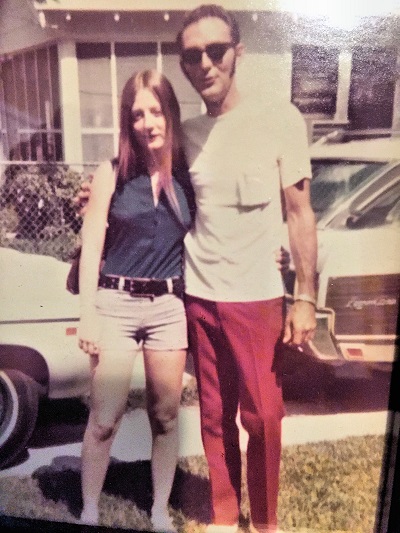 Our life truly is a study in nature vs nurture. What really makes a parent?