Where is Roy Rogers When We Need Him?
Today is the very last day of this accursed year, 2020, and is as always, a day for profound reflection on the relative progress we have made in our personal understandings of life over its past 364 days. It also happens that this morning I finished a book titled ‘Happy Trails: Our Life Story’, by Cowboy icon and exemplar of the 40s/50s era, Roy Rogers.
Although I maintain a strong interest, as a life-long history buff, in early Western America and the important influence that our Old West frontier heritage had on the nation, and despite owning quite an extensive reference library on Western American History, it is a small, illustrated hardcover book of 252 pages that I probably would never have acquired on my own.
I received the book as a holiday gift from a very good and close literary friend of mine, one Sevrin Housen, retired school teacher, poet and fellow (fanatical) bibliophile. We both treasure printed literature in all forms, regarding books as the pinnacle of civilized achievement (and both equally disdaining the modern ‘electronic media’ obsession that has turned most younger people into illiterate ignoramuses, devoid of any knowledge that they don’t absorb from association with (ugh!) their ‘social media’ peers.
So much do Sevrin and I regard books as necessary for a fulfilled life that when I die, I hope they construct my memorial mausoleum from some of the thousands of volumes I have acquired over the years in which to inter my mortal ashes. But I digress.
Thanks to a sweeping wave of cynical iconoclasts who in recent years have attempted to reconstruct and rewrite American history so that it reflects the voguish, racially overblown ‘political correction’ required by today’s young leftist zealots, even a brief search of modern America will quickly reveal an appalling dearth of valid ‘heroes’…individuals we can look up to who reflect the highest standards of moral, ethical and philosophical purity. Instead, we are surrounded by legions of ‘synthetic heroes’, or mere Hollywood-grade media constructs of overblown, wildly exaggerated social popularity (such as professional sports players, public servants simply doing their job, so-called ‘celebrities’ and even egregious scum like drug-dealers, overt criminals and ‘bad boy’ pop icons (like some black rappers and hip-hoppers, for example).
These are the people we are constantly told by commercial business motivated media and advertising campaigns to ‘honor’ as the icons we should emulate and set our standards by. And they are frequently ‘icons’ of the lowest possible denominator, whose fame, popularity and public notoriety has been achieved through ‘anti-heroic’ image and action.
In particular, commercial business interests, advertising media and news media have rabidly co-opted the term ‘hero’ and commonly, routinely bastardised the word by applying it capriciously to everyone from someone who rescues a cat in a tree to a search-and-rescuer who has pulled some total dipsh*t out of the woods, who has gotten lost (wearing only a T-shirt and shorts on a winter day hike somewhere he never should have venture to begin with, LoL) to rank & file medical & health care workers who now take care of COVID-19 infected idiots who blithefully ignored the most basic viral precautions to party-down with their young buddies. Thus, we have ‘hero-this’ and ‘hero-that’ applied with such frequency that the word has become totally meaningless in today’s world.
Of course, this is merely an endemic symptom of an inherent tendency in American mass-media to make needless synthetic superlatives out of just about anything that catches the news media’s jaded attention, and the res ult is that Americans have become, by and large, totally desensitized to both the word and its meaning. “Hero!” What is that now, but another ‘awesome’ or ‘cool’ or ‘radical, Dude!’
I know that I’m not the only person in America who finds this trend not just appalling but downright socially deconstructive over the longer term. Unfortunately, people like me who speak out on such matters that don’t usually reflect on the average person’s radar screen are usually just quickly disregarded as cranks, old fogies and/or anti-social maladapts. But then, that’s what happens to any society when majority say-so is handed over to shallow, insecure but passionately idealistic (and grossly immature) younger individuals who generally don’t yet know the difference between sh*t and brown shoe polish.
Sigh! OK, enough of the sour grapes here and on to what I wanted to say about ‘heroics’ and ‘heroism’. [And yes, I feel much better, now that I’ve gotten that particular measure of intellectual vitriol out of my system, thangyew furry moosh!]
My friend Sevrin, as I began to say, knows of my interest in Western History and so he presented this modest book to me, perhaps hoping only that it wouldn’t get lost among all the far more ‘important’ books I typically read on a regular basis. Little did he know that it would quickly resonate with me in a manner any book rarely does!
Back in the late 40s and early 50s, when I myself was a youngster, America’s youths’ imagination was captured almost exclusively by only two things: fast aircraft (and their pilots), as the post-war ‘new golden age of aviation’ took off, and the ‘Cowboy and Indians’ that Hollywood had so long capitalized upon! Ask any kid back then what he wanted to do when he was grown and if it wasn’t a fireman, it was either a ‘jet pilot’ or a ‘cowboy’.
In my particular case, it was a bit of both as my childish enthusiasms were almost equally divided between aircraft (particularly the new ‘jet planes’) and the matinee cowboy ‘heroes’ that Hollywood had created, literally from desert dust and sagebrush, starting back in the 1920s.
Just about every kid I can recall back then had a favorite cowboy outfit consisting of a two six-shooter holster set, furry chaps and an edge-embroidered, wise brimmed western hat. If he was VERY lucky (and his parents could afford them), he also had a spiffy pair of junior-sized red cowboy boots to round out his outfit, and maybe even a make-belief lasso!
Every week the local small-town cinemas (theatres) in every dinky town across America would features Saturday matinees exclusively for us kids (at a dime a pop) featuring the popular cowboy movie stars of those days (Hopalong Cassady, Gene Autry, the Lone Ranger and Roy Rogers…billed as ‘The King of the Cowboys’). The lines were long and boisterous in the little post-dust-bowl podunks where I spent part of my youth, I can assure you, and in addition to serialized cowboy movies, there would usually also be a sci-fi serial shown as well (such as the Flash Gordon, or Superman series).
It was pretty exciting stuff for most of us small-town kids and the resulting clamor and demand for licensed matinee cowboy toys and goods must have been ferocious, extracting hunks out of most American parents of the 1950s, who wouldn’t enjoy a moment’s peace until their little buckaroo had received his own matinee hero’s commercialized spin-offs. I certainly had my own outfit, despite the fact that such things, even at the then-modest prices demanded for them, were quite a burden on my school-teacher mother’s very modest salary!
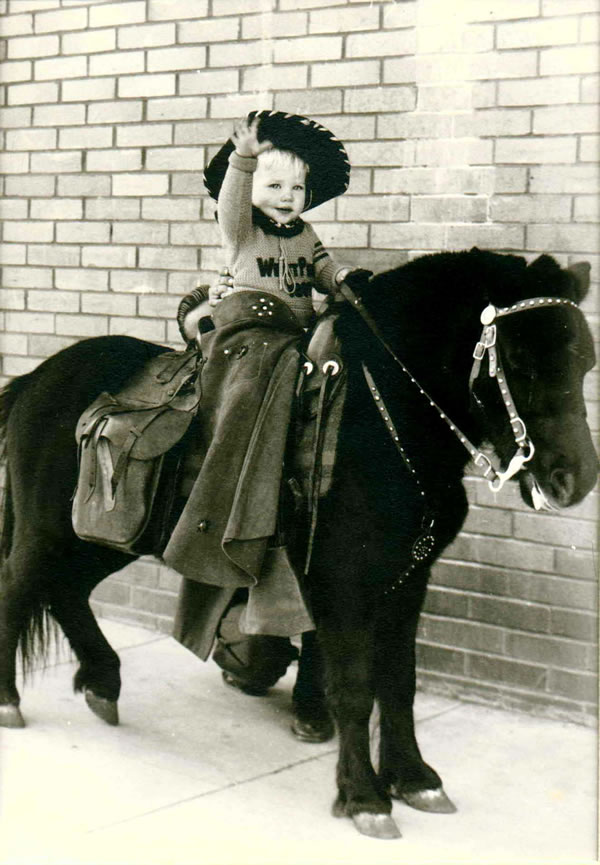
In fact, back when I was only 3 or 4 (just before my father suddenly passed away, unexpectedly), Da took me down to a street corner in San Francisco (where we lived at the time) to have a photograph snapped of me sitting on a gentle pony in my earliest cowboy regalia (this was about 1949 or so, I think). If you look carefully you can see the photographer’s assistant crouching down behind the pony to make sure I didn’t fall off the little horse! I was overjoyed by the experience and it shows plainly in my smile, which was almost unbounded (I don’t think I’ve since been half as thrilled by anything as I was by being able to sit on that Shetland pony’s back!
After being given my friend Sevrin’s book on Roy Rogers, I sat down to start through it and it didn’t take me long to realise that although many years had since preoccupied my concerns and attentions, suddenly there I was again in this book about Roy and his TV-partner and wife Dale Evans…one of the doubtless millions of little kids who then regarded Roy as perhaps a far better ‘father figure’ and role model that our own Dads!
The image of Roy Rogers, ‘King of the Cowboys’ is today a bit fuzzy in most baby-boomer’s recollections, since we’re all now such calcified old fossils in many ways, but it immediately stuck me how influential Roy and his larger-than-life screen presence had been on setting a good example for me on how to grow-up strong and honest and fair-minded.
As I learned in the pages of this book, expertly moderated in part by co-authors (and Western historians) Jane and Michael Stern, my old screen hero Roy Rogers was absolutely and completely just as good and morally ‘pure’ as he came across in his many movies. As the book progressed in its recounting of Roy’s and Dale’s personal stories, it became crystal clear that there was nothing at all that was false, faked or imagined about the pair and that (unlike most Hollywood ‘heroes’ of that era) what you saw on the screen was paralleled congruently in their personal and private lives. In fact, Roy and Dale were and are perhaps the last of the genuine, 100% true ‘real-life’ heroes Hollywood ever created & promoted.
Roy Rogers, born in 1911, began his life as Leonard (‘Len’) Slye, the son of a family that lived in a little rural ‘holler’ not far from Lucasville, Ohio known as…of all quaintly rustic names…’Duck Run’. With his three sisters, he was the sole male progeny of his parents and, like his father who was musically inclined, quickly picked up the guitar and other similar stringed instruments that were popular in depression-era rural communities.
In the very early 30s, ‘Len’ and his family packed up the faithful old 1923 Dodge they had with all the family possessions they could pack onto it, sold the family home in Duck Run, Ohio, and did what so many others did back then: migrate to California (in 1930), where they ended up in the state’s ‘Great Valley’ agricultural region, hoping to find work anywhere they could. Unfortunately, the depression had impacted California’s agricultural communities just as much as everywhere else in the nation, but Len managed to pick fruit (something I also did, when I was a kid trying to make a few spare dollars during summer breaks) in the Tulare area, and mentions in the book that he recalls meeting author John Steinbeck who was visiting the camp that he and his family lived in, who of course later became famous for his seminal book about the effects of the Depression (titled ‘The Grapes of Wrath’). While thus barely getting by in California, Len joined a couple of ‘country-style’ singing groups. Among these were the ‘Rocky Mountaineers’ and later still, the ‘Bar-O Cowboys’, until Len and two associates finally began their own band they called the ‘Sons of the Pioneers’ in 1934.The group caught on and so began Roy''s legendary rise to stardom.
Although the Jane and Michael Stern book on Roy’s & Dale’s life didn’t mention his very first marriage (rather strangely), Roy supposedly married a young woman fan of his named Lucille Ascolese in 1933, a marital relationship that we''re told lasted 3 years; but that early marriage seems to have ended in divorce (probably because of the heavy ‘road trip’ schedule Roy and his band made in those years and the fact that both Roy and his new wife were still quite young).
In the course of his band’s road trips in the early 30s, Roy one day met his second wife, a young woman named Grace Arline Wilkins, whom he married and stayed together with for 10 years; eventually, that marriage also ended in divorce. It is, as I earlier remarked, rather strange that nothing is mentioned in the book about his first wife or their divorce, so I can only imagine that he was still either still married when he met ‘Arline’ (Grace Arline Wilkins) in 1936, or very recently divorced. One can only speculate! The on-line Roy Rogers bio suggests that it was the latter circumstance that obtained…
Be that as it may, Roy eventually managed to gain some attention in Hollywood as a singer and his ‘Sons of the Pioneers’ quickly became known nationwide with some memorably famous songs (such as ‘Cool Water’ and ‘Tumblin’ Tumbleweeds’, etc.).
After appearing in a bit part in a 1935 Hollywood film, he advanced further as a cowboy actor, becoming a friend of Hollywood icon Gene Autrey, who used him in a ‘strong supporting role’ in one of his movies (still using his birth name ‘Len Slye’). When Autrey decided that he needed better compensation from Republic Pictures for his films and ‘resigned’ from the studio (to dramatize his earnestness), Republic gave Len a starring role in several of its own films and renamed him ‘Roy Rogers’ (the ‘Rogers’ borrowed from entertainer Will Rogers, whom Roy actually had met and greatly liked). The name created the impression of a strong and impelling character and immediately helped propel Roy into the Hollywood film spotlight, from that point on.
By 1940, Roy Rogers had become a number-1 matinee and box office star due to the popularity of his Western films and for a number of years was regarded by the American movie-going public as one of their top Hollywood ‘horse-opera’ film stars.
In 1944, he met his future (and third) wife, Dale Evans, starring with her in several pictures, and despite some interruption in their being a solid ‘film couple’, due to complications at Republic Pictures involving contracts, they became over time quite a seemingly well-matched screen pair. When his wife Arline passed away unexpectedly in 1946, it therefore seemed quite natural that Roy soon proposed marriage to his new screen partner; they remained married the rest of their lives. That popular image of them as singular American icons endured and still persists today, despite their both having passed on in the late 1990s/early 2000s (Roy in 1998 and Dale some 3 years later).
Of some substantial interest to me (although the entire, comprehensive story of Roy’s career is quite fascinating) is the fact that both Roy and Dale were absolutely dedicated and totally committed Christians. Although Roy was by nature quite gregarious, naturally friendly and sincerely generous throughout his life, Dale, in contrast had been born in Texas and was one of that particular type of Texan woman I jokingly sometimes refer to as a ‘Texas Chili Pepper’. She was not quite as thoroughly wholesome to a fault as Roy, but with some help from a son by prior marriage (named Tom), she had embraced her Christian evangelical faith uncompromisingly. That dedication to God had quite an impact on Roy, as well, and together they became the very model of a good Christian couple.
Meanwhile, Roy had become convinced that moving from conventional cine film format to the new medium of television was a wise proposition to consider, a move suggested by his agent, since the possibilities that television ‘serial programs’ presented for ‘Western’ actors were seemingly limitless. In retrospect, the decision was shown to be quite prescient and Roy’s reputation as everyone’s (and especially children’s) cowboy hero took off and never looked once back!
Roy had always been quite fond of children, an aspect of his character that he repeatedly underscored throughout his life in his many charitable acts and both he and Dale not only adopted several orphan children, they also supported numerous children’s charities and benefits (both in the United States and abroad). In then UK, Roy was regarded just as popularly as he was in America, such was his burgeoning fame on television. Roy himself repeatedly assures us in his own words that he alwas felt that his principal mission in life as the silver screen’s most popular cowboy matinee star was to provide children with a strong, clear and sharply defined role model so as to enable them to grow up to be responsible, conscionable and moral adults themselves. One particularly touching example of his commitment to children occurred when he found out, to his shock and dismay, that his second wife (Arlene) had suddenly died as a complication of childbirth. He was, of course, totally devastated by this unimaginable occurrence and left the hospital in abject personal anguish over the loss. However, no sooner had he left the hospital than he was surrounded by a number of children who instantly recognised him and clamored for his autograph. True to his deepest inner convictions, he put on a smile and signed each and every one of their photographs before he was able to depart and finally expiate his intense grief privately.
Dale was, as I’ve earlier intimated, a far more complex mix of feelings, attitudes and outlooks, but also somewhat mercurial at times and being a mother to her and Roy’s extended personal family, not to mention his public film ‘family’ of literally hundreds of thousands of admiring children (and adults the world over), extracted a far harsher toll on her than Roy himself experienced. To read her side of the story, there were, as test pilot Chuck Yeager (another boy from the rural ‘hollers’, back East) once quaintly put it, ‘Demons hiding out there, waiting to grab you when you least expected it!’ Yeager had been referring to flight and ‘demons hiding in the clouds’, rather than the ‘burdens and pressures of everyday life’, but the allegory is still quite apt. However, thanks to her resolve to be a good Christian and internal substance, Dale became a firmly committed wife and mother to all who met and knew her in the course of their lives, both professional and private.
When Roy and Dale finally retired in the late 1980s after a long career in radio and film, re-adjusting to a private and much quieter life on their ranch, Roy finally had time to plan and fulfill a longtime dream: building a Roy Rogers Museum on his spread in Apple Valley, California (…something that he had envisioned for a long time)…as a place where his many, many fans could and often did come to visit. And a welcome at his ranch was always assured to all who dropped by, either announced or not. He reports moments when a knock on his door brought him face-to-face (in his slippers and casual house-clothes) with total strangers who, not surprisingly, regarded him as their best and most respected personal friend!
The museum was reportedly full of thousands of objects that Roy had collected, throughout his career on the screen, and eventually included even his ‘wonder dog’, Bullet (a German Shepherd) and his prized horse, Trigger (both of whom had been ‘mounted’ by a taxidermist friend of Roy’s in lifelike poses). Trigger had a celebrity following entirely of his own, with many thousands of adoring fans, and Roy sometimes joked that he hoped Dale wouldn’t have him similarly preserved when he passed on (she didn’t). [Dale hadn’t originally been in favor of preserving Bullet and Trigger by taxidermy, feeling that they deserved a more dignified and suitable interment for their lifetime of faithful devotion to Roy.]
After some years at the Apple Valley site the museum was moved to a location in nearby Victorville (CA, in San Bernardino County) and eventually relocated to Branson, Missouri, until it closed permanently in 2009 (shortly after Dale’s demise). The contents, including both Trigger and Bullet, as well as Roy’s lavishly decorated custom car, were purchased by private individuals and wealthy fans.
When I finished this excellent and heart-warming book about America’s favorite screen Western matinee hero (and make no mistake, Roy Rogers truly WAS a true hero to many thousands of people across the globe, both on the screen and in his selfless, exemplary personal life), it quite naturally made me considerably reflective about the role that children play as an inextricably essential part of the human life experience…a subject that has intrigued me, whether I usually admit this or not, throughout my own life.
As someone who, in true Arthur Schopenhauer pessimist style, has always felt no philosophic compulsion to create small clones of myself to ‘carry on’ the family name and/or bloodlines, my wife and I elected quite consciously to NOT ‘have kids’ of our own. In many ways that decision has come back continually to haunt me, since there also has always been a strong concurrent urge within me to ‘be’ the father that I was denied so early in my own life. It may further be argued that there’s something extremely fulfilling and essential about ‘having a family’ and that experiencing the establishment of a family is perhaps the penultimate expression of our lives, properly lived. In other words, the creation of new human life is probably the only defensible, pure interaction of a male & female human being together. In thus ‘spawning’, we are probably closer to experiencing a spiritual, metaphysical link with all the ‘other’ animals in our world as our vastly overblown ‘reasoning vanity’ will otherwise ever permit us to be!
Thus, just as expressing human sexuality is a basic, utterly fundamental aspect of being human, so too is bearing, fostering and raising children. Aside from the fact that having one’s own children is a symbolic sort of immortality (about as close as we’ll ever come to that, at least), it also conveniently bridges the yawning canyon of time that spans birth and death…conveniently preoccupying us until it is time to check out and pass on to whatever infinity lies beyond human life (if any!). Properly carried out parenting furthermore keeps us out of trouble and usefully preoccupied, as creatures with a need to deal with and solve problems, since being a truly good parent leaves precious little time for much else!
If I hadn’t already begun realizing quite early in life that the state of America’s culture was rapidly going to hell in a flaming handbasket (socially, religiously, economically and in every way imaginable), I might well have yielded to the consequences of passion-driven sexual relations and allowed myself to become a father. And in fact, I actually did (become a father), for a fraction of time, when the lovely young doctor I met in my medical career (she was a Chinese ‘paper-daughter’ intern at a hospital where I was employed in the San Francisco Bay Area) got pregnant. To my immense unhappiness, and only due to the fact that completing her medical residency concurrent with bearing a child was absolutely incompatible with the successful completion of her medical training program, she had it aborted in San Francisco’s Chinatown one dark and foggy evening.
At the time, I was acutely in love with her (and still to this day regard her as my only serious ‘true’ love) and was immensely moved by the thought that we would shortly have a small offspring created from her blood and my own. I suppose it’s the ultimate flattery, after all, isn’t it? When she elected to have the pregnancy terminated, I was utterly crushed, therefore…a feeling of loss not dissimilar to what my hero Roy Rogers must have felt when his second wife died shortly after undergoing childbirth.
To this day, I have an active, aching regret over that lost moment in our lives that lingers on and on. I’ve written poems about it, reflected endlessly upon it and shall, in all likelihood take that strong sense of loss with me to my grave. And this, despite my rather profound philosophic reservations about not wishing to populate the world with more needless human lives! Go figure. It’s a basic contradiction I’ve never, ever been able to resolve or dismiss, either!
At any rate, today, when I walk my much-loved Siberian Husky pup through the local park and see serious-minded (but very loving) young Asian-American mothers playing with their infants on the swing-sets, I still get a sharp pang of regret that that wonderful sense of ‘family’ experience was forever denied me, those many, many years ago in my past.
The hard-nosed realist in me fully realises that, given the many, many unfortunate social pressures brought to bear on both young children and families (not least being the financial cost implicit, but including social media, commercial exploitation, adverse public-school peer associations, and things like substance abuses, alcoholism, gangs and what have you), it is no longer practically possible to bring up a child properly so that it grows to maturity as a thoughtful, reflectively intelligent, balanced, kind and humane individual. And as such, I know that at its core, I have made the right choice to remain childless. But on that higher, idealistic and idealized level of idealized yearning that surreptitiously fills so many small corners of our lives (consciously or not), I am simultaneously mindful of the fact that I have irrevocably denied myself a most basic human experience.
For all these reasons, when I look at an individual like Roy Rogers and his highly commendable and lifelong commitment to children and their welfare and well-being, I recognise in him the selfless qualities of true heroism that are so utterly lacking in today’s crass, pop-culture American culture. For all these reasons and more, my friend Sevrin’s book on the life and good works of Roy Rogers life moved me remarkably and considerably!
As this awful year of 2020 comes to its miserable conclusion, I can thank my good friend Sevrin for reminding me, through his gift of this wonderful biography of my childhood hero, Roy Rogers, that there is still much good in this life and that despite my refusal to believe in any ‘higher supreme deity’, I do not need any imaginary gods or religious nonsense to fully recognise the best & finest qualities of human existence that matter above all else: sincere love for all the little children and a strong belief in helping them grow up into strong and capable adults against often insufferable odds!
Thanks again, Roy, whatever high range you and Trigger and Bullet are venturing forth on today…! (And thanks, also, Sev, for about as thoughtful a holiday gift as I''ve ever received!)
-----------------------
Postscript: It should be noted that Roy Rogers, one of the most famous American screen cowboys, had an appreciable amount of Choctaw Native American blood (from his maternal family) running through his veins! One of the many high honors he received during his long career on radio and in cinema was an award (in 1967) from a group of Western Native American Tribes honoring him as out ''Oustanding Indian Citizen of the Year''.
By the way, that picture of the little cowboy on the pony up top is me, taken in the same month (and shortly before) my father passed away.