A paramedic shares a story about a case she had involving a young child with multiple health problems, and how she worked hard to try to save his life.
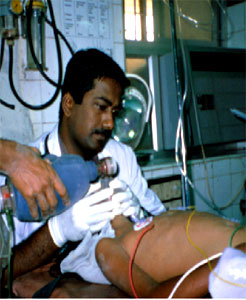
Even as a paramedic, I can never get used to the sight (or sounds) of a child who is in deep respiratory crisis, or the fact that the child may die, even as you try your best to try to save that child's life.
I had such a child last year. The child in question was a little boy of ten who was living with a severe form of muscular dystrophy, and because of it, doctors didn't hold out much in the way of hope for him. He was in a wheelchair and wore heavy metal braces upon his stick-thin legs, and he was scrawny: he looked as though he hadn't eaten a good meal in months. He also was on oxygen because his disease was starting to affect his breathing, and he was getting weaker every day; and things that were once simple and effortless for him now proved to be obstacles. He was a tragic case, and it broke my heart whenever we had to respond to calls involving this particular little boy.
I remember he was a beautiful little boy, as many of these kids often are: he had a headful of wispy, white-blonde hair that was babyfine and flyaway, huge, bright-blue eyes that looked even bigger behind his thick, wire-rimmed gold glasses, a smile that could light up the entire world, and a jovial (if somewhat shy) personality. But at this particular time, this boy was neither jovial or awake: he was unconscious, and he was barely breathing. He had suffered a seizure, and his tongue fell back into his airway, blocking his airway, and as a result, he had stopped breathing. His face was blue-black, and he was limp and unresponsive.
I remember the call going out over the speakers and the emergency tones going off, signalling a dire emergency involving a child. Calls are always stressful enough, but when a child, particularly a child with special health or medical needs, is involved, the situation is only heightened, and it makes the situation more dire, more desperate. The man over the radio said that a child was down and wasn't breathing, and they needed immediate advance life support to the residence. They said that the child was a white male about eight years of age, and that he had suffered a seizure and had stopped breathing.
Within a few minutes, we were at the scene. The boy's mother came rushing out, saying that her son was not breathing, and she was already having us follow her to where the little fellow still lay on the floor. He was lying in his bedroom, and he was lying faceup. His color was terrible: his face resembled a blueberry, and his eyes were closed, and he was limp and not moving. When I listened to his chest for any breath sounds, I was dismayed to find none; all I could hear was the faint, slow beating of his heart. His chest was also not moving, and I knew immediately that he was in trouble, big trouble.
My partner, Kendall, and I were on the case, and I told Kendall to get an airway ready, so I could put it down the kid's throat and get it down to his lungs, to open up his blocked airway, and so I could get some lifegiving oxygen to his still lungs. In a few minutes, I had the airway inserted into the little boy's mouth, and I attached a breathing bag to it, where I then started squeezing it every few seconds, to try to get air to his lungs, while Kendall affixed heart monitor leads to his now-exposed chest, to see what his heart was doing, and to react lest it should stop beating. The kid was still blue in color, and his fingernail beds were blue, too, which told me that he wasn't getting any air.
His mother watched us as we worked over her son, and as we worked on him, she was telling me about his medical history. He had muscular dystrophy and seizures, and unfortunately, this wasn't the first time this had happened. He had had such seizures before, and it was because he had had meningitis as a baby, and it left him with brain damage. He was also legally blind and was deaf: he wore hearing-aids in his ears, so there was no sense in trying to get him to respond to our calling his name, because he couldn't hear us, for one thing. She said that his seizurss had only gotten worse in the past few years, and his disease was progressing, too, to the point to where he now needed supplimental oxygen from time to time, as it was starting to affect his heart and his breathing. She said that he was ten years old (but he looked younger: he looked no more than the age of seven or eight), and that his name was Johnathon--"Johnny"--Sandusky.
We put Johnny on a rolling gurney, and we put him into the back of the ambulance, and we continued to breathe for him as we affixed him to the bed in the rear of the ambulance and hung the IV to the pole; and we continued to monitor his vital signs. Kendall and I sat in back with the stricken little boy, continually working on him, hoping, praying, willing him to start breathing again, and continually calling out his name, and doing other things to him, anything to get him to try to wake up; but he never moved. He still lay there, limp and blue. His mother rode in the front of the ambulance, along with the driver, as she continued to give him a detailed medical history of her son. For the seriousness of the emergency, the mother remained surprisingly calm, and when asked about it by the driver, why she didn't appear so overly concerned, she said that she was a nurse, and he had suffered these spells before; this wasn't the first time that this had happened. She knew that he was in good hands, and all she could do was pray and hope for the best.
At the hospital, Johnny was taken to a resuscitation table, where doctors and nurses soon took over; and it was while they were examining him and continuing to work on him when he finally took a huge, gasping breath and struggled to start breathing again. To hear him start breathing again was music to all of our ears, and we all breathed a huge, collective sigh of relief. We had saved his life in the nick of time (AGAIN!), and we had managed to defeat death, as the kid had survived yet another life-threatening respiratory crisis. For all his medical problems, little Johnny Sandusky was a force to be reckoned with, and he was a lot tougher than his tiny body (or his problems) warrented! It was obvious just how much of a little fighter he really was, and at last count, he is still defeating the threat of death each and every day. He is incredible, and when we hear that he has weathered yet another problem, another crisis, all we can do is shake our heads in wonder and thank God that he has managed to live yet another day!
Suspenseful and close to home, Rain of Deception 2 will leave you in Tears. Much like Part 1, this will shocking sequel will keep you on the edge of your fingertips.
Spoken Word
This CD will touch the deepest inner part of your humanness and spirit, you will never be the same after listening to the depths of struggle, the reality of life, the touching voice of truth. It will shock you, move you to tears. It w


 Even as a paramedic, I can never get used to the sight (or sounds) of a child who is in deep respiratory crisis, or the fact that the child may die, even as you try your best to try to save that child's life.