Early afternoon. A hazy day, that came with a smell of burning grass. On this Saturday in February, I spent several unrewarding hours behind my PC screen. “Error 17543210. You first have to uninstall the previous platinum antivirus program before you can upload version 5,” such appeared the computer-generated error message. “Please finish your uninstall process first.”
“Damned” I shouted.
“What’s wrong, Honey,” asked Maureen, who came walking into my home office.
“This bloody computer program… I’ve incinerated already every bit of this damned bit of software, but its register doesn’t want to uninstall.”
“Let’s leave for the country,” Maureen said. “Can’t you smell the fire? It’s planting season again. The farmers harvest dry rice, and burn the fields before the next planting cycle. I miss it so much.”
There was a deep longing in her voice, a feeling I found difficult to resist. Maybe it was time to visit again the other face of the world, I thought.
“Don’t you think it’s too late already for today? By the time we leave it will be two,” I queried. “Even if I push the pedal, we won’t reach your village in the hills before darkness. Can you find your way through the jungle, at night?”
“My sister Paya can come with us. She knows the way… Please, Darling, something is pulling me to go… I want to smell the fresh air of the forest. This city makes me feel sick.”
“Don’t you have to call your other sister in the fields?”
“There is no phone out there,” said Maureen. “No need to call. Everybody is in the rice fields right now. It’s planting season.”
I gave in, at last. Whilst on my way to pick up Paya, I noticed my car felt strange. Obviously, one tire was about to get flat. We picked up Paya, had the rear tires exchanged at a filthy workshop, and filled the tank. At four p.m. we were out off town, heading for the tarmac trunk road. At four thirty we hit the gravel track. I saw a black cobra snake wobbling from one side to the other.
Dusk fell after we had bounced for two more hours through countless potholes. I switched on my headlights. It had been raining ahead and the road was muddy. At six thirty it got pitch-black. Please no rain, now. Maureen was steadily chatting with her elder sister Paya. I didn’t get a word from their strange Kayan language conversation, and my eyes got tired negotiating the treacherous road.
The night felt dark and hot. As we pushed ahead through oil palm plantations, distant electric storms spuriously flashed like fireworks upon elongated and dark hillcrests. Rumbling along we arrived at the edge of the jungle, the realm of the logging roads by seven. These are made of compacted dirt, and wooden signs tell on which side of the road one is supposed to drive. One better watches and follows the signs. Logging trucks charged to the very maximum chase down the hills during daytime, and these guys can’t and won’t push the brake – not for you, not for anyone. Road slope angles can exceed 20 deg, and getting stuck uphill isn’t something healthy to consider, particularly at night.
To manage the hills, I went maximum speed in gear four, slammed the car up the hill, clutch-gas-clutch to gear three, clutch-gas-clutch two, gas-clutch-gas one, rattled over the hilltop with a bit of torque, and plunged into the dark valley ahead until the tracks reappeared on the bottom in yellow glow.
In fact, I got quickly into the mood of my snake-like driving, a fun job if there weren’t so many surprising potholes and road cracks. Luckily it was nighttime. We were on our own. Paya and Maureen’s kid Jok were sleeping already. Silence reigned in the car.
At eight I noticed a faint orange light hovering above the jungle canopy.
“The radio tower of Long Lama,” I said. “We are close to the Baram ferry point, already. Maureen, could you tell me where to go? If your family’s rice fields are on our side of the river, we better find the branch road, now!”
“Paya told me, she cannot remember well. It’s so dark out here…” Her voice had a sad tone. Obviously, she didn’t feel good about her sister’s scouting skills.
“Oh, my”... I answered angrily. “Didn’t I tell you we would hit the night?”
“Let’s drive to the ferry point,” said Maureen with a subdued voice, “and see if the ferry has stopped working already. Normally they stop service and go home at eight. Perhaps we can stay in the hotel.”
After some ten minutes we reached the ferry point. It was eight twenty p.m. A half moon pierced through the clouds and shed a hazy mellow light. It illuminated the gently flowing muddy river, the seven light-bulb-town of Long Lama a few hundred yards beyond. Somewhere behind was the only hotel, equipped with the only air-conditioned rooms in a perimeter of fifty miles. The ferry lay moored on the other side with a dim glowing positioning light. Someone was leaving the boat flashing a torch toward us.
“What does that mean,” I asked Maureen. “Is it a signal for us to wait, or for us to go? Let’s give him some fifteen minutes. Maybe he’s calling the captain. Why would he run, otherwise?”
“Maybe, who knows,” answered Maureen with a bit of hesitation.
I kept the engines running, and my yellow headlights shone across the river. If they wanted, they could see us. Our lonely presence on this side of the river was more than obvious. We waited until the motor started to get hot. I felt bad.
“Maureen,” I said with an angry tone, “please tell your sister that we must find the branch road. I don’t feel like spending the night in the car.” I hated Paya. She had let me down. Maureen nodded. I drove very slowly back up the hill, through the next valley, and up a lonely hill again.
“On our way toward the ferry, I noticed a faint light next to the road,” Maureen said. “Someone must be out there. Maybe they can help us.” After some five minutes of creeping along the road, we saw a faint light, indeed. It came from a hut on the right side of the road, a bit downhill and surrounded by bush. Three dogs were out, and barked at us. The smell of charcoal fire filled the air. Kids were sitting in front of the hut and were roasting some animal. As we stopped the car, an elderly lady came out and walked toward us. Maureen chatted with her. Then the lady invited us into her hut. They were farmers, and busy harvesting rice. Sacks full of virgin grain piled up along the entry wall. The lady of the house turned out to be one of Maureen’s many 4th degree cousins, and they remembered each other vaguely from the good old times. The lady’s husband had gone hunting, but he would return soon and could show us the way, Maureen said. So-far, so good.
We were offered some hot drinks and a bit of cake and chips. The hut was a fit-for-purpose construction, green plywood walls, simple sleeping mats, a rainwater-gathering drum and a small kitchen, where a charcoal fire glowed in gentle darkness. Against the background of our exhausting journey I really felt good. Down here in the jungle, at least, humanity continued to thrive. Then a bunch of kids came in giggling, and one boy was holding a roasted civet cat on its ten-inch-tail. Bon appetite.
At ten, the husband finally arrived back from hunting on his motorbike. He was Maureen’s distant cousin, too. A friendly, strong man in his fifties, he sat down for a while with us and smoked his smelly straw cigar. Then he took his homemade shotgun, and gave us a sign to come along. He mounted his bike and off he was. I tried to follow the bike as fast as I could push my aging car. He turned left on a branch road, then right, and left again. Now I felt a bit compassionate for poor sister Paya – after all, this damned place without any road signs wasn’t easily detectable in the middle of a cloudy jungle night.
After a while, the bike’s headlight reappeared in front of us as we approached another junction. The friendly hunter stopped his bike, waved ahead and mumbled something of ten minutes. We shook hands. The motorbike farted away back into darkness, and we were on our own trail again. Black darkness surrounded my car, apart from a cone of yellow light streaming over wet creamy muddy tracks ahead.
Paya and Maureen were discussing the right direction. After a while it got a bit loud and animated on the backseats. Paya seemed to recognize some familiar features, as we were driving along a valley floor lined by jungle walls. Here and there shone a mellow kerosene lamp, the glow of a charcoal fire emanating from tiny huts huddled against the forest. We had reached another rice paddy area, there was no doubt.
“Stop, here up, turn left, now” said Maureen. I hadn’t expected her sudden command but was able to pull the car up left onto a muddy cream-colored dirt slope. On the hillcrest we saw a cluster of huts. We had reached our destination, at last.
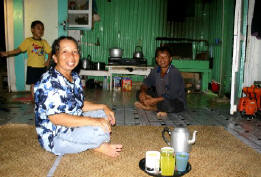
Maureen’s family gave us a warm welcome. In the simple hut we sat down and had a cup of tea. Maureen’s other sister pointed to a mat in the corner of the living room – my place to sleep. The air felt nice and cool. It was midnight. The re-united family sat in a circle on the ground, chatted and ate rice with their fingers. I didn’t feel hungry and lay down next to the open hole in the plywood wall. A wave of pure, sweet and cool jungle air descended upon my sweaty face. I didn’t miss the hotel any longer. Then my mind drifted away with the jungle buzzing in my sleepy ears.
© 2005 by Franz L Kessler