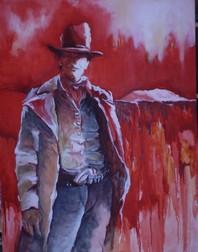
----- of course. However, engagement of the enemy, presupposes the formulation of contingency plans by the overall commander of the attacking force, to counter and nullify the enemies ability to attack, or otherwise cohesively adhere to the idea of attack independent of their main force. A breakaway troop of death and glory seekers irrespective of size, is not only demoralising to the attacking force but invariably inflicts losses amongst the advancing force out of all proportion to their own number. That is to say, no matter how overwhelming the attacking force may be. A good commander always remains aware of the possibility, however slight, of the attacked — attacking.
Hassim Hakakabar
6th century Arabian Theorist/soldier
from The Principals of War
Altruistic idealism minus the intrinsic reality of experience is a fundamental uncertainty that will constantly remain as unworkable as the principles of realities experience devoid of idealistic altruism
Richard Coyne 1996
(on corporate and governmental administration)
----- of course. However, engagement of the enemy, presupposes the formulation of contingency plans by the overall commander of the attacking force, to counter and nullify the enemies ability to attack, or otherwise cohesively adhere to the idea of attack independent of their main force. A breakaway troop of death and glory seekers irrespective of size, is not only demoralising to the attacking force but invariably inflicts losses amongst the advancing force out of all proportion to their own number. That is to say, no matter how overwhelming the attacking force may be. A good commander always remains aware of the possibility, however slight, of the attacked — attacking.
Hassim Hakakabar
6th century Arabian Theorist/soldier
from The Principals of War
Sad praise to thee my king
Sad praise to thee.
Zenobia
from Defeat of Kings
Down through long dusty centuries following the destruction of the merchant house of Al-Almek, the Brotherhood worked unceasingly. No longer confined to the land of Egypt, the Brotherhood wisely broadened their vision, in keeping with the ideals and notions of their now distant and somewhat legendary founder Hermes Trismegistus.
The Hidden Academy within the vast temple of Horus had almost ceased to exist, its usefulness replaced by another larger more obvious hall of learning behind whose facade, members of the Brotherhood quietly went about their secret business.
Indeed, as the Brotherhood quietly spread out into distant lands, and agents crossed the seas in ships of painted wood, the importance of the Egyptian House dwindled. It never became unimportant, it was simply that the Brotherhood, over the centuries established other secret places in distant lands in response to Hermes' written warning that an ENEMY known by many names, ever seeks to find and destroy knowledge.
Oddly, those of the Brotherhood who lived beyond the borders of Egypt never relaxed their vigilance, or failed to appoint Guardians, and send them to that exotic far away place of mountains and valleys, where to this day descendants of the Jamils can be found, if so they wish to be found that is.
Sadly the Egyptian chapter of the Brotherhood of the Book, failed to do likewise. Relegating the warnings and strictures of Hermes Trismegistus to the realm of fable and legend. 'Perhaps it was true ,' they said, 'centuries ago, but certainly not now, not in this enlightened age. No,' they rationalised, 'the Enemy no longer exists. We have nothing to fear, indeed it is time for us to come out of the shadows, there is no enemy, there never has been.'
Swayed by Xenocrates who was chief amongst them, the Egyptian Brotherhood of the Book made a terrible mistake. A mistake the Brotherhood later ensured would never, could never, happen again as they became a whisper on the wind until eventually even the whisper faded away into silence.
And the memory of Xenocrates became no more than words written upon the pages of an old dusty book, until it too was forgotten and lost. Somewhere within a cool labyrinth of dim interconnecting rooms buried deep beneath the earth. Rooms hewn out of the living rock that slowly, as centuries wept by in frustrations of war and ineffable suffering gradually overflowed, one room into the other, with the wisdom and knowledge of ages. And the sometimes recorded, sometimes not, fourteen thousand year history of a Brotherhood, that men of learning and wit would eventually claim did not exist and had never existed outside the fevered imagination of sun mad prophets and a single enraptured king who tried, unsuccessfully to promulgate awareness of a faint and mystic trace of blue; and the spiritual connectedness of all things unto the Aten, the apex and crucible of creation. Whose symbol is the Ankh of Eternity, the very soul, power and breath of spiritual awakening. Of course it was understood that awakening was only the first step towards a study of various levels of awakenings. That is to say, waking up spiritually is composed of many levels. Sadly, when most people find a first truth that awakens them, so to speak, they fail to continue, and often abandon the quest, failing to realise a first truth is only a tiny part of what could be a Greater Awakening. Such contend that what they found is the whole of everything pertaining not only to the spirit but to all matters spiritual. Therefore there is no need to seek further. Forgetting in their joy of a First Awakening, the one immutable law intrinsic to Being which is —
THE FIRST IMPERATIVE OF SPIRIT IS TO SEEK.
How can it be otherwise when spirit is part of the flux and weave of an expanding universe? We are made of the same stuff as stars, it is whispered, and the Egyptians once knew the exact location of heaven. One day, the mystery of it all will be revealed, but not yet. The Brotherhood and only the Brotherhood have ancient records of such wisdoms. And they yet seek a final piece whereby all of humankind may — touch the earth.
And yet, an Egyptian king born untimely, did once befriend a scholar who had grown lax in regard of an ancient warning, and thereby both did give direction to a dark seeking thing of ill intent.
It is written in the Book of Records that Xenocrates was a small stoop shouldered man in the third phase of life. Even so, he followed the Greek fashion of wearing his hair in long, oiled and perfumed ringlets; the only living descendant of a Greek trading family who had settled in Thebes, and though it was often spoken of, never did return to their homeland.
Xenocrates, born in Egypt was, for all his love of Greek fashions, Egyptian through and through. He was also a senior member of the Egyptian Chapter of the Brotherhood of the Book.
He was also a scholar who gave little credence to ancient words from out of an old and now almost forgotten age of legend and myth. Indeed, Xenocrates full of hubris and puff had of late, begun to doubt the veracity of events described within his collection of Hermetica, though he knew full well the books had been written by the hand of Hermes Trismegistus himself.
Xenocrates was not a fool. Indeed, his scholastic fame was an oft talked about thing within high walled Thebes.
Only, for all his vaunted intelligence he was no forward thinker and lacked that other mysterious spark that enables an individual to at least be aware, if not predict, consequence of individual action.
Xenocrates dismissed the warning of his master with an indulgent smile and an airy wave of his hand.
'We live in a more enlightened age,' he would say, 'far in advance of our ancestors. Yellow eyes are a condition of marsh fever, no more than that. Obviously the ancients had no knowledge of such things, and thought the condition to be the influence of some dark demonic power.'
How he managed to equate such nonsensical superstitions with the wisdoms he so assiduously studied no one knows. That he did so, is perhaps indicative of his mental disarray and may in part, help those who came after to find reason, however slight, in his otherwise sense-fled actions.
During the years that followed the fall of the House of Al-Almek, the Brotherhood under the guise of priest scholars of Horus, petitioned for, and were granted permission to build an academy within high walled Thebes. When complete, the few priests of Horus who were also members of the Brotherhood of the Book quietly left the great Temple of Karnak to work as simple scholars and teachers in Thebes great new Hall of Learning.
Under the protection of Pharaoh the Academy/Library prospered, attracting students, wise men, poets, astronomers, philosophers, men of science and medicine, architects and minor kings into its cool alabaster columned hall of study.
As the centuries leaked away it seemed as though the Hall of Learning had always been there, beating like a patient heart within the cities confines. And then, a new and very different kind of Pharaoh ascended to the throne.
Amenhotep IV, he who was named The Criminal, his true name forbidden to be uttered on pain of death; a mind crippled dreamer who was capable of extraordinary insight and huge intuitive leaps of thought; until finally, like all saviours and prophets, he stood alone, a crippled dreamer in the wrong age. His time would come again, but not for two thousand years.
Until then, he lived in the wrong place at the wrong time. His promulgation's far too radical to felicitate any easy road to acceptance.
Even so, his was the majesty and the power to enforce command. And like all those who consider they are chosen or divinely birthed, illumination rarely doth encompass awareness enough to view through any other eyes and they, like wounded spirits, blunder through the night unmindful of their inevitable doom.
Unable to empathise, Amenhotep IV remained singularly unaware of the magnitude of the cultural and psychic (spiritual) shock he literally forced upon his people. He was Pharaoh, God's regent on earth; his was the majesty and power to command.
Amenhotep claimed Sophia the highest attainable wisdom. The divine, mystical experience, that remains, by its very nature, ineffable. And yet, for all of that he failed. As all who impress visionary insights with duress ultimately fail. Leaving mystic Sophia, worth less than a featherweight of gold.
No glory to the saviour whose untimely message destroys what he fails to understand. No wreath or tomb of stone. No place in heaven or upon this earth. Amenhotep the Unready came too soon to the one place on earth that had no need of a saviour's visionary quest. Two thousand years had yet to pass before the exact location of heaven was finally lost and the nation of Egypt fell down into utter irreparable ruin; perhaps it had something to do with a weirding man who stalked the desert when Amenhotep was born, perhaps it did not. But then, in Egypt, not a one of the secret Brotherhood gave heed to ancient warnings any more.
Pharaoh Amenhotep IV named himself Ankhaten glory to Aten the one god. And why should he not name himself thus, he was Pharaoh, ruler of the two lands, who sadly had no memory of the two heavens or of ancient wisdoms lost beneath dust and sand.
Amenhotep eschewed the priestly class and thereby tumbled the Brotherhood of the Book down into ruin and to the attentions of a desert stalking man with terrible yellow fevered eyes.
Before ascending to the throne, Amenhotep developed a thirst for knowledge. And as all the world knew, Thebes' great Hall of Learning was home to the land's most knowledgable and educated minds.
So it was, that one day he invited Xenocrates of enviable fame to the palace to discuss the principles of an ancient book of Hermetica entitled, The Intrinsic Nature of Knowledge.
From this one agreeable meeting, tentative bonds of friendship were formed that gradually blossomed as the years slipped by. However, Xenocrates did not reveal his association with the Brotherhood until after Amenhotep ascended to the throne. Amenhotep, intensely interested, demanded to know everything. The idea of the existence of a secret group dedicated to seeking out, storing and preserving old wisdoms and knowledge that would otherwise be lost or destroyed, fascinated him.
Xenocrates spoke not at all of warnings, or of the destruction of other more ancient halls of learning. But then, why should he, they were after all, no more than overly imaginative stories. Nor could he envisage an enemy more powerful than Pharaoh.
The Brotherhood however was opposed to more than just the destruction of knowledge. Sadly, Xenocrates had forgotten that, or perhaps, he simply cared not to remember.
Eventually Amenhotep asked Xenocrates if, at some future unspecified time the Brotherhood would accept his patronage and come to live and work in a new city he was planning. There would be, he said, a centre of learning more vast than any known, built in the shape of an Ankh, symbol of life.
For is it not true , he said to Xenocrates, that knowledge carries the seeds of life within its understanding. Therefore it is fitting that it be housed within the symbol of life itself.
Ecstatic, Xenocrates agreed. In a rapture of blindness, persuading the Brotherhood to move out from the shadows and openly occupy a place of learning within Amenhotep's new city. When news of Xenocrates betrayal and that of his brothers, reached the ears of others in distant lands, it was already too late. Perhaps it had always been too late since the day the Egyptian Greek was born.
Pharaoh Amenhotep IV introduced his grand design during the third year of his reign, pushing everything forward with unprecedented speed. Carrying out a series of brilliantly contrived moves that left the nation reeling in a wake of uncompromising efficiency that quite literally stunned the priest caste, bringing the whole mechanism of what was now rote worship to a grinding halt. Unable to empathise, Amenhotep blundered on.
'You do not understand the words that spill from your mouths,' admonished Amenhotep, 'how then can you expect my people to understand. They look to you for guidance,' he argued, 'and the only wisdom you offer is a pale shadow of yesterday's dreaming, edged all about with words from out a golden age we cannot now even begin to understand.'
Amenhotep stripped the temple priests of power saying, 'You will unite,' he threatened, 'and worship the one god, else I cast thee out utterly.'
Appalled, the temple priests offered mute surrender, yet it is written, their eyes were terrible to see.
Pharaoh also ordered his name Amenhotep IV to be erased from all records and monuments, proclaiming his new name to be Ankhaten (Ankh + Aten).
As Ankhaten he adopted and displayed the Ankh (a cross with a loop on top) as his sacred symbol, naming it The Key to Heaven Opening, thereby displacing the symbolic sacred solar disk and worship of Ammon-Ra.
'You already possess enlightenment,' he preached, 'you have but to recognise its presence within. We all,' he proclaimed, 'carry the seed of god. Lift up your voice in praise. Proclaim the blessedness of Aten, the one god and the seed, and though it be buried deep within a thirsty desert (spiritual paucity), it will blossom.'
Claiming mystical insight as founder of the new religion, Ankhaten advocated no doom, no perdition and denied the very idea of hell as being no more than a realm of fantasy, conjured up from out the minds of priests to frighten those who otherwise would not heed or be shackled by their interpretation of divine constraints.
The common folk loved it and embraced the new religion with cries of joy and heartfelt thanks.
Displaced priests, forced to abandon scores of major and minor deities, smouldered with sullen vicious resentful anger.
Egypt's legions, oath sworn to uphold and carry out Pharaonic commands remained aloof, neither for nor against the new religion, bending knee to the one god whenever Pharaoh Ankhaten did so command. Conversely the legions did not bend knee if not directly ordered to do so. Indeed, many legionnaires continued to carry amulets of solar disc design long after the symbol was outlawed by the new faith. No matter how strong or true a new faith appears to be, it remains ever wary, or so it seems, of what it claims to replace. Monotheism was not a new concept; indeed it was old beyond imagining. It was simply that until Amenhotep IV came along no one had attempted to displace Egypt's polytheistic religion with the idea of worship of a single all-powerful god. But then, Amenhotep did not know he was born in the wrong age, two thousand years out of time. Sometimes saviours are like that, appearing too early or too late. Of the hundreds known around the world only a handful have so far gotten it right. Sadly Ankhaten was not one of them. He tried and failed and was branded a Criminal. Sad praise to thee my king, sad praise to thee and the get of thy seed who alas, possessed no seeking vision and betrayed thee even unto thy name. Even so, to this day there are some who breathe of thee and hold in their care thy holy books.
His new desert city complete, Amenhotep, now known as Ankhaten declared high walled Thebes to no longer be his capital. The new city, built of alabaster, stone and light veined marble would take its place. That it was surrounded by a desolate wilderness bothered him not at all.
The new city was vast, pristine and soulless.
Reaching out from within quiet, airy halls Ankhaten officially outlawed the worship of Egypt's multitudinous gods and principal god Ammon, replacing the entire pantheon with one all-powerful, all knowing supreme deity to be known henceforth as Aten. (Suggestive of Atom, the light within the seed. Papyrus No 33 the Ankhaten Temple Papyrus, contains the following — 'Aten - thou who art light within the seed. O Thou light bearer. Split thee Aten (atom) (and) light (and) fire and wind will thou unleash (to?) consume the world. The fire of god is thine, I pity thee, and I sorrow for thee. Should thou misuse the Aten (atom?) thou sowest seeds of thine own destruction.')
The crippled dreamer Ankhaten married Nefertiti whose beauty it is said outshone the moon. She bore him a son, Tutankhaten who later ascended to the throne and changed his name to Tutankhamum. But like his father before him he died untimely and of his mother, Nefertiti, who survived them both no story of truth has yet been told.
Ankhaten named his new capital city Akhenaten, and invited Xenocrates and his brothers to make their home midst the wonder of the first city built and dedicated to the power and glory of Aten (the consuming light).
True to his promise the city housed a magnificent Ankh shaped building to be used for both study and storage of written wisdoms and knowledge.
Xenocrates was over joyed. He gave no thought to betrayal as he led fellow members of the Brotherhood of the Book across the threshold of the huge, splendid hall. The spacious interior rang with light and a silent promise of golden years to come.
Aten who gave to the world a saviour son crippled with dreams during an age where he was not meant to be.
Ankhaten, who had no memory of where the precise location of the First Heaven might be, was destined, as all saviours tend to be, to die untimely. Vision quest unfulfilled.
Unfortunately those who rise with greatness are often called upon to share the rewards when greatness falls.
Xenocrates lived each day with almost orgastic pleasure, stocking the main library of the ankh shaped hall with wisdoms and knowledge obtained over centuries of diligent seeking. Writings on stone found within the ruins of the long ago house of Al-Almek. Hundreds of papyrus scrolls covered with sacred writings from the fallen Temple of Abydos. Clay tablets that spoke of science and told a story of an angel with broken wings that gave rise to the ancient study of Angelology.
Xenocrates was not discreet, he hid nothing, all was made available, both originals and copies. Of course it could not last. But Xenocrates didn't know that, and if he had, he most certainly would not have cared. Ancient warnings were after all, both ancient and foolish. Men of learning had no interest in such things. 'Such superstitious nonsense is for illiterates and peasants,' he was once heard to say, 'and is certainly not the province of an educated man.' Alas, poor Xenocrates all unaware that education be all but useless without wit and sense enough to use it.
But then he had not read Gildas and thought not at all of Hermes' description of the Pobal Na Cloch or the fate of the legendary City of Origins.
Nor did Xenocrates pay any attention to a short, broad shouldered old man who smiled infrequently and spoke even less. He had always been there or at least someone like him, sweeping floors, carrying messages and generally acting as a sort of unpaid watchman around the place. Xenocrates had read the story of Onuris of the Spear but gave no thought to there actually being Guardians who somehow turned up when needed or came to replace one who was called elsewhere. To Xenocrates, Guardians were like warnings, superstitious nonsense no sane man bothered his head about.
If Xenocrates had ever bothered to look, he would have noticed that the short silver haired man walked with a lithe, easy grace of motion and that his infrequent smile rarely lit eyes the colour of grey winter skies. His eyes alone, in a land of dark eyed men, was enough to warrant notice. Nor did Xenocrates observe that the small man always wore a short sword, sheathed alongside his right hip, indicative that he was trained to unsheathe the blade with that curious twisting wrist motion affected by warriors who carried a shield on their left arm. The curiosity of his weapon was that whilst it was the customary length, the double-edged blade was less than half the width of the standard short sword used by Pharaoh's legions. It was an old blade of tempered steel, wickedly sharp, relic of an earlier long ago age of Citeanns, Pobal Na Cloch and the now almost forgotten Four Kingdoms.
Lacking height the warrior had trained almost exclusively in close quarter combat. Powerful chest and shoulder muscles able to drive the slim blade like a deadly giant's needle, through armour and flesh with almost preternatural skill, speed and ease.
He was not a young man, though he wore his sixty-eight years of life like a comfortable cloak of easy weight.
He had no wife, and no sons or daughters or close personal friends. Guardians do not marry. Life for such as they is a chancy, uncertain thing, and the short grizzled veteran had lived longer than most. Like priests they are oath sworn and true . Though of course they enjoyed from time to time, pleasures of the flesh, celibacy being looked upon as an unnatural state resulting in cloudy, mind twisting thoughts and dark secret habits.
He was not a legend, nor would he ever birth legendary fame, he was simply a name written in the Brotherhoods Book of Records (of Guardians). It wasn't a complete record, it would never be that, but it was a record of sorts and that is all that can be said for it. An incomplete record of names with brief descriptions alongside nonetheless made it the kind of book historians would barter their very souls to own.
When he died, months later, the date of his death was recorded in an old dusty book along with brief unfeeling comments of how. Apart from that one brief mention, no one knew he had even lived. Except for the mystery that held his promise and some few amongst his own kind.
He did not regret his oath; indeed it had given direction and purpose to his life where before, life had been no more than a sorry succession of empty days.
How he was called or why, he never knew. It was one of those mysteries best left alone he concluded, and never thought of it again.
He had worked as a soldier, a mercenary and a sometimes guard of desert caravans. Wandering distant lands with a knot in his belly and a void inside his head. He made no friends during those cold years and wanted none, only laying with a woman now and then, when he felt the need or simply wanted for a while, to feel close to someone. A quiet unassuming man he was, who paid scant attention to the world around him, and fought without passion.
He had nowhere to go and a lifetime to get there. He could not read or write and felt no urge to learn. No one knew him and he knew no one, always alone, with a knot in his gut and a void inside his head.
Childhood memories were no more than a blur of faces, of hunger and cold, of sleeping alone in dark musty corners of abandoned houses and old decaying ruins. He survived, but was never quite sure how he managed to survive, only that he did. He did not dream of better days to come, or think of what it would be like to have a full belly. He did not cry for want of someone to hold and care for him when the nights were dark and full of prowling winds that moaned and sighed like some lost nameless haunt. He did not think his life to be cruel and mean, or bemoan an existence the wrong side of poverty. He did not sob and wonder why he had been abandoned. And when he came to manhood he did not use his childhood to excuse or otherwise mitigate the way he was. He came to accept that actions say who and what you are, and that all the fancy words in the world could not change, or say you were otherwise. And then, during the hours of a single day he came out from the darkness and faced the world, a fledgling warrior.
Morning it was, the sun scarce risen from its bed. His stomach growled from hunger. Dark rings circled his eyes, cheeks hollow, flesh stretched tight over cheekbones. The ribs of him an easy count down to skinny shapeless hips. A starveling he was with no thought of tomorrow only of surviving for one more day. He scavenged through garbage and the gutter leavings of others. He skulked around market squares, stealing food when he could. No one cared if the starveling child lived or died, except for slavers that is.
They came upon him as he emerged from out the ruin where he laid down his head, squinting against the rising sun's brightening light. His throat ached from thirst. Ignoring hunger pains he ambled out from the shadow of a crumbling wall in search of water and a bit and piece of something to eat. Only to find his way blocked by two armed men.
They stared at him, eyes flat and cold. A rank smell of unwashed flesh permeated the air and something else, something sour and acrid, the tainting smell of slavers. He whirled, intending to flee back into the ruins where he had spent the night. Strong hands grabbed his shoulders, spinning him round. He had not the strength to resist, and so he did not, much to the slaver's delight.
The boy thought only of food, as the two slavers dragged him down a deserted dusty street. Stopping before a small windowless house, they unbarred the door and threw him in, barring the door behind him. It was a holding house. The slavers would gather what they could and then, in a day or two, transport the human merchandise directly to the auction block, or to a large roofless stockade where buyers could inspect the human merchandise at their leisure.
The boy crouched in darkness, the unmoving air hot and stifling. He could not escape, not yet, therefore he sat and waited, soon or late the slavers would return, until then he thought of nothing at all. Time passed, the room grew hotter until the air felt like a thick smothering cloud about his head. He ignored the discomfort. He wanted to pee but couldn't, the pain in his belly intensified. He stared into the darkness, waiting. He was good at that; he had been waiting all his young life. Waiting for the sun to rise, for the night to pass. Waiting for food and water. Waiting, waiting the endless minutes and hours down through days and nights into weeks and months that bled slowly into a wound of years. He would wait forever, until the last of days when life ceased to run and the final wait was over. Until then, all he owned was his name. Perhaps he would never own more. Perhaps the desire to own more would never infuse him. To truly own a name, for some it is enough.
Suddenly the door crashed open. Hot shafts of late afternoon sunlight speared in, lancing his eyes as he slowly climbed to his feet. Grey eyes following his captor's every move.
Surprisingly the two slavers were alone and even more surprisingly one of them stepped into the room, silently offering him food and water. The boy ate and drank in silence and then, when he had finished he turned his back and with a quiet sigh of relief peed in a corner.
The two slavers, both burly men blocked the open doorway, leering at him with broken, gap-toothed smiles. The boy tensed as they began to advance slowly towards him. His blood ran cold, he had heard of men who lusted after the flesh of boys. His belly gurgled; he belched and with a smile advanced to meet them. His mind was a void, yet he sensed in a distant way that his body knew what to do, as though the very cells of his flesh carried memory of something, something he would never divine for as long as he lived.
And then, without conscious thought or prior intent, he moved with incredible speed. His actions, no more than a blur in the half-light of the room taking the two slavers completely by surprise. By the time they registered what had happened, it was too late. They died in the space of a heartbeat with looks of stunned surprise etching their faces. Eyes bulging in horror as the boy watched dispassionately as the two men expelled their final breath. Hands clawing futilely at severed throats, the blade of their doom held loosely in his right hand. The blade he had drawn from the nearest slavers sheath and with a curious twisting wrist motion opened their throats.
The boy quickly took what he needed from the two cooling bodies, strapped weapons around his waist, and a travelling bundle across his back, and then he stepped out into fading sunlight and faced the world a warrior, a small one to be sure, but a warrior nonetheless.
His name was Ta-Ara-Nis (Taranis - quiet, waiting one of strength). Who named him, he could not say only, as he grew, surviving each day as best he could, he came to realise his name was all he owned and that he was like his name. Sometimes he sensed it to be old and familiar, as though he had worn it before. Sometimes he gazed up at the night sky, searching for a constellation he could not name. Why he did that he had no idea only, sometimes it was a comfort to him in an otherwise bleak and friendless existence.
No, he was not a legend nor would his name give rise to legendary stories of hero warriors. He grew to manhood against all odds. An itinerant warrior who learned his trade along the road, watching, always watching the moves, patterns and styles of older more seasoned mercenaries he met along the way. Regular meals and constant blade practice swelled his arms and chest with a weight of hard muscle. And then he would suddenly bundle his few belongings together and without a word to anyone wonder off in a southerly direction. Always, he headed south. It was simply somewhere to go and he had a lifetime in which to get there, wherever there might be.
When in need of food or coin he hired out to whoever would take him and then, a few days or weeks later he simply walked away, heading south. Nor were his many and varied employers fool enough to hinder his going, there was something about him. He rarely spoke, never smiled and the cool grey eyes of him had a way of looking right through whoever spoke to him.
His life changed when, eight years later, he wandered into a high mountain valley hidden within the folds and towering peaks of the Southern Ranges. That he had found it at all was something he never even thought of. He was asked to stay for a while, by a small dark skinned man with black button eyes, and so he did.
Now and again the odd little man courteously invited him to join for an hour or two a small group of warriors who, he said with a smile, were learning a new way to dance. The little man never pushed, always extending his invitations to take part in this or that exercise with a politeness of manner Taranis found hard to refuse. The odd occasions when he did so, were simply greeted with a nod and a smile and a soft voiced reply of, 'maybe next time.'
Gradually, as time went by, a pattern was established that by increments had Taranis training just a little more each day, the little man's courteous invitations becoming increasingly difficult to refuse.
Once only did his host speak of the use of spiritual strength in combat, Taranis stared at him with such blank incomprehension; the little man never spoke of it again.
And when those who lived in the valley gathered together to eat and drink and talk of this and that, Taranis was always absent. Nor did anyone remark upon his absence or impolitely ask him why he did not attend such gatherings. He was granted the courtesy to simply BE who and what he was, The whole valley knew he was one of the silent, waiting kind, to whom silence itself is a kind of strength, and that to such as he, the most grievous wounds are often of the spoken kind.
The magic of the mountains is a compelling, addictive magic of high dramatic skies and seasons that whistle and change like the wind. Soft beauties there are, midst an ever-changing pattern of colour, whilst the very air you breathe, rings with crystal purity.
Nor is time the same as that of the lower desert lands. Time in the high mountains is a slower moving thing, but it does pass, the inevitability of its journey remains the same.
Taranis did not think of such things. Each day was enough in itself and like those ancient ones, who came down from out their mountains to build a city, he thought not at all of gods or kings.
And then one day he was asked to stand before a stone and swear an oath.
'If you give promise,' he was told, 'it will become your life.'
'I live each day,' he replied, 'and that is enough.'
Even so, he gave promise and learned of the Brotherhood of the Book. Their purpose, ideals and a vague notion of future goals and, he learned of Guardians.
Before he came down from the mountains the void inside his head moved away and the knot in his belly untwisted.
He was Taranis who owned only a name and now, a sacred trust. For the quiet, waiting one, it was enough.
'Let your actions speak for you. Let them say who and what you are,' the little man told him.
Taranis had flashed a rare smile at that and did not care to know more. The little man's words said it all. From gods to temples and down through kings to streets of walking, the wisdom of ages encapsulated within a single sentence, mused Taranis and thought of it no more, as he journeyed north towards a distant city of Pharaohs and a place of books.
Taranis, in company with Xenocrates and others moved to the new city dedicated to the worship of Aten.
Only a fool defies Pharaoh within the boundaries of his rule, or openly opposes Pharaonic edicts.
Some few, urged on by displaced priests of Ammon-Ra, did so. Punishment was swift and final.
Ankhaten's rule was not benign, his implementation of a new monotheistic religion imperfect at best. Discontent began to rumble through the land. The legions, oath bound to Pharaoh, carried out his commands with bleak, unsmiling faces. And the years went by, falling one into the other like wind broken riverweeds.
Xenocrates, unaware of growing discontent, supported Pharaoh in any way he could. Praising Aten whilst at the same time supplying Ankhaten with a seemingly endless supply of old, written wisdoms that in a vague roundabout way hinted at a similar form of worship centuries ago. As the years went by Ankhaten's mystical insights gradually turned into a form of religious ecstasy that was little short of outright madness.
Of them all, only Nefertiti possessed enough political acumen to recognise the danger of a splintered nation. Even so, for love of her crippled dreamer she supported his visionary rule and actively worked towards promulgating the worship of Aten. That their son Tutankhaten would continue to endorse the worship of Aten, when he ascended to the throne, she did not doubt.
Of course he did not. Changing his name to Tutankhamum in support of the displaced worship of Ammon-Ra, he won the love and support of a nation. He died untimely during his eighteenth summer of life, but then, he had always been a sickly child. That his beloved father had been branded a Criminal broke his heart thereby hastening his certain demise. Nefertiti survived them both. Living in seclusion, her wondrous beauty withered as she mourned the loss of both husband and son, worship of Aten was by then punishable by death.
Even so, fourteen years went by in a ferment of discontent before the fall of Ankhaten and all his mystic dreaming.
Xenocrates should have known when an unpopular Pharaoh died, all those who had openly supported his rule invariably died too, or at the very least were stripped of all possessions and exiled. Perhaps he did know, but thought with hubris that no one would harm a scholar or even presume to touch, let alone destroy precious scrolls and books. But then, he gave no thought to ancient warnings of one who stalked the land, in search of hidden wisdoms and knowledge to destroy.
Xenocrates was not a fool; he was simply blind to what he did not wish to see. The death of others is not a factor to such men, merely a product never acknowledged.
During late summer of the fourteenth year of Ankhaten's rule, he fell victim to a mysterious malady no court physician could diagnose. He died on the third day, just as the sun reached its zenith, in a welter of sweat and vomit. That he had been poisoned was obvious.
Now sadly, only a hidden Brotherhood, possess proof of such claims. But then, only they possess authentic records of his reign, the life of Nefertiti and their son, and of what actually happened when Ankhaten died, not mere supposition of facts gleaned from the writings and inscriptions of those who condoned tearing his body apart and branding him Criminal.
(The word though lightly used today was in ancient times the ultimate malediction, implying one whose actions show him to be devoid of spiritual awareness. Therefore, anyone found guilty of harm against the people were thought to have also turned away from god. That is to say, there was no such thing as a devout, church going criminal. You could not be both, one cancelled out the other. Be it robbery, murder or whatever. A criminal, no matter protestation, was not and could not be a religious, that is to say, spiritually inclined person. To be named a Criminal was to be cursed.)
”The king is dead” whispers crackled through the streets like summer lightening. “The king is dead”. And then the madness began.
A tall lean priest with burning eyes stalked the streets and market places, exhorting, urging, commanding the people to reinstate the worship of Ra and to destroy forever the heretic's notion of monotheism.
Priests in their hundreds caught the flame of his words, burning with religious fervour, adding their voices to his stirring the populace into a heaving, yelling mass of hysterical religious zealots. And then, pointing them like an arrow towards the heretic's city, foaming mouthed priests loosened their shafts to the manic braying laughter of a tall lean man with yellow-flecked eyes who walked amongst them.
Within hours, a spreading stain of humanity, soldiers, artisans and priests, flowed across the desert engulfing the city of dead Ankhaten. Storming the palace, Pharaoh's body was quite literally torn to bits by the hands of the vengeful priests of Ra. The bloody remains cast out into the desert, food for jackals, vultures and dogs. The swarming multitudes destroyed everything, soldiers amongst them taking care of any bit and piece of armed resistance.
Nefertiti fled to Thebes with her son, who was now Pharaoh.
Smoke coiled lazily up towards a peaceful sky of purest blue as ravaging, mindless mobs set fire to the city and then, led by soldiers they streamed towards an ankh shaped building of books.
Too late did Xenocrates remember an ancient written warning, "minions of the dark one will destroy a city and all its people to reach a single house of books."
Xenocrates and other members of the Brotherhood stood in fearful silence. He knew he should have fled before the angry mob arrived and wished now that he had. Certainly there had been warning enough, only he had been too blind to see, and too full of hubris to listen to the soft voiced advice of the old man who had urged them all to flee.
Not that it mattered. He had betrayed the Brotherhood and if the mob broke in, the accumulated knowledge of centuries would be destroyed in an instant. What should have been a house of copies only, was not. He had failed in his duty to copy and then send the originals on to the hidden places.
Cold hands clutched at his heart. Perhaps, he thought miserably, the old man will persuade the people to leave the library alone. It did not occur to Xenocrates to add his voice to that of the old man's standing alone outside the barred bronze doors. But then, for all his fear Xenocrates did not think the angry mob would actually kill him, the notion was absurd. They would not dare, he assured himself, poor Xenocrates, blind to the end. He and all those gathered in the Great Hall would die beneath the sword of a tall lean man with burning eyes, who would then set fire to the wondrous library and stalk away, his dark work done.
Though not fatal, the loss of the entire Egyptian chapter of the Brotherhood was a grievous blow that would take many a year to heal and repair. Sadly, of the original works destroyed, along with the ankh shaped building, none could be replaced. Some attempts were made, down through the centuries to verify the existence of rumoured copies, sadly, few such rumours proved to be true .
From that time on (up to the present day) the Brotherhood never again made the error of assuming, simply because one has the intelligence to acquire high, often, select education, such a person also has wit enough to use it, and or the ability to think beyond its boundaries.
Around this same time period a basic was also introduced, study of which resulted in attainment of (for some) burgeoning spiritual awareness. It was (is) however made quite clear that the level or degree of awareness gained was not considered to be a first principal. However, certainty that spiritual awareness does indeed exist was. Members of the Brotherhood (including Guardians) were then expected to at least gain a modicum of familiarisation with the basic idea underlaying the formulation and introduction of such an important yet fundamental premise (concerning the spirit).
Sadly, it has taken a Bernard Coyne, to discover an old forgotten book of ancient records detailing amongst other things, the fall of an unknown Guardian named Taranis who was no more than a name, a scribbled mark in a book. And yet, from the little that was written alongside his name, Coyne realised the ancient warrior had displayed traits that constantly informed the world with a silent voice that here was an extraordinary man. Only no one bothered to listen or even notice that he was there. Certainly, Coyne thought dispassionately, Xenocrates was a bigger fool than ever the Brotherhood had thought him to be. Perhaps Coyne, himself a silent man of not over large stature, empathised with the unknown warrior whose name was covered in the dust of an earlier age. If only for a few brief moments, whilst writing his notes Coyne made him live again. Later, when Coyne retold the story to Marie, they drank a silent toast to the whisper wind memory of Taranis, a quiet, waiting one of strength.
The huge bronze doors of the library closed behind him with a hollow thud of finality.
Settling his shield he glanced off towards his right, gauging the angle of the sun's rays, shifting slightly left to ensure the westering light would not splinter his corner vision. Not that it mattered. By the time the sense-fled mob reached him the sun would be the least of his problems. Still, he thought mildly, old habits die hard. His right hand lay lightly on the pommel of his sword. Stance relaxed and easy as though he faced no more than an afternoon's casual stroll around the perimeter of the ankh shaped building.
The noise of the angry crowd drew closer.
The air had a sultry feel to it, still and oppressive. He glanced up and around, could be a sand storm brewing, he thought idly. He did not think of the scholars cowering behind barred doors. He had tried to warn them of danger when first the king fell ill. He advised the Brothers to flee whilst the desert road, leading north, yet remained open. No one listened, least of all Xenocrates, who brushed him aside with a contemptuous wave of his hand.
'How dare you address me without permission,' Xenocrates had snapped, a disdainful look pinching his face, 'attend to your cleaning duties you senile old fool, and get out of my way.'
Taranis stepped silently aside, staring after the retreating scholar with a mild expression completely devoid of anger. And then he turned away with a careless shrug, eyes flat and cold. It never occurred to him to walk away and leave the supercilious scholars to their fate. Nor did he think, if I stay I die. He simply did not think in terms of life or death or shades in between. He had lived his entire life; comfortable in the certain knowledge that to breathe the life of a single day was enough. That Xenocrates and his fellows were ill mannered, discourteous and at times downright rude to him, bothered the old man not at all. He didn't even think about their loutish attitude towards him.
You are, after all, what your actions show you to be.
He was aware that his inability to read and write sometimes gave cause for others to cheat him when, from time to time he dealt with traders. Taranis remained supremely indifferent, theirs was the actual loss not his.
Your actions show who and what you are.
Their fellows may laugh and slap them on the back for having gotten more than they should out of the illiterate warrior. But then, if they wished to show the world, by their actions that they were liars and cheats, that was their burden, not his. Neither wealth nor goods were any good substitute for what, with deceit you pretend to be.
Taranis was not mentally slow; indeed quite the reverse was true . Nor was he indifferent to those around him, he simply walked a different path, and was indeed a most unusual man.
The sky had begun to haze a little. Dust devils danced around his feet as an errant breeze moved the sultry air. Sweat trickled down his face. The yelling crowd had spotted him now, surging towards the lone, armed figure like an ocean wave. Soldiers led them, brandishing swords and spears and the odd hand axe.
Diffused sunlight edged the top of the library walls glowing pale yellow across the flat tiled roof. The old man no longer had cause to worry about slanting sunlight splintering his vision. The huge, burnished bronze doors gleamed copper red behind him.
The wild-eyed mob came to a milling halt staring at the lone figure in confusion. Soldiers looked at each other, gazed at the armed figure standing before the closed doors and with unspoken agreement formed up into a loose skirmish line.
Taranis braced himself. He wanted to pee. He did not blame Xenocrates and his foolishness for placing him in such an untenable position. Nor did he blame Ankhaten for trying to live his dreaming visions that were, when all was said and done the start of it all. Nor did he blame his childhood for the shaping of him. Of course it plays a part, he knew that full well. But you could not use it to excuse what you become. You are after all, exactly what your actions show you to be, murderer, thief, good man or otherwise. Perhaps that is all Taranis ever knew, perhaps it was all he had need of knowing.
The milling crowd was silent now, waiting to see what the soldiers might do.
The lone figure guarding the closed entrance to the ankh shaped building looked, for all his hair was white with age, dangerous, eyes full of brooding menace.
One from amongst the soldiers shuffled forward.
'Step aside old man, we respect your years and have no wish to harm you,' he growled.
Indifferent, Taranis remained silent, hand tight gripped around the hilt of his slim blade.
'Blood and balls, are you deaf old man?' the soldier's voice rose, 'I said step aside,' he waved his sword around threateningly, 'or I will kill you.' He gestured towards the silent, watching crowd, 'we are hundreds and you are just a senile, stubborn old man. Now, for the last time, STEP ASIDE' he roared.
Taranis wanted to pee very badly indeed, his bladder nigh on to bursting with the urge. Turning his back to the yelling soldier, Taranis faced the bronze doors, fumbled for a moment, and then, with an audible sigh of relief, released a gushing torrent of urine.
The crowd howled, laughing and stamping their feet in approval. The soldier's face turned beet red. 'The bloody old fool,' he screamed towards the yelling crowd, 'is so bloody scared he's pissing himself.'
'What's next,' someone yelled out.
'Turds,' yelled another, dissolving into fits of hiccupping manic glee.
Face thunderous, the ridiculed soldier strode forward, left arm outstretched to drag the old man away.
Taranis, finished now, whipped round with the speed of a striking snake, and with a curious twisting wrist action drew his sword and struck with an effortless flow of graceful motion.
The red-faced soldier reeled back, sword falling to the ground as he clutched his pierced throat, eyes open wide in horror. He tried to speak and then, as the liquid life of him gushed out, toppled backwards, hitting the ground with a wet sounding thump, heels drumming.
Laughter died away into an awful silence. No one moved.
Suddenly, a spear hurtled through the air, point glitter bright and deadly.
Taranis barely moved, catching the spear on his shield at an angle, to prevent penetration, he batted the deadly missile aside with casual ease. The assembled soldiers looked at one another, lips suddenly gone dry. They would have to fight this one. And from the look of him, old or not, he was a seasoned warrior. Conferring, the soldiers decided to give the old man one last chance.
'Step aside, or die,' one said curtly, 'NOW.'
Taranis ignored him.
He wasn't angry or sad or fearful. He had given promise to defend and that is what he would do. It was no more complicated than that. No battle lust, no rising tide of heroics. He had promised to do something and so he would. Life or death had nothing to do with it. All else were unnecessary vocal complexities that someone somewhere used to explain what was essentially a very basic simplicity. Why is it so hard to understand? But then, some do maintain importance, pride of position, only by ensuring simplicities are never understood.
'Choose old man, life or death.'
Taranis gave a rare half smile and said with simple dignity. 'I live each day, each hour, one by one. Can you say more?' he asked, 'and no,' he added, 'I will not step aside.'
And then, from within the crowd, a tall, lean man with burning eyes, yelled out, 'Kill the bastard, KILL HIM NOW.'
The soldiers' eyes took on an odd empty look as they shuffle footed forward en mass, weapons raised to strike.
The watching crowd held their breath.
The old man was no ordinary legion warrior. Something unusual was about to happen. Not one out of the hundreds gathered, glanced towards the lean man who had called out for the old man's death. Nor did Taranis deign to notice him.
Taranis, true to his name, uttered no shout of defiance, gave no wailing war cry of a brave warrior standing alone, facing fearful odds. Nor did he think himself to be heroic or courageous. Indeed, he gave no thought at all to such things. He was neither brave nor foolish. Though of course it could be argued that only a foolish man would strive to protect those who were primarily responsible for placing him in a position where, to save his life he would be required to abandon not only his trust but also his oath, which of course he could not do. But then, Taranis was a singularly different kind of man, who lived and balanced the factors of his life against a personal code of ethics. The formulation of which, was uniquely his own. His final stand had nothing to do with life or death but everything to do with an ancient code of promise.
He did not run. Nor did it occur to him to do so. He settled his shield and waited. Having realised from the start of it all that the soldiers who faced him were certainly not elite legionnaires, merely slash and stab front rank fodder, for all the fierce hungry look of them. Taranis knew full well that if they were of the almost legendary Blue Crane regiment, he would have died ere the words of his refusal to stand aside had left his mouth. And then, his face twitched with a smile, perhaps not.
With the bronze door of the library at his back, long shield protecting the left side of his body, Taranis began to fight.
Later, when it was all over and priests ordered the destruction of the entire city, those who had witnessed the fall of Taranis were heard to say, that for an old man he fought well but that he must have been far gone in senility to have fought in the first place. Others less kind, cursed him for being a crazy, stupid, stubborn old man. With the passing of days no one remembered him, no one remembered him at all. Until eventually, months, perhaps years later his name and the manner of his death was written down in an old dusty book of records, by an unknown hand in a distant, foreign land beyond the sea.
He wanted to pee again. Surprised that his bladder had filled so quickly, he ignored it.
The soldiers were not very good, but there were enough of them to get the job done, he thought bleakly.
And then it was all point and edge as the soldiers swarmed around, hacking at him with sword and axe.
Should have used spears, he thought with a grim smile, could have stood off and brought me down with spears.
And then he didn't really think of much at all as he emptied his mind, allowing his body to follow the familiar, well practiced moves of sword and shield. His blade flicked out again and again. Men reeled away, eyes wide in shocked surprise; some fell, shrieking in agony and then lay still. As he fought he emptied his bladder and felt the better for it.
He gave no thought to life or death, to winning or losing. He simply fought and he fought well, because when you got right down to it, that was the one thing he had always known how to do, with a curious wrist-twist motion he could never remember learning.
Suddenly, with a sense of numb wonder ringing inside his head he realised his shield had finally been battered and smashed into pieces by a particularly savage rain of blows. Dropping the mangled remains he pulled his belt knife free. And for a few moments, wielding sword and knife, he wreaked bloody havoc amongst the soldiers, causing them to draw back with startled cries of horror. About six or seven lay unmoving on the ground and as many again stood off to one side desperately striving to staunch blood flowing from bone deep wounds.
It couldn't last. But then, that wasn't something Taranis had particularly thought about. Once he lived the hours and then days of his life one by one and was content to do so. Now it had all turned full circle and he lived each moment for whatever each moment had to give with no thought of blame against anyone.
Gathering themselves, the soldiers surged forward faces grim with intent, eyes glitter cold and hard.
The old man's flashing blade killed two in less than a heartbeat and then, a swinging axe cut deep into the muscle of his upper right arm, the force of it almost knocking him off his feet. Sword slipped out of nerveless fingers, arm and shoulder numb and useless from the crushing blow, nervous system failing from the sudden shock of pain beyond its measure to absorb. Taranis faltered, lashing out with his left hand blade in a desperate attempt to protect his useless arm. Too late, to falter in close quarter combat is to die. A rain of blows drove him to his knees, smashing down on his unprotected head, shoulders and back.
Raising his head, he felt something hot and sharp slide deep into his belly. And then with a final show of strength, he surged to his feet, slashing blindly, feeling the blade bite deep as the sting of a thousand bees burst through his chest.
Not a sound escaped from his lips though the head of him filled with a terrible roar of red and black and brilliant shards of white light that slashed through his mind like pieces of broken glass. And then he was falling, falling endlessly towards a faint misty ocean of deepening blue.
Tumbling, tumbling out from the constraint of cooling butchered flesh. Floating, gentle as thistledown on the windless airs of a perfect summer's day. Peaceful harmony. The ultimate harmonious accord of heaven and earth and all the spaces between, the essence, the core, the spirit, the thinkingness of he who once was, floated above a serene sea of unblemished blue. Shimmer bright it was, soothing, calling, gentle tug pulling he who once was, towards ineffable embrace and the kind and dreaming wonder of a boyhood he had never known.
Sometimes during dark moonless nights
When winds moan chill voiced
Over empty desolate places
Where men no longer go
Whispering Taranis, Taranis, Taranis.
And the only god lends his voice in prayer,
Crying out, 'O Thou, O Thou quiet waiting one of strength
Taranis, O Thou, steadfast, Thou who blamed no one.'
It is a matter of record that a lone soldier fought and died before the closed doors of a strange ankh shaped building. And that when the soldier finally fell, an angry mob forced open the great bronze doors, killed those found within and set fire to a great and costly array of books.
Compared to what followed, the mob need not have bothered.
It is also a matter of record that in the wake of Pharaoh Ankhaten's death (formerly known as Amenhotep IV), hundreds of self reinstated priests of Ra descended upon his capital city like angry vengeful furies, declaring the entire city to be a cursed place, whose very stones be tainted even unto the least.
The priests, having swiftly reinstated the worship of Ra (Amon Ra), quickly set in motion wheels of eradication, of what they unanimously declared to be, the Heretical worship of Aten. With planned and deadly intent, the all-powerful priesthood declared Ankhaten, in the sight of god to be a Criminal.
'Henceforth, his name,' they said vociferously, 'is forbidden on pain of instant death, to be spoken or written.' Continued worship of Aten was also punishable by death, (such bigotries were later exemplified by the Crusaders who worked quite hard to add a whole new meaning to such insanities).
Priests of Ra called upon the entire nation of Egypt to stand forth and remove the very stones of the cursed city.
It was an incredible feat, involving as it did, hundreds of hundreds of thousands.
In the light of our present day world, it is hard to imagine so many people from all walks of life, working together to reduce a huge, sprawling city complex, stone by stone, until finally not a trace of the once magnificent city remained. The entire labour accomplished within an astonishing ninety days.
The stones were not moved away to be used in other ongoing building projects, 'The stones were,' said the priests, 'tainted, even unto the smallest of broken stones (and?) all (its?) fragments.' As the city was pulled down, stones were carried away, deep into the desert and buried one by one. Now and again such stones can still be found today, when for a while, contrary winds uncover them, some pieces are inscribed with religious texts pertaining to the worship and glorification of Aten, some are not. Nor is it true to say that every vestige of the city was removed. Ancient texts of the Brotherhood hint at the existence of a secret underground chamber where Ankhaten stored written mystic revelations and prophecies as they were revealed to him during his tenure as the light and saviour on earth. Sadly, no one knows where the exact location of Ankhaten's once upon a time city might be. What is currently claimed as its location; certainly is not.
Eradication of the city complete, the priests of Ra immediately set about executing the final stages of an awesome revenge.
A small army of novice priest/scribes and stonecutters were gathered. Formed into mixed groups and sent out to scour the land. That is to say, groups made up of both scribes and stone cutters were to seek out and efface from stone and papyrus the name of Ankhaten and or anything of stone, wood, papyrus or otherwise that even hinted at his existence.
Twelve months later groups began to straggle wearily back to high walled Thebes declaring, 'all is done.' Only it wasn't, the sheer magnitude of the task precluding finite completion and certainly not within so short a time span as twelve months. Even so, the priests of Ra declared their self imposed task complete and got on with the job of persuading the newly crowned boy king to change his name, as an act of faith, from Tutankhaten with its overtones of Aten worship to Tutankhamen, thereby signifying love, worship and obedience to Ra.
However the task was far from complete and at best sloppily executed, in so much that erasure of the Criminal's name, seemingly did not include erasure of the name of Ankhaten's city. The name of the city was, here and there, defaced but not erased. Omission of which gave rise to a confusion that persists to this day. That is to say what tantalising bits and pieces remained were thought to refer to the name of the enigmatic Criminal. When in fact such defaced glyphs referred to the name of his city, which was just about guaranteed to confuse anyone attempting (in later centuries) to identify the Criminal.
Finally when western archaeologists began studying what is now known as Egyptology, it was erroneously assumed that the mysterious Pharaoh cursed as a Criminal changed his name/title from Amenhotep IV to that of Akhenaten. Only he did not, Akhenaten being the name of his city, which was understandably assumed to be his adoptive name/title, due to the sloppy work of priest/scribes and stonecutters who failed to completely obliterate his name and or that of his city, but did in fact leave tantalising bits and pieces of both, perhaps deliberately so? However that may be the true significance of his adopted name, Ankh Aten (Ankhaten) was conveniently forgotten and buried somewhere along the elusive and all too often, bitterly contested highways and byways of a sometimes conveniently manufactured history.
That the Brotherhood possess documents written by the very scribes who helped carry out the final act of priestly revenge, describing what exactly they were required to do and why, is neither here nor there.
Certainly no Egyptologist would thank any individual or group, who dared, without prior censorship, to release documents that show history to be far different from what is currently promulgated.
Imagine the awesome insensate fury that would erupt should ancient documents concerning various religions, saviours, prophets, priests and kings be revealed in any form other than that of (novelisation) general fiction. Small wonder then, that all too often revival of what were once, fashionable rumours hinting at the existence of a secret group who, for almost 14,000 years have been quietly retrieving and storing written works, are greeted with hilarious disdain and cavalierly dismissed as absolute stuff and nonsense old boy, I do assure you, absolute stuff and nonsense, my word on it.
Only it isn't, is it? Bernard Coyne thought idly, wondering, not for the first time, how the Brotherhood, of which he was an integral part, was ever going to surmount their own self imposed barriers of secrecy and would they, if chance were offered. Indeed, more to the point could they, after so many thousands of years of silence.
And what of the Enemy, the true enemy of humankind? To ignore the warnings of ancient Hermes was to suffer the fate of Xenocrates. And yet for all of that, he had come across more than one prophecy concerning the Brotherhood of the Book that spoke of an age to come. When secrets, long gathered and held were to be revealed. An age when hitherto Hidden Scrolls were found and an ancient book of wisdom revealed, a book that scholars and theologians claim was never written, or, mused Coyne, like the gospels of Judas and Lucifer they hope they were never written, but can never be sure. (Lucifer - light of heaven or bringer of light. Judas Thomas - the twin of ? a saviour.) Well, whenever this age might be, I doubt I'll be around to greet it, thought Coyne, my son maybe or his son. As for the book, he knew to what book the prophecy referred and to what Hidden Scrolls. Indeed they had record of the one who wrote them and, as far as Coyne could tell, the existence of the scrolls or something like them, were not unknown to others.
I would like to seek out those scrolls, and I would find them too, he thought bleakly, but then I would like to be the one to find the City of Origins and, he sighed, I be too old to find either one or the other. Perhaps my son or the son of my son, he thought reflectively.
He would never know just how prophetic his thoughts turned out to be.
Fast Track is a Mystery/Suspense novel about a young, strong-minded woman's quest to find purpose in life as she unravels the mystery of her parents' deaths 25 years earlier when she was an infant. The setting is Southern Wisconsin; the backdrop is j
Set in 2022, new novel features a successful Baltimore attorney who attempts a run at the state senatorial seat. But she is suddenly faced with obstacles she didn’t know existed and decisions she never dreamed she would have to make…
The most difficult thing that two humans can attempt is to communicate. No, not talk, communicate! Most relational problems are either caused by or aggravated by a failure to communicate properly. Learn how to do just that, communicate. See how much