The day I met Osama Bin Laden.
In mid December 2005 I met special police constable and restaurant Manager Farook Ahmed in Buccleugh Street, Dumfries. Farook had lost a niece in the October Earthquake in South Asia and was about to head out to Islamabad to administer the four Muslim Hands International Camps in the North West Frontier Province of Pakistan. As I was retired from being the Authority Reporter to the Children’s Panels in Dumfries & Galloway and was now an author, I thought I could help by entertaining and counselling young children in a camp and offered this suggestion to Farook. Without any hesitation he told me to get my visa and he would meet me in Islamabad. The largest of 161 independent emergency camps was at Mundihar. In the second week of January I was taken there where during a heated meeting, I learned that aid was being siphoned to the local community. Colonel Shazad insisted that the camp be run by an independent person. Suddenly all eyes turned towards me. I became the Camp Manager of Mundihar Tented Village that day. 324 families provided a population of 2,268 in five camp sectors unimaginatively named a-e. Most spoke Urdu but Henco and Peshtu were also spoken. English was the common denominator but used as a last resort, despite being the national language. One camp dweller had lost his sister and three of his four daughters in the Earthquake on 8th October at his home town of Balakot. He had come to the Camp at Mundihar but on the day I arrived, he had suffered a tent fire in which his only surviving daughter had died. One week later in hospital, at Mansehra, his wife died of her injuries. The Pakistan Government had already given each earthquake victim’s family 100,000 Pakistani Rupees for each death. And that too went up in flames in his tent. The terraced landscape contributed to the restricted ground in each sector and so fires were always a real threat. As he showed me the death certificates of his family, I was moved to hug him but when we separated, he smiled. “It was the will of Allah,” he said with conviction. On a happier note I played cupid to the first loves of Jehangeer, the seventeen old young man setting out in a film career to twenty five year old Cuban medical practitioner Dr Jenny Carnet. Ages differed, she was Roman Catholic and would have to convert if she married Jehangeer. She would also be disowned by the Cuban delegation which held her passport and be deprived her return home to see her mother and brother again. The stakes were high. Yet on St Valentine’s day they became engaged with myself as their main guest. There was a significant administrative aspect to my work ordering aid supplies be they vegetable oil from the USA; high energy biscuits from Japan, sneakers from Sweden and anoraks from Norway. I let slip a remark I was to regret when distributing British Airways blankets, neatly packed in polythene bags. Fabric softener fumes filled my nostrils as I delivered two blankets to tents of three or four dwellers while only one blanket was given to single occupants. I passed one to a widow saying, “This is the Robertson tartan.” Moments later, those who had already received their blankets caught up with me demanding to know which tartan they had. I was accurate on the Hunting McLean and the Dress McGregor but in the end I had to make a few improvised suggestions. As the weeks progressed and planning was underway to close all the camps by 31st March 2006, I grew tired and ill. It had been a 7 day week, 24hrs a day post and fraternising with some wonderful people in camp had led to a massive scabies attack. There was hardly a square centimetre on my body that was not infected. It was decided I should rest at the base camp some eight miles away at Mansehra.
So behind a high metal gate, under a free eye hospital on the floor above, I slept and bathed, creamed and powdered till strength returned. One early evening alone in the base camp, resting on a mattress, I heard a visitor arrive. I stood up and went on to the vehrandah to meet him. The vehrandah was raised from the ground but even although the visitor stood on the ground, he was still taller than I was. He wore a Taleban hat, a long cream gown (Kameez and Shalwar) and stood lean and gaunt at well over 6ft 10ins. “Asalaam Aleikum”, I said in greeting him. Our cheeks met twice on each side, our beards touching.“Aleikum Asalaam”, he replied.“Who is here?” he asked in impeccable English.“Just me but I think Rahim Ullah is making his wudu before his Maghrib prayer,” I said. Suddenly the formalities returned.“Who are you? Where are you from?”
“I am the Camp Manger at Mundihar. I’m from Scotland.”
He said no more. He turned awkwardly and shuffled away hurriedly. As he did so I realised I had just spoken to the most wanted man in the world. Ironically, in the room behind me, was my kalashnikov. I had the means to end his life but I gave no chase. I was not going to take the law into my own hands. Guns will not make the world a happier place. But Bin Laden’s days will be numbered if he frequents Pakistani towns, from the nearby Afghanistan border. Someone will have the motive to kill him and gain a massive reward. My reward was massive too. I have met and lived with caring, thoughtful Muslim brothers and been accepted to share with them in their traumas.The Mundihar tented Village is closed now. All have returned to their land to build anew with aluminium roofing and wooden beams. More earth tremors will return but they will be better prepared. It is ordained by Allah. Asalaam aleikum wa rahmatullah - Peace be with you and the Mercy of Allah. For Pictures of Camp Life at Mundihar in the North West Province of Pakistan and my kalashnikov, see under links at
www.millercaldwell.org
Miller Caldwell MA FFCSCamp MangerMundihar Tented VillageNorth West Frontier ProvinceIslamic Republic of PakistanJanuary – March 2006.
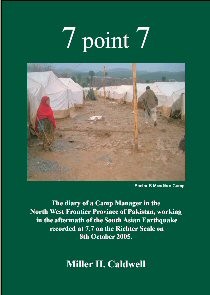
I invite you now buy the book, 7 point 7 (On the Richter Scale) Or contact me for a copy. £7.00 + P&P. mhcaldwell@btopenworld.com


 I am coming to terms with my encounter
Ted
Love Tinka
God bless,
Sandie.