The challenges of raising a child with a progressive neurodegenerative disorder, of which there is no known treatment or cure.
My last story of 2007; enjoy! :)
I look at my son, Jeremiah Peter, and I can't help but cry.
I remember to how he was when he was born seven years ago, and I look at him now; I see the progression of his disability, his disease (of which there's no known treatment or cure; he has something called leukodystrophy), and I am at once saddened, burdened with the harsh reality that he may never live to see his tenth birthday.
Jeremiah was a seemingly healthy baby at birth; however, at about the age of six months, he started shutting down--that is, he was having trouble trying to raise his head, his eyes wouldn't track properly, and he cried all the time. It was as though he had a permanent case of colic; nothing we did seemed to soothe him.
It was maddening.
That was when we decided to take our son to his pediatrician; we were convinced that something horrible was wrong with Jeremiah. Well, the doctor seemed to think so too: he suggested that we see a geneticist; he suspected that the boy had a hereditary disease--something along the line of Tay-Sachs or canavan disease, both which killed children before they reached the age of five, both also, of which, caused worsening disability and deterioation of developmental milestones.
Invariably, these children would end up totally blind, totally wheelchair bound, and dependent on tube feedings to keep them alive. Death mercifully followed not long after they became totally disabled (usually at the age of four or five).
Very few made it past that point; if they did, it was often looked upon as a miracle.
Of course, at the news, we cried. We were devastated.
Nothing crushes a parent's spirit more than to be told that their child is going to die of a disease we had never even heard of.
Well, we did as our pediatrician suggested: we saw the geneticist. We both had blood tests, and our son underwent many painful, scary procedures and tests, to see what was going on with him. It tore at our hearts to hear him wailing as he underwent the tests; yet we had to know what was wrong with our little boy. We had no choice in the matter; unfortunately, neither did he.
About a week later, the results came back. The news was not good.
He had something called Canavan disease, which is in the leukodystrophy family of dieases; like Tay-Sachs it caused worsening disability and deterioation of development until the child was rendered completely helpless, unable to walk, unable to see, unable to talk, unable to do anything for himself/herself. They would more than likely require twenty-four-hour medical care, and they would probably die before they reached the age of four or five.
There was no treatment. No cure. We would only have to watch our baby boy get worse as time went on--and then die.
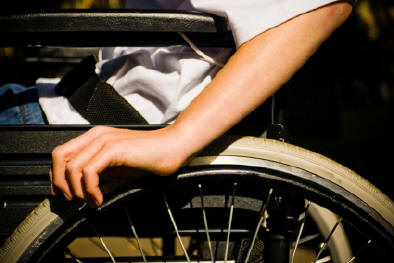
That was seven years ago. Jeremiah is now seven years old, and instead of running around, laughing, playing, enjoying life as any normal, healthy seven-year-old boy should, our son is totally without sight (he can hear), totally without speech, and cannot walk (he's in a wheelchair or in a hospital bed), and he's fed by a tube inserted into his belly.
All because of Jeremiah, our world is mainly involved with his medical care. If we aren't caring for him, skilled nurses and doctors are doing the job whenever we are tied with previous plans or caring for our other children, who also demand our full attention, our love, our guidance.
I don't know what we would do without them, especially when Jeremiah gets sick and/or has to go into the hospital. When this happens, our whole world stops; everything, our time, our energy, our minds, is focused entirely on our little boy.
We give him his nutritional suppliment every five hours, his medications every four hours (they are also given through his stomach tube), and we clap his chest, back, and sides, to keep his lungs as clear as possible, or else he'll get pneumonia. He is very susceptible to any bug that may come along; so we do this, every day, to keep him alive.
We suction his mouth, his throat every day, every night; we monitor his breathing, his temperature, his heart rate, his blood pressure. We do everything possible to ensure that he doesn't get sick; if he does, he often ends up in the hospital, fighting for his very life. We get terrified whenever he gets sick because he could very well choke--or die.
Despite his many health problems, Jeremiah is a delightful little boy. He smiles and laughs in his special, silent way, and he has a most happy disposition. The little guy loves life, he loves people, just loves being the center of attention.
Whether being held, read to, or rocked, or holding a soft teddy bear in his hands, or listening to music, Jeremiah is happiest; this way, people are paying attention to him; this way, they are acknowledging him as a person, and they are learning about accepting the severely handicapped.
This is what we try to teach people whenever we take our Jeremiah in public. Yet there are those who stare at him, make rude, inappropriate comments regarding his appearance, his inability to do things, his wheelchair, the IV pole where his suppliments hang from bags whenever he "eats". They remark about his noises, his drooling, his inability to go to the restroom on his own (he wears diapers); it's embarrassing at times.
Somehow, we try to soldier on, try to provide for our boy, make his life (or what's left of it) as comfortable, as enjoyable as possible. It's not easy raising a child with Canavan disease, but we think we are doing a good job: we must be because Jeremiah is still alive.
He is nothing but a medical miracle--and the light of our lives.
The eastern cultures have an explanation for these type of unexplained things that happen to people. Unlike Christion beliefs, that it is God's will. They believe that this terrible earthly fate is possibly a Karmic debt being repaid. To me it makes it a lot easier to understand that our earthly problems are cause and effect, not just the capricious whim of God.
When Kathy finds a small stray kitten some amazing things happen. Story's from a Mom's view of the love, caring and patience needed when a child wants to own a pet. Recipient of the prestigious Mom's Choice Award. Delightful illustrations!
You May Be Single, But You’re Not Alone.
Being a great dad is challenging enough when you’re part of a two-person team. But now you’re raising your kids single-handedly. How can you provide the emotional, physical, and spiritual support your
When Kathy finds a small stray kitten some amazing things happen. Story's from a Mom's view of the love, caring and patience needed when a child wants to own a pet. Recipient of the prestigious Mom's Choice Award. Delightful illustrations!