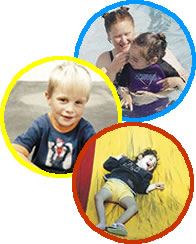
A boy with autism spectrum disorder brings his family many challenges as well as joy, as recounted by his mother.
Kip is a child of many perplexities. He doesn't look disabled; yet he has a disability that affects the way he relates to people or social situations.
Kip is sixteen; yet his social skills are like a much younger child. He babbles incessently at times about nothing in particular, or he stares off into space, staring at some invisible object that's grabbed his attention.
He walks around, holding a spoon in his hand; this is his means of "comfort". He treats the spoon as though it is a person; he calls it "Spoonie", talks to it as though he were talking to a close friend.
When stressed, he will pull out his hair in huge clumps; bald patches can be seen, and he will hide his face with his hands, rock back and forth nervously.
Seems that he's had a lot of those stressful moments lately.
Doctors really haven't given our son a definitive diagnosis; they just call it "autism spectrum disorder". It's like they're telling us he has autism, yet they haven't made a definite clue as to why he is the way he is; they just tell us to work with him, try to help him to adjust to life.
When he was a baby, Kip seemed to be a normal child. His developmental milestones were right on target; however, at the age of two, it was as though he was going backwards. He stopped talking, playing like a normal child, started sucking on a bottle, became incontinent, went back to wearing diapers. He would only eat certain foods; most other foods seemed to make him sick, caused him to vomit, which drove us all crazy.
Thank God as he got older, he lost some of his peculiarities; yet he developed new ones, such as his "friendship" with the spoon. When he has his spoon, all seems okay with his world. He also now eats graham crackers ("cack-cack" he calls them), cereal (most will do as long as it isn't oatmeal), hot dogs, and mac-and-cheese. Most other foods remain untouched.
Kip pulls at his hair, pulls it out when upset or stressed; he doesn't say but a few words, and when he's with us out in public, people look away, or they stare; worse, they move away, tell us why we don't discipline him better. Well, that's all in good, but what do you say to a child who relates to spoons better than people, a child who really doesn't understand about the world around him??
If anyone has any answers, I'm willing to listen--as long as it doesn't involve institutionalizing him. Kip is a healthy boy with a little-understood disability; he's not mentally retarded. He may act retarded; however, his IQ has tested in the gifted range, so don't tell me there's anything wrong with his mind!!
Well, Kip is screaming again; wonder what's upset him this time. I will have to go now; will write in here again soon. Take care!
There are no easy answers and He up there aren't saying nothing, love shouldn't need answers, faith no support, patience will make the child feel well.
Georg
It's sad, trying to figure out why children do the things they do. It's made even more difficult if a mental disorder is behind them. An excellent write, well done.
The familiar lament of dual-career parents raising children is, "I just can't do it all." The Libra Solution provides an alternative - a more satisfying and sustainable work and life approach - to the overwrought modern day norm.
It's almost Christmas. Lynn Basil is writing her last book about a secret entrance into the magical doll land of Sha Bebe that she loves so much. Bagannos have taken over the world! Lynn finally meets her dolls in real life. Can she write in a Secret