A true story of ghost sightings at my grandfather's house brought forth by a family conflict of greed, deception, and revenge.
A Ghostly Retribution
by
Cynthia B. Baello
The house and property where this story happened still exists in Maypajo, Caloocan City, Philippines. Because of my Christian faith, I will not attempt to give any comment on the story, but will relate it as it happened based on the testimonies of the witnesses themselves.
In the 1920's, my grandfather,Tomas Ayson, and his five daughters moved to Manila from Porac, Pampanga and sold their vast track of land there to settle down in Caloocan, not yet a city at that time, and largely undeveloped because the Philippines was then a struggling republic in Asia.
The move was initiated perhaps by the grief my grandfather had when his wife died from giving birth to their youngest daughter, Priscilla, and by the lack of opportunity for his daughters to manage their farm by themselves.
My mother was second to the youngest and from her stories, I could conclude that the tragedy affected them so much.
"There were no antibiotics at that time, and the doctor lived miles away, so your 'Lola' (grandmother} bled to death and I stayed and watched till she was no longer breathing. I was just two years old then. We moved to Manila after her death and the place your 'Lolo' [grandfather} bought was "bukid"
{wilderness}."
"We were the first to have that house built in that area where people usually lived in "nipa huts". We had our own vehicle, an Oldsmobile, {the type used in the 1920's made by Ford company}."
The house was built in old-style Spanish architecture with Capiz shells in the windows and "Kamagong" wood for its structural frame and floors. This type of wood is so ruggedly strong that nails would bend when hammered on to it.
The bathroom fixtures were of silver and the knobs on the doors made of steel which have been preserved up to this writing.
The first floor provided space for the garage/entrance and the driver's room with its own toilet and bath. The dirty kitchen was accessed from the driveway, and a long, winding staircase led to the "azotea" or receiving room with a large window were families used to sit and engage in conversations on the day's events or watch the religious processions that passed by the street in front of the house.
"It was peace time," my aunt relates, "and there were many Americans
living in the Philippines because we were a commonwealth of America."
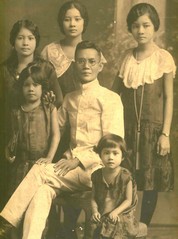
My grandfather's daughters, my aunts, were Carmen, the eldest, who resembles Greta Garbo, Espinela, who married a very rich sugar plantation owner from Bacolod, Restituta, who is now 92 years old, Emiliana, my mother, who is in Australia and is now 88, and the youngest Priscilla.
Only my mother and my aunt Restituta are still living as I write this story.
Because my grandfather was asthmatic, he could not work and earned a little making hand-sewn "barong tagalog", a shirt worn for weddings and formal occasions. Eventually, their finances from the sale of the property in Pampanga was soon depleted. Later on, my aunts, the three eldest {now beautiful young ladies} had to find work, unfortunately the only work available and which was socially "taboo" at their time was: dancing partners for rich gentlemen.
"We had to resort to that kind of work because your 'Lolo' was too sick to work. There your Tia {aunt}Nellie met a very wealthy gentleman from the Visayas. He was a banker who owned an "hacienda" {plantation} in Bacolod, and he fell so madly in love with your Tia Nellie that he proposed marriage right away after discovering he was the first man to hold her hand."
He was from a family of landowners and belonged to the upper class of the ritzy rich and their property in the Visayas covered almost half of the province. He courted my aunt with much sincerity and did not buckle in fear when he met 'Lolo' to offer his marriage proposal.
The eldest, Carmen, or Tia Mameng, married a man my Lolo did not approve of and that somehow caused a rift between them. They had eight children and later settled in Pasay, only to return to my grandfather's house when the war broke out in 1941.
Restituta, the third daughter, met a handsome and very wealthy Spanish landowner from Batangas, an Yrezabal, and they had a son, Anthony, and a daughter, Bing, who died of pneumonia at the age of three. "Don" Yrezabal was so rich, my aunt Resting said that "he would fly his private plane and shower our house with red roses when he was courting me". But the tragedy of the matter was, he was a married man and she ended up as his mistress.
Even so, he bought her a big house and many properties in Caloocan that she lived in luxury and pampered herself with expensive cologne baths every now and then. She had several maids and their own gardener and driver at her beck and call.
The sudden surge of her social status, however, eroded her character and she became haughty, disdainful, and materialistic. This was manifested even to her father and to her sisters, particularly my mother who suffered much from her verbal and physical abuse.
"You are the only one who cut my head off!" Lolo used to say with disgust over this relationship. Thus a wedge was drawn between my aunt, Resting, and my grandfather- a bitterness that lasted until after his death.
And now, my mother. Emiliana, who was fourth, was only eighteen, when my father Vicente met her in high school. It was 1939, and because my Dad was a Scout Ranger working as part-time junior reporter, he had access to military reports that war was imminent.
As scouts used to say "always prepared", my Dad eloped with my Mom just before the Pearl Harbor attack of 1941. My eldest sister Florianne was born in 1944 before "the Liberation" of Manila.
Then the inevitable war broke out, Carmen's husband eventually died of stomach ulcer while the Japanese burned Pasay and nearby Dapitan. Nellie and her husband stayed safely in their mansion in Bacolod, while Resting's partner, Don Jose Yrezabal, was shot and killed by Japanese soldiers who mistook him for an American because of his fair skin.
My father joined the resistance and later the "death march" in Capas, Luzon, and he was able to escape when he fell into a ditch due to extreme exhaustion. He was suffering from malaria and crawled his way into a canal where farmers later found him barely alive.
The rest of my grandfather's brood found their safety in the house at Maypajo. 'Lolo' had a basement made under the garage, where they hid when sirens signaled the Japanese bombs were about to be dropped. The house walls itself showed holes where shrapnels and bullets went through.
The walls of that house had two pannels of wood, and there was chalk in between, so that the walls were sound proof, and these provided enough protection from the bullets and bombs fired by the Japanese.
War brings out the worst in humankind, and my mother relates how she would peep through the tiny ground holes to see men and women being killed with bayonets and their bodies burned. Her shock never really left her and she suffered from nervousness which lasted for years.
After the war, my grandfather's house was badly damaged and needed immediate repairs. Because of the war, people struggled financially and 'Lolo' was at the lowest point of his life, money-wise.
My Tia Nellie in Bacolod learned of their predicament and promptly came to the rescue, with strings attached. Her husband, being the able banker that he is, offered to finance the repair provided he gets hold of the property Title "for safekeeping".
"Because she is the favorite of your Lolo, she gets her way all the time," my aunt Resting said.
"Your Lolo trusted him because he could manage money wisely," my Mom also
recalls.
So the house was repaired and improvements were also made to the delight of my grandfather and everyone was satisfied. Three families settled in the house because there were individual rooms and areas large enough for the whole clan.
Years passed and my grandfather's
health continued to deteriorate until he became very ill. He kept trying to get in touch with Nellie but she was either
traveling in Europe or was in Bacolod all the time. If ever she was in Manila, it would be for a short visit.
Too short in fact, she rarely dropped by the house to look into Lolo's health.
When my grandfather was younger he walked with a cane which had an ivory handle and he wore a white suit matched with two-tone leather shoes that distinguished him as middle class. He walked with regal bearing and rarely engaged in senseless chatter.
Now, in his old age, he bore the brunt of my Tia Resting's verbal tirade,
since she and Tony were the only ones left to stay with him in the old house.
Once, when my mother and I came to visit, I witnessed the maltreatment my Lolo suffered from my aunt. He asked for rice porridge and when my Tia Resting served it she threw the plate of rice porridge on the table and with utter disrespect remarked, "There's your rice porridge, you good-for-nothing old man!"
My Lolo stood up and took me by the hand (I was just a toddler then, around four years old) and we went to a nearby canteen where he treated me to snack of rice porridge. I took a spoonful of the warm delicacy but when I turned to look at my grandfather, I saw the tears in his eyes.
"Please tell Nellie to come, I want to talk to her," was his last request to my mother Emilie.
I was five years old then, I was sitting at the top of the stairs, when my aunts frantically yelled at my Mom to get a taxi quick. Then I saw them help my Lolo down the stairs, he could barely make a step and they literally carried him to the taxi.
"He started to cover his ears in the taxi as if he did not want to hear someone whispering into his ears. Then he slumped down and the driver said he was dead." My Mom was the last person to be with him.
At the funeral, Tia Nellie came.
My Tia Mameng screamed at her, "Pinatay mo si Tatay!" (You killed father!) Her words were full of grief and anger at her sister's indifference to the old man's illness. I wondered too what a dead man will do with the big floral bouquets she brought at his gravesite.
After my grandfather died, my Dad bought our own house in another city and only Tia Resting and her son Tony remained in the old house. Her wealth was gone because of the war and she had to sew dresses for the neighbors to support herself and her son.
Once while they went to church, a friend of my aunt went to see her and kept calling her name from the street below.
"I came to see you, but an old man came to the window and said you were in church," the lady told my aunt.
"What old man, my son and I are the only residents of this house, there's no one else here." My Tia Resting declared but at that moment, the hair at the back
of her neck started to rise.
Years later, when my brother got married, he had a hard time finding an affordable place to rent. My aunt offered to rent a portion of the house to him and he agreed.
My brother and his wife both went to work during the day and they left their one-year old son to a relative who acted as baby-sitter.
One afternoon, while the baby-sitter was putting the child to sleep in a hammock, he saw the baby looking at "someone" and was smiling.
He turned to look at the stairs and to his amazement he saw an old man in white
descending down the stairs and looking back at him. The shock of his life came when he saw that the old man had no legs!
When he told us about it, we took it as just a pigment of his over-active imagination but he described the figure he saw to the last detail.
My brother took the family portrait of Lolo and his daughters and asked him
"Is this the old man you saw?" He answered yes.
The next day the baby-sitter left.
The Title to the house was never again seen by my aunt but years later, a bank in Bacolod sent them a letter of Notice of Foreclosure. The house and the lot had been mortgaged to a bank in Bacolod by my cousin, and the Title was transferred to her name. The amount due was four million pesos.
Because my aunt Resting and cousin Tony could not redeem the property from the bank, the property was put up for sale. My Mom had long given up her rights to the house when she migrated to Australia and became a citizen there.
In 2004, my aunt Resting and her son were evicted from my Lolo's house and the buyer of the property was their neighbor, who bought it out of spite and revenge on my aunt who used to downgrade
him when his brother rented a room there.
The buyer had the house renovated and modernized, and much of its appearance has been sadly changed.
The place had been turned into a commercial building with spaces for rent.
The last time I came to visit him, he told me that tenants would rent the place but they rarely lasted a month
and would soon leave. Nobody stayed very long because they said "someone else seemed to be in the house".
My cousin who mortgaged the house later died of cancer in 2006, and no matter what legal actions my aunt intends to take against her will only be an exercise in futility since at 92, she will not even last through the court proceedings.
My Lolo's house was where I grew up and it holds a lot of memories. During the times when I stayed there to visit,
I never "saw" or encountered anything unusual.
The mystery remains to this day and many still experience the presence in that house, and although no harm has been done, the unsettled issues still haunts the last remaining heir, Tia Resting.
My grandfather vowed she will never have the house and the property, and neither will the other parties who by crafty legalities tried to take it from him.
This is a true story.
Copyright,2008 - Cynthia B. Baello
Note: Restituta Ayson Yrezabal passed away last Novemeber 1, 2009 while my mother Emiliana Ayson Buhain passed away last September 18, 2010. As of this writing there are no more ghostly manisfestations in the old house.
My cousin Hedy Hernandez Montilla, daughter of Carmen Ayson Hernandez, wanted me to change the story and remove the part about my aunts' work as "dance partners" (escort ladies) of rich gentlemen. I refused to change it as this it what happened and the truth is material to the story. I mentioned this to show how and why that house was eventually built and not to put my aunts characters into a bad light. In the 1920's that work was not what it is today.
We all make mistakes in life, none of us are pure and spotless - but to learn from these life lessons is more important than creating false impressions.
I sat down an did the word count on this one as my grandfather who is a 1st generation born in the United States from Italian Family; this me thinking about this part of the word.
I did a word count on this and surprised you're not published with this -- would it be okay for me to publish this as I have published a few writers from AuthorsDen.com over the years. Matt if you're reading this I am often the goto when writers on the Den want to be in an anthology or two.
I had been published for a true ghost story myself. Christians don't like to openly talk about ghosts but I had done so since writing fictional ghost stories in real haunted places. Shoot me a message when you see this because is too good not to publish.
A long time ago I spent four wonderful days in Manila. I was only able to take one side trip to Pagsanjan Falls, but enjoyed it immensely.
Your story is so immense (like a great historic novel) that perhaps it should be turned into a book. It is so sad to see how war affects us all and turns some of us into people we should not be. I was expecting one of those hokey ghost stories, but I find your honesty in this story very believable.
Thanks for sharing your heritage with us.
Ron
Reviewed by randy smith
4/28/2009
A very good story Cynthia.I could see your familys history unfold. As it went from event to event. Nice. GOD bless. Randy
Cynthia, so now I have read "a Ghostly Retribution". I truly enjoyed a little of the history of the Philippines, along with the family photo.
You wrote the story very well, and it was easy to follow through the years. The central theme of the old house and your Lolo, Mother, and Aunties was captivating to read. I really enjoyed it and I hope you find time to write more about your family and your life in the Philippines. Thanks for sharing
David
Reviewed by Sophia Ann Montoya
8/6/2008
Interesting story. My ex-husband was born in Manila & raised in a catholic school. He was born in 1951. FYI: There is a great memoirs class at UCLA on-line that will help you make this story read like a powerful novel. This paragraph shows off a voice and style that is absolutely wonderful. If you ever rewrite this let the story unfold via dialog and action such as this:
"We had to resort to that kind of work because your 'Lolo' was too sick to work. There your Tia {aunt}Nellie met a very wealthy gentleman from the Visayas. He was a banker who owned an "hacienda" {plantation} in Bacolod, and he fell so madly in love with your Tia Nellie that he proposed marriage right away after discovering he was the first man to hold her hand."
Well Done and definitely worthy of expanding into a memoir.
Following several murders, means, motive, and opportunity all point to out-of-work actresses Bootsie Kittredge and Babs Harrison. Their claims of righteousness and lack of guilt seem fabricated, thanks to a cheerfull announcement made to the patrons
Book three in series. Excitement and tension begin on the first day of filming a Restoration drama on location at the historic Jacobean mansion, Ham House in Surrey.


 A Ghostly Retribution