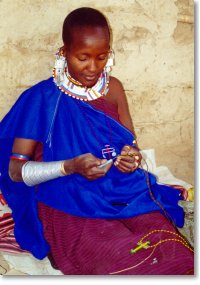
I was born in Thika, a little village in Kenya, Africa,that is northeast of Nairobi, but I came to America because I wanted to get an education and become a teacher to small children.
I remember when I first stepped from the plane: the sights, sounds, and smells were nothing like what I had experienced back in my little village. For one thing, the DIVERSITY of people: the way they talked or dressed. Or even looked. Also, there were so many sounds and smells. It was all SO confusing...
But I knew I had to come to America to better my lot in life. Back in Kenya I raised cattle for a living, and I was getting over an ugly arranged marriage--let alone, the death of my husband, Lengoni, who had been killed by a marauding lion. It was just as well: Lengoni treated me very badly. Also, there were no educational opportunities for women, especially me, seeing Father was so dead-set against it.
I was also angry at Father. He wanted me to remain in Kenya, wanted me to retain my Maasai ways. I wanted to become a teacher. Father called me a fool; he said the water people [white people] were too much of a influence on me and my thinking. I got mad and left in a huff. I wasn't ABOUT to listen to a skinny old man who thought he knew everything: I, M'buti Moore, was in control of my destiny!
Now here I am--in America.
That was almost four and a half years ago.
My life hasn't really gotten much better; I sometimes wonder if I have made a terrible mistake. For one thing, my health's suffered. Terribly. I have been in and out of hospital and must use sticks (crutches) or a wheel chair because I had been burned and now carry terrible scars. I also got sick with flesh-eating disease and lost an incredible amount of weight. I am painfully skinny: I look like I have ukimwi [AIDS] and am so weak a lot of the time.
But in a way my life HAS gotten better. I am now married (it is soon to be 3 years come September) to a WONDERFUL man named Roberto Sormiento, and we now have a BEAUTIFUL little boy named Jubaki. Jubaki looks just like me. He also has his daddy's smile and dimples. He is the sweetest little child!!
But in my heart I carry much sadness. Besides my poor health, I also carry the memory of my parents. Father and Mother [their names were Mbaki and N'gaire Moore] were killed by gunfire. They were at the bank, getting money to go back to Africa, and kids with guns started shooting and they killed my parents. I can't talk about it now without crying: my eyes are wet now just thinking of this...they never got to see their grandchild be born, never got to hold him, never got a chance to love him...
But I know in my heart I MUST remember my Maasai ways. I can't raise cattle in the city, but I still dress like the Maasai, and I still eat traditional Maasai and East African dishes. I also continue to speak Maa [Maasai language] and Swahili in addition to English. I still believe in Engai, but I don't talk of Engai much because here in America people believe in Jesus, so I must try to believe like the Americans and believe in this Jesus. It's hard, though...
Someday I hope to return to Kenya, and I hope to take little Jubaki there. I want him to know he is half Maasai, and I want him to learn of my Maasai ways. That way, he'll have the best of BOTH worlds.
This is very powerful. Thank you for sharing this! I hope that you can one day feel less sadness about the past. There has been a lot of pain in your life and you will always carry some of it with you but your life can be happy. You have a wonderful husband and child and so many people in the US want that so badly but don't know how. You are very fortunate in many ways.
Exploring the impact of literary icon Flannery O'Connor's noted legacy on the cultural realities of modern-day America, the world, and a certain author.
Yankee Doodle Daddy is a historical Appalachian Family Saga. The story follows a mother's reckoning as she struggles to survive and keep her four daughters alive.