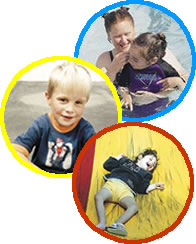
Up until now, it's been my wife, Teresa, writing about our family, in particular, our now nine year old daughter, Nashi Danielle, who is severely physically and mentally handicapped. She's written of the daily struggles we face in raising a child who can't do anything for herself, and the frustrations (and joys) we feel in caring for her.
Now it's my turn. The father's perspective, as it were.
When she was born, Nashi seemed perfect: rosy-pink, crying her lungs out, sporting ten fingers and toes. She absolutely glowed with health. She was absolutely beautiful. When I first saw Nashi emerge into the world, I cried with happiness!
From the start, she seemed to be a happy, easy baby; however, we noticed that as she grew older in her infancy, she seemed "floppy": she had difficulty holding her head up, and she didn't seem to be following us with her eyes whenever we moved around the room. We dismissed it as nothing serious; we didn't think too much about it at first. Maybe she would develop better head control, eye movement later on, we surmised.
We remained hopeful that all would turn out okay for Nashi.
At about the age of six months, Nashi didn't seem to show any improvement. Concerned, we took her to our pediatrician, who assured us that it was really nothing serious. We went home, relieved. We were certain that Nashi would be okay, that she would learn to hold her head up or track us with her eyes--but she never did.
She remained as floppy as ever. It bothered us, so we took her to another doctor.
This doctor suggested we see a specialist (a neurologist) because he suspected something neurological was amiss. We did just that; what we learned alarmed us, shook us to the core of our being.
It turned out that after extensive tests (CT scans, MRIs, blood tests, etc.) that Nashi had the beginning signs of a little-known neurodegenerative disorder called Canavan disease. It was prevelent in some Jewish families; it was similar to Tay-Sachs; the baby started out healthy, but by the time the baby reached a year old, there would be physical and mental deterioation, rendering the baby helpless; death would follow by the ages of four or five years old.
There was no cure or viable treatment for children with Canavan disease or diseases like it.
As you can imagine, our world as we knew it was shattered. Our daughter, our firstborn, was going to die; doctors didn't think she would live to see her fourth birthday--fifth if she was extremely lucky. At the news we cried. Oh, how we cried!
That was nine years ago.
By the grace of God, Nashi is still here. She's with us. She's now nine, has lived four years longer than what doctors first predicted; each day she continues to surprise her doctors with her courage, her will to live.
Nashi has since turned into a beautiful young lady with long, flowing locks of dark brown, huge, luminous dark brown eyes that sparkle with life, and a sweet, laid-back personality. She is absolutely gorgeous!
She looks just like her mother in miniature.
Nashi, however, is severely handicapped. You can see that when you see her for the first time. She can't sit up without help, is blind and nonverbal (she can make noises; her noises are happy or sad, depending on how she's feeling), is unable to feed herself (she's tube fed by a special tube in her stomach), and can't go to the restroom (she is not toilet-trained).
She is severely and profoundly mentally disabled and cannot walk. She spends her days lying in her hospital bed, where Terri, I, or skilled nurses help care for her many needs on a daily basis, or, when up, sitting in her wheelchair.
Three times a week she has ongoing physical therapy, to keep her strong, to keep her muscles from deterioating any further. We try to include her in all activities, and we do things together as a family. We do not want to hide our daughter; she's as much a part of our family as is our other child, seven-year-old Hyman, who is healthy.
Even though he's younger, Hyman is more like the older child because he can do more things than his sister; he's had to grow up faster than most little boys his age, and it's been very hard on him. Lately, though, he's been showing better acceptance of his sister's situation, and he's been good at helping care for her. We are very proud of our little son; he's becoming quite the little man about town!
We do not know how long we will continue to have our daughter. Every day she lives, breathes is a gift from God. We cherish her, enjoy every moment we have with her, even the bad times are easier, as we've learned to lean on God during the difficult seaseons (her frequent illnesses or hospitalizations).
Our faith in God has helped tremendously, and it's shown us that we can get through anything that life throws at us (or at Nashi).
We plan on making what is left of her life meaningful, special for not only Nashi, but for all of us. We benefit greatly in having a child like our daughter; she's taught us so much about courage, perseverence, and, perhaps most of all, love and acceptance.
Well, I am going to go now; I just wanted to let you know the blessings we've received in caring for our special daughter, and how honored I am to be her father.
Nashi has been an incredible force in my life, and I wish nothing but good things for her. Even if she doesn't live to graduate from school or grow to be an adult, the impact she's already made on our lives will last a lifetime, no, a thousand lifetimes. She is truly a living little miracle child!
~Written by Tovah Abrahiam Ben Ami, father to Nashi Danielle (and also Hyman). :)