We were heading back to the firestation when we passed an accident. Something told me we needed to go back and help out as best as we could.
It was a bad one. Two cars. A body lay on the street; it was covered by a blood-stained sheet. No doubt that the person underneath was already dead. Both cars were mangled up beyond recognition; it was a miracle anyone survived the carnage.
Whereupon, I turned our rig back and headed back to the scene. That was when I saw a thin, pale arm dangling out of the shattered window of what was once a purple PT cruiser. The person in the mangled purple car needed help.
Stepping out of the ambulance, I walked over to the car. The person in the car, a young female of no more than eighteen at the most, was sitting up in her seat. She was unconscious. Blue. Seemingly lifeless. It didn't appear that she was breathing.
I took the woman's limp hand in mine, felt for a pulse. Nothing. She was asystole. She needed help immediately to stave off brain damage. She needed immediate attention if she was to have any chance of survival.
I barked at my partners, Wendall (Gilmarten) and "Goose" (Gorge Guzman) to grab a long spine board and our life-restoring equipment: defibrillator, EKG monitor, oxygen, airways, IV equipment, other various tubing. This woman needed help, and the sooner she got it, the better it would be for her.
And for us.
We carefully got the woman out of the vehicle, gently laid her on the spine board, tied her down, so she wouldn't move in case she regained consciousness. We attempted several tries in getting an IV line established; her veins kept collapsing. I found a nice, thick pipe on the side of her neck; I immediately placed the needle there, and got the IV going. Good. One thing down.
I placed a mask over her face, started squeezing the rubber bag attached to it every few seconds to help her get air to her lungs, brain. The woman was in dire straits; she was still in danger of dying on us.
As I helped her, I remember praying for this woman, asking God to spare her life, let her live another day.
That's when I heard Wendell say: "She's not breathing!! Start CPR!!"
Suddenly, the situation took on a whole new sense of urgency. Time was of the essence.
I immediately started pressing on the woman's now exposed chest, pressing rapidly, in order to get oxygen to her brain, blood to her still lungs, heart. Nothing. She remained still, limp. It was very discouraging.
After what seemed like an eternity, George took over the chest compressions while I now manned the breathing tube, squeezing it every few seconds.
The advance life support team was now on its way to the scene; the woman needed more help beyond what we could give her. Yet we carried on.
If she survived this thing, it would be a bona fide miracle, I kept thinking over and over to myself. Never did I feel as discouraged as I did during this time.
I honestly didn't think that the woman, a young 18-year-old Hispanic female, didn't have a chance. She was as good as dead already, the way things were looking now.
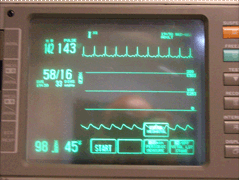
Twice, George shocked the woman, trying to get her heart back. Nothing. The line on the monitor screen remained flat, devoid of any activity.
We continued to work on her, even as the sirens started wailing in the background, as the advanced life support team rushed towards the scene.
The advance life-support team soon jumped onto the woman, continued to try to revive her, while George, Wendell, and I gave them the latest information on the condition of the woman.
They had her going within moments. What we couldn't do, they did, effectively and swiftly. Soon, the woman opened her eyes and gasped as she started coughing, breathing again.
The woman, it turned out, had asthma. We saw the inhaler sticking out of her jeans pocket.
Apparently, she suffered an asthma attack right before the accident, lost control of her car, wrecked it into a cement divider after hitting another car. The person in the other car was killed instantly. The accident tied traffic up for hours until the mess could be taken care of and the dead body moved out of the way. It was very depressing; I still have nightmares now as a result.
Miracle of miracles, the woman survived. No brain damage. No disability. No lasting effects. Nothing. After a short stay in the hospital, she recovered, returned to civilian life.
The woman was eventually charged with failure to control her vehicle, as well as vehicular manslaughter. She now is in jail for upwards to a year, on probation for two to three.
I will never forget the sight of that sheet-draped dead body on the side of the road, or that thin, childlike arm hanging out of the window of the car, the sheer helplessness I felt as I surveyed the scene before me. It was one of the worst cases I'd faced as a EMT, but if I can make a difference in saving a life in danger, then I'd do it all over again, in a heartbeat. After all, that is my number one priority in my field of choice: saving lives when it's needed the most.
~Written by Patricia Eileen Moss, EMT, on Sunday, December 28, 2008.