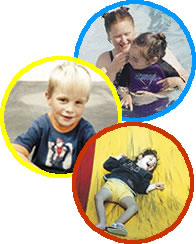
My son, Caleb Trevor, has Batten's disease. He is six years old, and in his short life has had to endure much suffering and/or pain; it breaks my heart each and every time, especially when he gets sick.
Batten's disease is rare: it occurs in only 2 to 4 of every 100,000 births in the United States. It occurs only when a child inherits two copies (1 gene) from each parent; when both parents have the defective gene, there's a 1 in 4 shot that they will have a child with Batten's disease.
To give you a clearer explanation of what it is, it is an autosomal recessive disorder. It is also known as Spielmeyer-Vogt-Sjorgen-Batten Disease; there are four forms of it:
*Infantile (begins between the ages of 8 months and two years),
*Late Infantile (begins usually between the ages of 2 and four years),
*Juvenile (Batten; this is what my son has; it usually begins between the ages of 5 and eight years),
*Adult (usually begins before age 40).
Over time children (or adults) suffer worsening seizures, progressive motor impairment, and loss of vision. Unfortunately, it is always fatal; there is not, at the current time, any form of treatment or prevention of the progression of the disease.
Batten's disease (or any of its other cousins) is suspected when the infant/child/adult develops sudden, unexplained vision loss or loss of motor or developmental skills. It can be diagnosed by either of several methods:
~Eye exam/electrical studies of the eye,
~skin/tissue samples,
~EEG (electroencephalogram),
~CT-scans or MRI scans of the brain, or
~Enzyme essay.
It occurs when there are buildups of substinances called lipopigments in the body's tissues, especially in the tissues of the eyes, brain, or CNS. It causes, in time, death of neurons in these areas.
It was first discoverd in 1903 by a British pediatrician who first described its symptoms in 1903. It is the most common form of a group of disorders known as neural ceroid lipofuscinoses (NCLs).
In any event, back to my story. Caleb is six, as I just said, but he's now unable to walk, see, or talk. He requires twenty four hour care; he has to be fed by a tube in his nose or in his belly; he's recently lost the ability to swallow or chew food on his own; if he were to try it on his own, there would be the danger of him choking, thus, sending him to the hospital with pneumonia or another reacurring respiratory illness. He is usually in his bed, but when up, he sits in a wheelchair.
Caleb is a beautiful little boy with red hair and brown eyes; he is my pride, my joy, my world. He is the darling of his older sisters, Corinthe (eight) and Celeste (twelve), both, of which, do not have Batten's disease: they are perfectly healthy.
Now, I don't know why Caleb got Batten's and his sisters didn't; it's just the way it happened, and it is hard to deal with sometimes, especially when we can remember how he used to be verses the way he is now. It is a horrible disease, and I wouldn't want to wish it on anybody!
Caleb, even with all of his disabilities, is like any other little boy: he loves to laugh, "dance", be read to, be held in our arms, listen to music, go to school (he goes to a school for children with severe disabilities), and play with his dog; his dog, "Cuddles", is his bestest buddy.
Well, I will go now. It's time for me to pick up Caleb from school; he has a doctor's appointment at two. Hopefully he will have a good report from the doctor. I will write in here again soon; I feel that our story is not over, not by a long shot! Take care, and may God bless you!
~Sincerely, Mary Elaine Maxwell, Caleb's mommy.