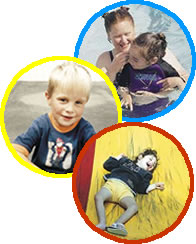
I look at the pictures of my son, Andrew Charles, and I can't help but get a little misty-eyed, even though it's been a few years since he passed away.
My son was only four years old. He died of Tay-Sach's disease, a neurological condition causing increasing disability. Typically, children with TS don't live past their fourth birthday; by the time they are two or three, they are totally incapacitated, blind, unable to do anything for themselves. They lose their hearing, speech, sight, cognative skills, physical milestones, until they are left more like the babies they once were prior to being diagnosed.
It is a horrific, cruel disease. It is one of the worst things that can ever happen to a parent. A nightmare you never wake up from.
Once you get over the initial shock, you then find yourself doing everything humanly possible to ensure that your child stay alive as long as possible. You grieve, but eventually, slowly, but surely, you move on as best as you can.
This is what we did with Andrew.
Andrew was, at first, a typical baby: he laughed, cooed, learned to smile, recognize my voice and face, learned to recognize family members, crawl, cruise, then walk. He was a very cute little guy with curly black hair, dark brown, almost black, eyes, and a megawatt, dimpled smile that could light up any room. He was beautiful.
Then, around six months, he started showing subtile signs that something was wrong. It scared us silly, so we took him to our pediatrician, who then sent him to a specialist; he suspected something was going on, so he wanted the child to have more tests.
It was hard to subject him to so many proddings and pokings; it tore our hearts apart to hear him screaming as he got stuck with yet another needle, or had strange hands holding him down as they did their tests. I can't tell you how many tears we cried during this time!
Once the test results came back, the geneticist called us. He wanted to talk to us about what he found out. From the serious tone in his voice, we knew it couldn't be good. We steeled ourselves for whatever lay ahead in regards to Andrew.
We went to see him; it was there where he told us that Andrew had Tay Sachs. I or my husband never heard of it. He said it mainly affected babies who were of Jewish extraction; another form affected those who were of Acadian French (Cajun) background.
My husband was Cajun French. Somehow, unbeknownst to me, he had the defective gene that was handed down to our son.
At the news we cried. We found out that it led to increasing disability and ultimately death by the age of four years.
Our beautiful, laughing, sparkly-eyed, chubby-cheeked baby boy was to eventually become helpless, unable to do anything for himself. The realization of this hit us hard, like a sledgehammer; it nearly destroyed us.
Sure enough, by the time he was two, Andrew started losing one skill after another. He became blind. Stopped babbling/cooing. Stopped being able to hear. Feed himself. He became increasingly disabled; we were soon to become his full time caretakers.
We tried to do all we could for him. Feed him through his feeding tubes. Relieve any breathing problems with oxygen and medications. Squirted liquid meds through his feeding tube every four hours, day and night. Changed his diapers wheenver he'd messed in them. Bathed him. Combed his thick hair. It was hard because we had no other friends who could help us.
We were on our own.
Finally, on Christmas Day of 2007, Andrew peacefully died in his sleep. He was only four years old. He would have been five in April had he lived long enough.
Miss him still? You bet. We miss Andrew every day; holidays and April, his birthday month, are the worst. There isn't a day where we don't think of him; we wonder what he's doing up in Heaven; we know He's there, with Jesus and the angels. We wonder if he even thinks of us as he enjoys renewed health, healed of Tay Sach's.
We still cry, grieve at what we had, what we lost. Does it ever get any easier??