During my sophomore year at the University of Michigan, I approached the Martha Cook Building, an imposing Gothic structure in the same style as the nearby Law School. Like most buildings constructed near the beginning of the 20th century, there was a statue in a niche over the door. There seemed to be something different about that statue. It was thinner and taller than the usual mythological representation of an Athena or Minerva, but I was not really paying attention that crisp Michigan morning.
I hesitated in front of the heavy, oaken door and wondered if this was a residence hall to which I could ever be admitted. I reviewed the reasons for the upcoming interview: increasing noise and disorder in my current residence hall, a much more difficult course load than I had anticipated, and a roommate with whom compatibility was a challenge.
Unlike many of my fellow students, I did a great deal of my studying and out-of-class work in my room both in the afternoons and evenings. When I was a freshman, the Mary Markley residence hall was reasonably quiet in the afternoon and tolerable in the evenings. At the start of my second year at the University, the building seemed to be a cacophony of sound from morning until Quiet Hours started in the evening.
On a suggestion from my future sister-in-law, I called Mrs. Quail, the Director of the Martha Cook Building, an all women’s residence hall in the heart of campus with exacting academic entrance requirements and a reputation for excellence. However, I had also heard that Cookies, the colloquial name for the residents of the building, were required to have a solid social standing as an additional entrance requirement – and I came from a distinctly blue-collar background. On that autumn day, I held out little hope that I would pass the interview and be given an application.
To meet Mrs. Quail was like meeting the heart and soul of the Martha Cook Building. She was a stately, austere matron, impeccably coiffed and dressed. She radiated her passion to the care and development of the young women in her care. I felt distinctly shabby, even in my Sunday best. She quickly put me at ease and asked me why I wanted to live in the Martha Cook Building. I remember little of my answers to her questions and walked out with an application for fall 1969 in my hand. Mrs. Quail suggested that I complete it immediately although she held out little hope for space opening up sooner.
I completed the application, got the letters of reference, and prepared my parents for the increase in housing costs if I were accepted. That task faded into memory as I attended classes, wrote papers, and completed quizzes. I went home for Thanksgiving for a much needed break before final exams.
On a wintry December afternoon I was not prepared for the call which started with the single word, Pamela. Only my mother ever called me by my full first name and then it usually wasn’t good news.
“Pamela, are you still interested in living at Martha Cook?” began Mrs. Quail.
“Yes, of course.” I replied.
“If you can arrange it,” Mrs. Quail continued, “you may move in at the beginning of January.” I quickly agreed and collected all the particulars on cost, deposit, and so on. And, yes, I could pack and store my things in the luggage room with my new room number marked on the boxes and suitcases. With profuse thanks, I began my Cookie journey.
As I began living in the building I found out that it was Portia who greeted me that first day from her narrow niche. While Portia may have been installed “o’er the door” because the niche would not accommodate a more robust classical female figure like the expected full-figured Greek goddess, it is appropriate that Shakespeare’s professional woman watches over all the professional women that have called, now call and will call Martha Cook home.




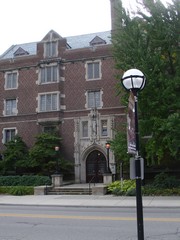 College Living at its best