We humans tend to misjudge our furry (or feathered) friends: they're a lot smarter than we make them out to be.
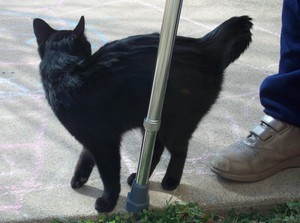
For example, take my Maine Coon/Norwegian Forest cat mix, "Heidleberg" (called "Berg" or "Bergie" for short): roughly a half hour to forty five minutes before my wife comes home from work (or church), "Bergie" will immediately walk around the house, going to every window or to the door, meowing his fool head off, or looking at the clock. Then, when Helen comes home, Bergie is right there, winding his fat, furry little body around her legs, chattering loudly, as he "tells" her about his day. All of this elicits a lot of extra ear rubs and cuddles from Helen as he purrs his way into her (and my) heart.
Or take the example of pet intelligence: my next-door neighbor's mutt "Herbie" can tell whenever his master is sick or not feeling well. He was recently diagnosed with prostrate cancer, and it is all because of how Herbie acted. Herbie started sniffing his master's crotch area, whining piteously, as he did. Much to his annoyance, Herbie wouldn't give my neighbor a moment's peace. His wife noticed the dog's unusual behavior, and she noted that he wasn't like himself: he was more reserved, more to himself. This wasn't like him, she thought to herself. She suggested that her husband see the doctor, to make sure that it wasn't anything out of the ordinary.
Well, Elmo went to the doctor, w ho then suggested tests. The diagnosis: prostrate cancer. The outcome: successful removal of the offending cancer and a brief hospital stay (and subsequent recovery). Several rounds of chemotherapy and/or drugs would take care of it. (The cancer was in the earliest stages, and it was all due to Herbie's odd behavior. He would be credited with saving his master's life.)
Pets seem to know our moods better than we humans ever could. When we are happy, then they are, too. When w are sad, they snuggle up next to us and try to comfort ou worried/troubled hearts/moods better than any licensed therapist ever could. They don't ask for much: all pets want out of life are to be loved, given clean water/fresh food up to five times a day, quality time with their master (or mistress), excercise and/or time for play, and good health care so they are looking and/or feeling their best.
As a rule, animals aren't afraid to show (or tell) how they are feeling while we humans tend to mask our deepest, innermost feelings. Once you learn what to look for in your pet, in terms of visual cues, knowing what your pet is feeling (and why) should be a snap.
I know I have certainly learned a lot from watching Bergie, and I have gotten rid of a lot of second guessing my animal's moods. My cat is a great communicator; even though he doesn't speak English, he still can give me clues on his moods by the way he looks at me, holds his tail, or "talks". He certainly isn't any chump: he is everything all rolled up into one small, neat, furry package: teacher, clergyman, healer, therapist, clown, disciplinarian, politician, interior designer/home decorator, construction worker, gourmet cook, and so much more. He is everything I (or Helen) could have ever asked for in a cat.
Bergie is the "purr"fect pet, and we, as his "humans", are very blessed to have him in our lives! I can't imagine people living without a pet because Bergie has certainly brought so much joy into our lives!