Can Du IMMORTAL MEMORY
3rd February 2013.
Mr President, distinguished guests and wonderful friends,
My wife and I were in Ryickholt Castle, in Maastricht, in the Netherlands last Saturday. A rather fine affair to see the Maastricht Burns Society in full Scottish regalia in what was their 4th Immortal Memory; the club having been established in 2010.
Robert Burns described the good folk of the Netherlands as the ‘Cloudy Dutch.’ So dining at their Maastricht table, in the very heart of Europe, which would be the last place to see David Cameron on holiday, I had to show I came with no malice but in brotherly love and I thought they’d loved to hear this story!
A couple of years ago we were producing some homemade jam. We had boiled up the fruit and added the sugar, when a terrible thing happened. Our pet hamster, which we allowed out of its cage, from time to time, ran across the work surface and dived headlong into the boiling mixture. Well as you can imagine, we were doubly upset not only was the hamster killed, but the jam was also ruined. After it had cooled we scattered it over the garden as a sort of memorial to our deceased pet. Early the next year, the spring flowers started to appear in our garden, crocuses and daffodils as usual, but this year the tulips were the best ever – bigger and more vibrant and colourful. It just goes to show that you get the best tulips, from Hamster Jam.
The Maastricht Burns Society was delighted to hear that I would be attending a Burns Supper in Ellisland, a place where many of their club have already visited.
But I’m not here to talk about the Netherlands or indeed this newest of new European Burns Clubs, but I will just say one thing more.
100 years after the death of Robert Burns, an artist began to draw. He used dull paints to capture the work-a-day life of the village folk characters in the Netherlands. In his later years he would draw a vase of sunflowers and his bedroom in southern France at Arles when he was shown how to use oil paints but still he returned to depict the daily life of his people, capturing their grim faces as they worked the soil and as the womenfolk prepared their meals. I lost count of the number of drawings and paintings of Vincent van Geoff we saw in the Hermitage Museum in Amsterdam. But the truth was clear to see. Life’s moments had been painted vividly by Vincent van Goff and a centaury earlier, made poetic by Burns.
So now a prophetic truth emerges.
When I was 9 years old, I was asked to go to my father’s study. (He was a Kirk Pastor). Now I thought I had been sent to him to learn the facts of life! And, if truth be told, I thought well, with my playground understanding of the subject at Shawlands’ Primary, I might be able to enlighten him with my knowledge of sex! But instead, he showed me our family tree and at the top of it, was Robert Burns. “Miller”, he said, “as you grow older you may find your are called to speak about Robert Burns and give Immortal Memories”. How prophetic my father was!
In Ghana, West Africa and The Islamic Republic of Pakistan as well as Dumfries and Galloway I have enjoyed such occasions and now I add Maastricht in the Netherlands, where equality and freedom reign, and please the spirit of Robert Burns who wrote in 1786:
"While Europe''s eye is fix''d on mighty things, The fate of Empires and the fall of kings; While quacks of State must each produce his plan, And even children lisp the Rights of Man; Amid this mighty fuss, just let me mention, The Rights of Woman merit some attention."
In the kirkyard at Alloway, on the grave of the Poet’s father, William Burnes, you will find these words written by the Bard.
O ye whose cheek, the tear of pity stains
Draw near with pious reverence, and attend!
Here lie the loving husband''s dear remains
The tender father and generous friend.
The pitying heart that felt for human woe;
The dauntless heart that feared no human pride
The friend of man, to vice alone a foe
For even his failings leaned to virtue’s side.
You will at once recognise that these words are in pure English. No broad Scots words used. And that is hardly surprising. Here, the poet is honouring his father who gave Robert and his brother Gilbert, books to further enlighten them after school in the town of Ayr at the instruction of 19 year old Mr. John Murdoch. And it is worth recalling these books: Salmond’s Geographical grammar; Dorhams Physio and Astro Theology; Hervey’s Meditations among the tombs, Ray’s Wisdom of God, and Taylor, On Original Sin.
And so I see a Myth emerging.
It’s a myth that can be obscured by erudition, by clever learning. From the worlds of Politics, Journalism and Celebrity I have been privileged to hear over the years, men who knew their Burns cover to cover.
And it’s a Myth that could be partly obscured by Whisky!...and whisky can certainly obscure the memory and create,...a bletherin, blusterin, drunken bellum! And Burns, or Tam o’ Shanter, knew that!
Here lies Jonny Pidgeon
What was his religion?
Who else desires to ken
To some other world
Man follow the carl
For here Jonny Pidgeon had nane
Strong ale was ablution
Small beer, persecution
A dram was momento mori
But a full flowing bowl
Was the saving of his soul
And Port was celestial glory!
And it’s a Myth that can be hidden by character. I have seen the faces of local villagers where few could have been absent. I neither enjoy nor particularly approve of all-male gatherings but such occasions have been an exception. I have been almost moved to tears by the rapt attention of these men with their weathered faces, in formal suits. It seemed they had stepped from the pages of Robert Burns Collected Works. I sensed strongly for the first time that I had reached the heart of Scotland. Yet although it could be partly obscured in these and other ways, there was no denying the existence of the myth or its hold on our national consciousness.
In our collective imagination, Robert Burns has ceased to be what he was, and has been transformed into a caricature! The most anticipated turn at a Burns Supper is of course the Toast to the Lasses. Here the caricature emerges in all its disfiguring horror. “Rabbie” they call him. Robert never approved. Rabbie as the typical Queen of the South Football supporter constantly on the pull (wink wink) knocking back the alcohol big time after the game, generally A Bit o’ a lad, you might say. Suddenly once a year, there is somewhere to put all that guilt about sex, faithlessness and booze and hang it on him. A forgiving recipient of all our excuses and excesses. Rabbie is worth celebrating; cos Rabbie eases the pain!
But that is the least of the Myth.
We then go further and try to pretend, because it suits our shallow vanity to do so, that Robert Burns was, because we celebrate his birthday each January, because he was, one of us!
Dear Friends, he wasn’t and he isn’t.
To understand why, we have to deconstruct the reputation of Burns as an ill-educated peasant, and then we need to take a good hard look at ourselves!
I return to the Burns Family home. Burns was brought up in a family environment of culture and learning. His father, deeply serious and well read, the man who laid out the Meadows in Edinburgh’s centre, would have loathed a typical Burns Supper. As he was repelled by all forms of ribaldry; nor was he an admirer of the Scots vernacular; insisting only English was spoken in the home.
By the age of six, Robert and his brother Gilbert were ‘substituting synonyms; turning verse into prose, paraphrasing and learning passages of Shakespeare by heart. And when he failed to sing the Psalms to John Murdoch’s satisfaction, he was thrashed with the tawse, a leather belt, the Lochgelly fingers, which teachers used until even after I left school!
By the age of 14 Robert was teaching himself the rudiments of Latin, although in all probability, as in subsequent generations, it might have bored him. It was France that excited him a great deal more, as you can imagine in 1773. This then was Robert Burns’ early life. An educated lad who, if his family had been more wealthy, could have seen him studying literature at a Scottish University. He might even have been a pastor. Just where is that un-educated peasant poet now?
So what about ourselves, the Burns idolaters – and our own lives nearly 220 years later?
Well, the reverence for books has largely disappeared. The Internet provides the answers. The reverence of learning seems also to have gone. Governments expect pupils to pass as many examinations as possible in the belief that this will somehow create for them “REAL LIFE”, whatever that is. We no longer belt pupils for failing to sing the psalms to the teacher’s satisfaction. No, and that’s a good thing, but cruelties are more subtle now. They proceed to some form of higher education, producing at the end of the experience a ‘dissertation’ full of received wisdom. Or lack of it, and from which all original thought has been excised in advance. Call this education?
Robert Burns was the lucky one. Robert Burns, and this IS the Myth, was not one of us.
Burns is not surfing the web; he is not writing a dissertation; he is not watching reality TV in a darkened room; he is not in the pub, staring dully at a screen.
He is not addicted to football, although if he had been alive today, he’d be proud of the Queen of the South this season! .....But he is not attending a Burns supper, because, he never did. For all these reasons and so many more, he is not one of us. He is worth rather better than us. He is that free spirit we should call an artist.
In 1790 Burns wrote to a gentleman who had given him a newspaper and promised to supply him with a regular subscription. His reply was preoccupied with historical events on mainland Europe.
Kind sir, I’ve read your paper through
And, faith to me was really new
How guessed ye sir, what most I wanted?
This many a day I’ve groaned and gaunted
To know what French mischief was brewing
Or what the cloudy Dutch were doing
That vile doup-skelper Emperor Joseph
If Venus yet had cut his nose off
Or how the collieshangie works
Between the Russians and the Turks
Or if the Swedes before the halt
Would play another Charles the Twalt
If Denmark, anybody speak o’ it
How cut-throat Prussian blades were hangin
How libbit Italy was singin’
If Spaniards, Portuguese or Swiss
Were sayin or takin aught amiss.
How Royal George...the Lord look o’re him
Was managing St Stephen’s quorum
How cesses, stents and fees were rax’d
Or if bare arses yet were tax’d
Or if he was grown oughtlins douser
And no a perfect kintra cooser
A’ this and mair I never heard of
And but for you I might despair of.
So grateful back your news I send you.
And pray a’ guid things may attend you.
Robert Burns, like King David, like Dante, like Shakespeare and like those whose years on earth he shared in those glorious years of the European enlightenment: Adam Smith the economist, Wolfgang Amadeus Mozart, Johan Christian Bach, Franz Joseph Haydn and Ludwig van Beethoven. Burns is not to be measured by ordinary standards alone. Such standards when applied to the inspiration, to the mighty gifts of the man of genius, do not help us much; they serve only to show forth the man, as what we have already instinctively realised in him, to be a pure phenomenon. A clear exception. A man who is greatly and grandly like no other man.
Each man of genius is a miracle of nature. Burns is a composite of living forces and heaven-born powers, so transcendent in their kind and so extreme in their intensity that the surging of thought and feeling within his soul pass beyond human understanding.
In his famous tale, Tam o’Shanter there are such perfect nature notes:
But pleasures are like poppies spread
You seize the flower; its bloom is shed;
Or like the snow falls in the river
A moment white – then gone, forever
Or like the Borealis race
That flirt ere you can point their place
Or like the rainbow’s lovely form
Evanishing amid the storm.
That’s the appassionato, now to the Allegro:
The night drew on wi sangs and clatter
An ay the ale was growing better
The Landlady and Tam grew gracious
Wi favours, secret sweet and precious
The Souter tauld his queerest stories
The Landlord’s laugh was ready chorus
The storm without might rair and rustle
Tam did na mind the storm a whistle.
And so to the Calando:
Now wha a tale o truth shall read
Ilk man and mother’s son take heed
When ere to drink you are inclined
Or cutty sarks run in your mind,
Think! Ye may buy the joys o’er dear
Remember Tam o’ Shanter’s Mare.
And being the descendant of Dear Bought Bess, Robert Burns first child, his verses to his first child are so poignant for me, personally.
Thou’s welcome wean! Mishanter fa’ me
If thoughts of thee, or yet thy Maamie
Shall ever daunton me or awe me
My bonie Lady
Or if I blush when thou shalt call me
Tyta or daddie
Welcome my bonie, sweet we dochter
Thou ye come here a wee bit unsought for
And tho your comin I hae fought for
Baith Kirk and Quier
Yet, by my faith, ye’re no unwrought for
That shall I swear.
Lord, grant that though may aye inherit
Thy mother’s looks and graceful merit
An thy poor worthless daddies spirit
Without his failings
Twill please me more to see thee heir it
Than stocket mailins.
For if thou be what I wad hae thee
An tak the counsel I shall gie thee
I’ll never rue my trouble wi thee
The cost nor shame o’ it
But be a lovin’ father to thee
And brag the name o’ it.
Few Scots have not heard of the ‘Timrous beastie’. But again in the first two verses, is evidence that this, the most well known of his poems, were not composed by an ill-educated peasant. See how he flows from the continuum of pure Scots to pure English and back again.
Listen to the contrast between verses one and two.
Wee, sleekit, cowran, tim’rous beastie
O, what a panic’s in thy breastie
Thou need na start awa sae hasty
Wi bickerin brattle!
I wad be laith to rin and chase thee
Wi murdrein pattle!
I’m truly sorry man’s dominion
Has broken Nature’s social Union
And justifies that ill opinion,
Which makes thee startle
At me, thy poor, earth-born companion
And fellow mortal.
But mousie, thou art no thy lane
In proving foresight may be vain
The best-laid schemes o mice and men
Gang aft agley
An leave us nought but grief an pain
For promised joy!
Still, thou art blest, compared wi me!
The present only toucheth thee:
But Och! I backward cast my e’e
On prospects drear!
And forward, though I canna see
I guess and fear.
From the grateful field-mouse to the dentist’s chair. Not such an unpleasant experience for us today but 200 years ago! that was something different. One verse will let you experience excruciating pain!
My curse upon your venomed stang
That shoots my tortured gums alang
An through my luggies many a twang
With gnawing vengeance
Tearing my nerves with bitter pang
Like racking engines!
Enough I hear you say! So Burns recorded poetry, as he noted nature on the farm and in every experience he had. But the country had the largest hold on him. No, not a country with wind farms and three-laned motorways, conurbations and rail lines. But a wild Scotland where the national emblem of the thistle grew everywhere.
The rough bur-thistle spreading wide
Among the beareded bere
I turned the weed-clipers aside
An spared the symbol dear.
Could patriotic sentiment go deeper than this? Could it colour more completely, the side issues of the work-a-day world?
With a failing farm, Burns left here at Ellisland farm and settled in Dumfries where he became a Government official, an excise man. It was a difficult period of his poetic life as his patriotism grew. So he turned to history and took William Wallace as his banner in Scots Wha Hae and poked his snoot at the English. Much as I like The Flower of Scotland, this in my opinion, should be our Scottish national anthem.
Scots, wha hae wi Wallace bled
Scots, wham Bruce has aften led
Welcome to your glory bed
Or to victory
Now’s the day and now’s the hour
See the front of battle lour
See approach proud Edward’s power
Chains and slaverie!
Who wad be a traitor knave?
Wha can fill a coward’s grave?
Wha sae base as be a slave?
Let him turn and flee!
Wha for Scotland’s King and Law
Freedom sword will strongly draw
Freeman stand, or Freeman fall
Let him follow me!
By oppression’s woes and pains
By your sons in servile chains
We will drain our dearest veins
But they shall be free!
Lay the proud usurpers low
Tyrants fall in every foe
Liberty in every blow
Let us do or die!!!!
This is still a rally call for Scottish independence but Burns went one step further and this made him the spokesman for universal mankind and this is why Burns Clubs in Russia, The Commonwealth countries, the Netherlands and Poland and many more, saw Burns poetry as theirs too.
A Man’s A Man for A’ That. Here Burns disregards the status which mankind gives itself and argues that no matter who we are, or where we are, no matter what our station in life may be, we are all brothers in mankind.
Is there for honest poverty
That hings his head an’ a’ that?
The coward slave we pass him by-
We dare be poor for a’ that
For a’ that an’ a’ that
Our toils obscure, an a’ that
The rank is but the guinea’s stamp
The man’s a man for a’ that.
Ye see yon birkie called a lord
Wha struts and stares and a’ That
Though hundreds worship at his word
He’s but a coof for a’that
For a ‘ that, an a’that
His ribband, star an ’ a that
The man of independent mind
He looks and laughs at a’ t
Then let us pray that come it may
As come it will for a’ that
That Sense and Worth o’re o’ the earth
Shall bear the gree for a’ that
For a’ that an’ a’ that,
It’s comin’ yet for a’ that
That man to man, the world o’er
Shall brothers be for a’ that.
Burns has his seat among the immortals of the world’s literature, and as a musician of more than 400 hundred songs. He is enthroned there because he sang, in the spirit of truth, the joys and grief that are primal and not confined to any age or clime, and he is enthroned there because he sang, in the spirit of beauty, love as his source of joy and the solace of grief, love in all its aspects ranging from earth to heaven.
With careless step I onward strayed
My heart rejoiced in Nature’s joy
When, musing in a lonely glade
A maiden fair I chanced to spy
Her look was like the morning eye
Her air like Nature’s vernal smile
The lilies hue and roses die
Bespoke the lass o Ballochmyle.
The love of home with its sacred Associations centred in the figures of father and mother; love of wife and children, the main-spring of man’s perennial effort in his daily toil; love of social comrades, the source of endless gratification in the inter-play of personal gifts of speech and song; love of country, the compelling force that raises man to the plane of self-effacement and self sacrifice; love of humanity that embraces every type from the vagrant to the noblest examples of many worth and every nation.
So the Myth no longer exists. He WAS NOT One of us. But that means, throughout the world, wherever our kinsfolk and friends meet, we can honour our National Bard...We Must honour Robert Burns...because we owe it to him.
It is in his spirit of humanity that I now ask you to stand, raise your glass and join me in a toast, remembering:
THE IMMORTAL MEMORY of ROBERT BURNS.


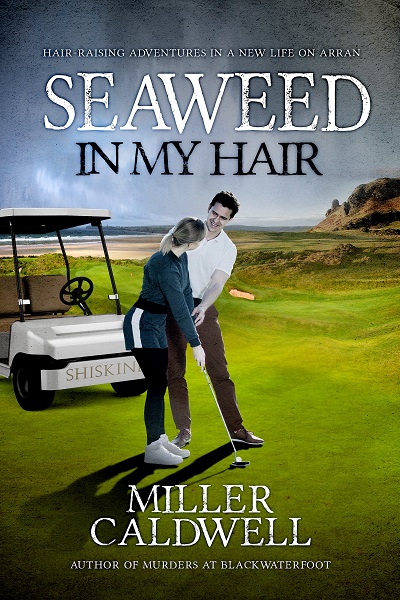
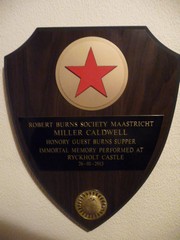 As a descendant of Robert Burns I am asked to give Immortal Memories around the world. Last week I was in the Netherlands at Maastricht; tomorrow at the Canada/Dumfries (Can DU) at Ellisland Farm where Burns once lived.