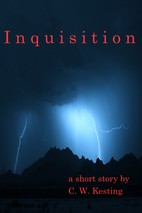
Inquisition is a short story that introduces the epic tale of Man and God and their insatiable quest for one another. This is the inspiration for Kesting's latest novel: This Garden of Souls
Inquisition
By C. W. Kesting
Copyright 2014 by Christopher Kesting Smashwords Edition
Rindell disliked his job.
In fact, he was fairly certain that given the proper set of circumstances he could grow to actually hate it. The relentless pressure of consecutive assignments was beginning to wear him down—particularly the depositions. He had grown tired of the monotonous histories he was forced to listen to; the desperate and wheedling defenses he had to endure. He had grown intolerant of all the weak testimonies that feigned innocence and impatient with the arrogant ones that insisted foul play.
But most of all he loathed the constant travel. They sent him so far away, so often, that at this stage in the game he’d become convinced that he’d never be able to enjoy a life of his own. He couldn’t remember the last time he had been home. Or even talked to an old friend.
Such was his obligation. His duty.
He sighed as he walked down the wide corridor toward the deposition room. Rindell allowed his mind to wander, taking in the majestic views as he passed each of the small windows that had been set into the outside wall. The blues and greens beyond the glass warmed him with a sweet melancholy. Memories of home.
And of hope.
He was one of many assessors currently assigned to this particular inquiry and despite the overwhelming number of top associates on this team, Rindell was constantly being reminded that he was still considered one of the best. He had to admit that while he was certainly the oldest, he still couldn’t help but wonder if it was also fair to assume that experience actually translated into excellence. This particular inquest was nearly over and, like all of the others before, when the final audits were performed he doubted that his personal brand of detail-oriented work would prove to be any more efficient than that of his younger colleagues. After all, his tactics were far more methodical and his conclusions based solidly on historical reasoning; while his youthful counter-parts relied more on formulae and rigid algorithms. Rindell’s ways were considered archaic—even hopelessly romantic—if not, at the very least, effective.
Once upon a time he had actually enjoyed the intense grind of the forensics; when success was measured by small yet significant discoveries: Those fantastic little revelations that, when stacked carefully together in just the right order, challenged old ideas and allowed exciting new theories to evolve. Rindell preferred the slow and steady path. He possessed a meticulous, persistent awareness that accounted for everything and disregarded nothing. He was never one to ignore the subtle nuances; always allowing for any possibility; regardless of probability. He had built a solid reputation for himself following those instincts.
But times have changed. The Program has changed. This younger generation of investigators was arrogant and aggressive—quick to judge. They were narrow of focus and impatient—even cynical. Perhaps even bored. Rindell lamented for an age when meaning actually mattered and hope remained a virtue.
Standing now outside of the deposition room, he felt ancient and redundant. With a weary sigh, he shifted the thin HoloMem tablet under his arm and activated the door. He entered and nodded absently to the usual horde of assessors seated about the circular chamber. There had been a time when he would’ve actually wrestled with these ambitious and callow associates for one of the more coveted seats closer to the observation window. Now that he was older he just didn’t care.
Instead, he chose an isolated chair along the back wall and fell exhaustedly into the plush seat. Ignoring the critical and judging eyes he knew to be on him, Rindell waved open his tablet and keyed up the docket. Thankfully, there was only one deposition scheduled for today: The final Proof in a long and frustrating line of inquiry. With a light brush of his fingertip through the display field, the single case file fanned open. Rindell quickly perused each of the document folders within, oblivious to the drone of the other assessors’ bantering.
The door to the room coughed open and the buzz of conversation dropped to a whisper, then died altogether as it sneezed shut. Without comment or greeting, the Prime Counsel strode impatiently into the silent room, scanning the assembled members with quick raptor eyes. He found Rindell almost immediately and gave him a perfunctory nod.
Rindell sighed as the Prime took the last remaining seat, situated directly in the front of the frosted observation window. The room became a respectful vacuum as the associates waited for the Counsel to address them.
The Prime calmly gathered his audience with a smooth and economic sweep of his dark avian eyes, lingering only for a moment on Rindell before continuing. That pause was nearly imperceptible; but Rindell noticed and tried to conceal his aversion by casually shielding his eyes with his hand as he studied his tablet’s display.
“Let’s begin, shall we.” The Prime Counsel’s voice was deep and oppressive.
On that simple command, the opaque observation window melted from frosted chrome to crystal clear translucence. Rindell had to squint against the milky brilliance of the deposition chamber as he gazed through the one-way glass. Beyond the transparent barrier, a man sat on a metal chair in a small utilitarian room.
“This is Alec LeDarq, aka Ali al Khyayraat. He is Proof Seven of the final seven,” the Prime Counsel stated. “And to my reckoning, the very last of the decanted Sequences. Our aim—as always—is to determine if, from both an intellectual and logistical standpoint, it is reasonable to continue our investigation here.”
The younger associates traded glances before one finally cleared his throat and spoke.
“Well, sir, in light of what we’ve already learned from Proofs One through Six, I suggest that this might be an exercise in futility. I fail to see what this one could possibly offer us that would change our consensus?”
He glanced around at his colleagues as they nodded agreement.
“I say it’s wasted effort and we move on. After all, this certainly wouldn’t be our first unanimous terminal sentencing.” The young auditor crossed his arms over his chest and tipped his chair back.
“That very well may be,” his superior responded coldly. “But, while I’m Prime Counsel, we will give witness to all of the evidence and exercise due diligence before reaching any decision. We will be thorough. Is that understood?”
“Yes, sir,” came the defeated response. Rindell could barely conceal a smirk of disdain for the young assessor.
“Good.” The Prime shifted in his seat. “Then let’s listen.”
~*~
The interviewer entered the deposition room briskly, walked around the small table and took a chair directly across from the young man. He opened his tablet, touched a few icons and then launched straight into his query.
Rindell and the others watched and listened through the glass:
“Would you like to review our last dialogue for clarity?”
Alec LeDarq glanced at the reflective surface on his side of the one-way viewing bubble and then after a slight pause, shook his head.
“Fine. I’d like to begin today’s session with some questions about your final flight.” Alec folded his hands on the table in front of him and shrugged assent.
“Mr. LeDarq, you were the mission commander of the high-orbital attack shuttle, Baal Ashtoreth? Were you not?”
“I was the pilot.”
The interviewer raised his brow in curiosity and then deftly fingered various icons on his tablet, scrolling through data.
“According to the logs,” he paused as he quickly read an item. “You are listed as senior officer of a crew of seven and the lone command element. Your biometrics alone were the only authorized ciphers capable of unlocking the weaponry onboard the aircraft.”
The interviewer’s challenging glare arrowed through LeDarq. Alec countered with a nod of stoic confidence and then smiled softly.
“Pilot,” he repeated.
The interviewer sighed in frustration before continuing.
“According to our records, the Baal Ashtoreth was commissioned by the Fatum Jihad —the largest, most aggressive Islamic terror faction in the world—and outfitted with the most powerful array of weapons known to exist. The shuttle was then placed into a strategic geocentric orbit by the Sino-Korean Force Consortium. When we finally interceded, you were actively targeting every major city within the European Collective.” The interviewer rolled through the list of incriminating facts with calculated precision.
Alec LeDarq smirked at the mirrored observation window and then winked arrogantly.
“Don’t forget the North American Commonwealth, as well,” he added through his grin.
The interviewer glanced over at the view bubble with a look of exasperation. He then leaned forward in his chair and addressed LeDarq with renewed aggression.
“You cannot deny your significant role in the most elaborate global terror attempt in the history of this planet.”
“I cannot,” Alec also leaned forward as he whispered, “As a pilot.”
“You realize, of course, that you’ve failed?”
Alec arched his brow, feigning dramatic surprise.
“We have?”
The interviewer sighed, his face drawn tight in agitation.
Alec laced his hands behind his head and rotated his upper body, cracking his back. “What exactly is the point of all this, really?” He then gestured to the one-way surface of the observation bubble. “I mean, who are you guys? What are you really looking for?”
The interviewer simply watched as Alec casually stretched and then slouched back into his seat.
“Besides, you’re asking all the wrong questions.” Alec looked directly through the view shield, even though all he could actually see was his own distorted reflection. After a moment he shook his head and rubbed his mouth with his hands.
“What questions should we be asking, Mr. LeDarq?”
“Motive and money,” LeDarq answered soberly. “Motive and money.”
“Explain.”
Alec LeDarq snickered. “Who benefits and why?” He spread his arms. “Moreover, who can afford it?”
“Fatum Jihad has extensive resources--.”
“Fatum Jihad doesn’t exist, you idiot!” Alec snapped. “It’s a fabrication. A convenient cover for something far more terrifying than radical Islam.”
“What could that be?”
LeDarq narrowed his eyes.
“The one true God. The absolute faith.” He confessed solemnly.
The interviewer rolled his eyes. “Yes, yes. We’ve heard it all before. Allahu akbar...Allah is great, right?”
Alec frowned, looked back to the observation bubble and blinked rapidly. His face was suddenly pale, nervous. He shook his head weakly and then, to the surprise of the interviewer and those observing from behind the one-way barrier, he crossed himself.
“Stato della Città del Vaticano,” he said reverently.
“I’m sorry?” Asked the interviewer, caught off guard.
Alec LeDarq flashed an anemic smile and then hung his head.
The interviewer cast a confused glance toward the observation port just as the surface of the bubble turned opaque.
~*~
The assessors filed out of the observation room on a tide of excited murmurs. Rindell rose and collected his tablet only to make wary eye contact with the Prime Counsel. From his high-backed swivel chair, the chief assessor narrowed his gaze, frowned and then nodded once to Rindell’s chair in a silent command for him to return to his seat. He complied with a frustrated sigh, laying his tablet across his lap.
“So, Rindell,” the Counsel formed a steeple with his fingers, studying their tips as he pressed them together and then released them. Pressed and released. “What do we think about Proof Number Seven?”
“Apart from the fact that he appears to have been a top-tier religious zealot and an obvious terrorist?”
“Yes.”
Rindell knew exactly what the Prime Counsel was fishing for; they had danced this dance many times before. However, this time Rindell was suddenly and inexplicably reluctant to concede to the tired old script.
“Well, to be honest, sir...” Rindell took a breath. “I really don’t want to believe a single word of what he says.”
The Prime shifted in his chair and considered Rindell with a calculated stare before speaking again.
“Interesting. And yet, you obviously recognized the language he spoke at the end of the interview?”
“Yes. Italian.”
“Why am I not surprised?”
“That it was Italian? Or that I understood it?” He paused. “Sir.”
The Counsel shook his head and mumbled disparagingly. Rindell absorbed his boss’s ire with silent subjection.
The Prime Counsel finally waved a finger disgustedly at the closed door. “I’m more disappointed that none of those little pups even picked up on it,” he snorted. “No, I suppose I’m not surprised. But certainly disappointed.”
Rindell nodded and shrugged. “They’re young and it is a dead language.”
“Hmm.” The Prime eyed Rindell before continuing. “So, I suppose all of your covert research into their fantastic and ridiculous cultures has actually paid off then, hasn’t it?”
Rindell sat silently, ignoring the veiled accusation while deflecting his superior’s sour tone.
The Counsel eventually pointed a long finger at Rindell. “We’ll come back to your unauthorized recreational studies later. Now, you say you don’t believe him. Why?”
Rindell shrugged. “I said I didn’t want to believe him. It doesn’t make any sense considering what we know of their political and religious histories.”
Rindell took a breath, gazed at the floor and frowned.
“But I suppose I do. I do believe him.”
“Why?” The Prime Counsel interlaced his fingers and brought his clasped hands to this chin.
“Well, the Christian/Judeo/Islamic triangle has been the core of this world’s conflict since the beginning of their recorded history while--.”
“All mythologies! And as meaningless as any other theo-political relationship that we’ve run across anywhere else in this desolate wasteland of a universe.” The Counsel interrupted.
“Meaningless, sir? Meaningless to the countless souls that have perished because of conflicting political theologies?”
“No, Rindell. Meaningless to our cause. Our endeavor.”
Rindell tilted his head and silently concede the argument.
“Look at them, man! Every time it’s the same model: Egocentric mythologies, prideful empowerment and violent imperial campaigns. And it always ends, inevitably, in self-righteous justification and global annihilation. All in the name of Religion.
“It’s fantasy, Rindell.” The Counsel allowed his words to echo throughout the room. “They’ve created these elaborate histories and it is not our job to determine which of these fairy tales is correct or who is the most righteous according to their convenient and contrived doctrine. We cannot choose sides because none of them even come close to the truth. We are here to do one thing, Rindell. Just one.”
The Prime Counsel frowned intensely before finally continuing.
“And you know what that one thing is, don’t you, Senior Assessor Rindell?”
Rindell nodded and the Prime Counsel pursed his lips, clearly awaiting Rindell’s verbal response.
“To find Purpose.” Rindell finally said. “And failing that, the Source. The Origin.”
Now the Counsel nodded. “That’s correct. Purpose: A worthy and viable civilization that hasn’t destroyed itself from within. A version of Man that hasn’t allowed hubris to consume itself. That’s the only reason we bother reconstituting them from their own ashes in the first place.”
The Prime folded his hands on top of his head as he continued:
“We’ve been searching for the Origin for eons, Rindell. Literally, eons. So, what makes this particular collection of egotistic adolescents any different from all the others? Why should we think they’ve actually found It?”
Rindell carefully pondered his response and then simply spoke from the heart. “Faith, sir. They believe.”
“Bah! They can’t even agree on simple human morality, let alone the true nature of what they perceive as God. Throughout their entire history, these paranoid fools have created as many religions as they have languages. And they’re all as useless—as dead— as that sluggish, pedestrian Italian.”
The Prime Counsel shook his head in exasperation. “Vatican City,” He spat the words and shook his head in disgust. “The Pope? A terrorist? Honestly! It goes against everything they have ever created.”
“That is what he said, sir,” Rindell responded softly.
They sat in thick silence for a moment before the chief spoke again. “How long have you been with us, Rindell?”
“Six generations, sir.”
The Prime arched his brow. “This is my twenty-first. If you can believe that.” The elder shook his head. “So you can just imagine how many cases I’ve heard. And during those times, I cannot recall a single, solitary shred of proof for the existence of God. In any form.” He leaned forward and narrowed his gaze. “Or on any world.”
Rindell cleared his throat and shifted uncomfortably. He had sat through his chief’s rants before.
The Prime readjusted himself in his seat. “Our ancestor’s ancestors attempted to find God too, and they failed—embarrassingly. The universe is simply too large and our numbers so few. And yet, they still persisted, didn’t they?
“If you want my opinion, their efforts were arrogant and inelegant,” he shook his head.
“They even seeded the cosmos, Rindell. Misting droplets of our genetic code throughout the void; in hope that it might cling to some viable rock and eventually evolve into a like-minded species that just might share in our obsessive search for the Origin.
“And so now here we are, you and I: Tasked with tending our impetuous ancestors’ dying gardens. Distilling and decanting ancient souls from the dust of dying worlds.”
The Counsel furrowed his brow and clenched his jaw before continuing.
“In all of my travels I had hoped—yes, even prayed—that something would come of these quests. That we’d actually come across a civilization spawned—not from our own myriad branched tree—but from something completely unrelated. Truly alien. Incontrovertible evidence of a design beyond us; an Architect with a sense of variety, not irony.”
The Prime Counsel fell back into his chair and sighed. “Instead, there’s been nothing but redundant slices of ourselves, Rindell—derivative after derivative. Cousins that are trillions of quanta apart, yet still incontrovertibly related.” He waved a thick hand at the ceiling. “There’s no one out here but us, my friend. There is no God.”
Rindell chewed his lip and stared at the floor. He puzzled over the numerous beings he’d deposed over the many generations—activists, fanatics, philosophers and poets— from this world, as well as all the others before. Were they really so different from one another—the faith-blinded terrorist or the desperate, hopeful apostle?
He considered his own role in all of this and it made him wonder:
Which am I?
The Prime Counsel quickly rose and walked toward the exit without a word. The door snapped open as he approached; he paused halfway across the threshold. He stood quite still, his rigid frame filling the wide space between the smooth jambs. He addressed Rindell without turning.
“You still have those archaic books in your possession? Those ridiculous fairy-tales from their diseased past?”
Rindell dry swallowed his fear before answering in a carefully measured tone. “Yes, sir.”
“May I ask why?”
“The archivist wanted to ensure that his cross-references matched those of the actuary. He said I could keep them while they reconciled their research.”
“Again. Why?”
Rindell simply stared at the back of his superior’s head, formulating his response. The Prime Counsel remained motionless.
Rindell finally answered, his voice sounding weaker than he had hoped: “I find the ideas within challenging. The authors are...”
“Misguided at best; delusional and insane at worse. There’s no ontological value. It’s foolish cultural fiction.”
“Sir?”
“I trust that those books and whatever other contraband you might have in your possession will find it’s way to the recyclers before we jump the Crease?”
Rindell clenched his teeth, his glare burned intensely into the back of the Prime’s head.
“This world has had its chance, Rindell.”
The Counsel now turned to him. “We bounce soon. You have until then to dispose of the lies, or you too will become a permanent part of their past.”
The silence hung solidly between them.
“Do I make myself clear?”
“Yes, sir.”
With that the Prime Counsel exited the room and disappeared down the hall.
~*~
Rindell sat in the external observation bubble, protected by the ionized plasma field.
He gazed down upon the hazy dome of the condemned planet. He watched with impotent sadness as the massive piebald continents crumbled and broke apart, spreading across the turbulent hemisphere like so many fractured mirrors. The blue-green waters of the world’s oceans churned frothy white as rapidly shrinking glacial floes dumped gouts of polar ice-melt into the widening fissures that formed behind the sliding landmasses. Towering chrome tinted clouds coalesced in the upper atmosphere; birthing giant, swirling hurricanes as the young planet superheated under the intentionally focused singularity created by the antimatter quantum spinners.
The ship’s deck shuddered beneath his feet as the Inquistion released the Baal Ashtoreth from its containment field. Four other captured craft, each from a different era of the planet’s short history, drifted past the bubble as they also slid from their moorings and spiraled into a fatal descent back toward Terra as she prepared to die. The flotsam of doomed craft was evidence of yet another worlds failed attempt to prove its worthiness.
Rindell reached into his pocket, pulled out the crumpled strip of paper that he had torn from a contraband book and, not for the first time, contemplated the prophetic words printed there:
Thou art God.
It came from an ancient Terran novel entitled Stranger in a Strange Land. He discovered it, ages ago, tucked away among the crew’s personal affects on one of the first forsaken spacecraft they had reconnoitered.
He glanced out the viewport and frowned in contrition; his penitent gaze settled again on what he now was certain was the last viable planet in this system. He shivered from a chill of persistent guilt as he watched Earth roll through the final seizures of her mortality.
Once again, Rindell would be a reluctant witness to the execution of another world— another iteration of mankind.
The view outside of the plasma bubble suddenly shimmered as the fabric of space- time bent protectively around the ship in preparation for the bounce through the Crease. The Earth below began to swell at its edges and then abruptly flashed a brilliant neon tangerine for a millisecond before expanding into a piercing fiery white bloom as the planet went null-nova. The convex surface of the view bubble instantly thickened and polarized against the blinding flare of global fission.
The Inquisition quaked beneath Rindell’s feet as it creased out of the dead system.
Thou Art God, indeed.
Rindell wadded the piece of paper into a tight ball and then placed it in his mouth. He closed his eyes against remorseful tears and chewed methodically before swallowing the ancient, bittersweet words.
Bravo! I really love this bittersweet tale of how some other entity might view our world. The idea of seeding civilizations based on "in the image of God" is superb.
The few minor typos that I picked up along the way that don't detract from the story at all:
But times "had" changed. The Program "had" changed. "Translucence" and "transparent" seem to be at odds… I may be wrong. Silently "conceded" the argument. Yet another "world's" failed attempt…
Chaos on Earth began with an evil snake in the garden, peace can be restored by a Divine snake from the light of the small chandelier that has no power source. Can Jenny and Joseph get help from the planet Jupiter, in time?