Dale Day, click
here to update your pages on AuthorsDen.
The Atomic City by Dale Day
Friday, June 20, 2014
Rated "G" by the Author.
(Watching the First Atomic Test in Nevada)
The Atomic Age came at the end of World War Two with celebrations that the horrible Jap Menace was over and peace had come. The people who’d built the bomb in such secrecy were hailed as heroes, responsible for saving the lives of thousands of young American soldiers, sailors, marines and flyboys. They even bragged how millions of Japanese civilians had been saved by their terrible bombs. We all sat and watched in awe as newsreels showed the incredible beauty of billowing mushrooms. The original testing had been done at White Sands, New Mexico and in the distant Pacific Ocean.
The troop leader of the Boy Scout Troop in my church saw a news release indicatin a-bomb tests were to be conducted outside of Las Vegas. He and other adults felt it would be a great experience for our young, malleable minds to view and got permission to take us to see them.
We drove there in a bus owned by the church. In those days, the two-lane highway passed through endless miles of desert after the long, winding climb over The Cajon Pass. Victorville was little more than a wide spot in the road and Barstow existed because it was a junction for several major railroads. And, if that wasn’t desolate, the following miles had almost no human structures of any kind, except a few alongside the railway. Baker was another junction, only there because it was where Boron from mines in Death Valley was brought for further transportation. A grueling climb over two more passes finally brought us to the state line between California and Nevada.
A gasoline station was located there - and that was it. Then and in later years, I remember how expensive the gasoline was as compared to Southern California and that they charged for water to fill radiators and the canvas bags hung over car radiators to keep the water cool. When radiators boiled over, as they usually did, there would be something to keep the cars and trucks going.
After crossing miles and miles of dry lakebeds, we topped the last hill before Las Vegas. There wasn’t much to see. After another long, downhill drive, we passed a small oasis of cottonwood trees and a building with black Cadillac limousines parked outside. It was not until later years that I learned it was a spa reserved for those who belonged to an organization the FBI denied the existence of for many years, The Cosa Nostra.
And then, our bus was forced to stop because the highway was filled with goats! Lots and lots of goats. They took their time crossing and we saw the leaders were going into a fenced in area. At last, we reached a one-story motel alongside the highway with a windmill and water tank on the roof. It had a dirt parking lot and a sign offering an all you could eat breakfast for thirty-nine cents. I remember seeing a couple of slot machines and two or three gaming tables. The huge herd of goats were out back. So, the next time you drive by The Mandalay Bay Hotel and Casino that was once the site of the Hacienda Hotel and Casino, remember that it was once a goat ranch.
From there, we drove to the parking lot of the New Frontier Hotel. It was late in the evening but there were several other vehicles parked in the back portion of the unpaved area. The street on the south side of the hotel was also unpaved. The hotel let us use their sanitary facilities but we spent the night in sleeping bags in the bus. We were awakened very early the next morning and got out of the bus, gathering in an area with a clear view to the northwest. It was still dark with no moon and, even with the neon lights of the hotel, the blazing stars seemed close enough to reach out and touch.
It was time. The morning of January 27th, 1951. The night disappeared as a ball of light filled the northern horizon, silhouetting a range of mountains far away. Then, the ground shook like a minor earthquake. We held our breaths and counted as we did when a bolt of lightning struck. A-one, A-two and so on until we counted to sixty-five, telling us that was how far away the bomb had exploded. A cloud rose, formed like a giant mushroom, boiling and filled with awesome sun colors and ebony black.
When the sun rose, revealing the towering cloud, most gathered up their things, many going inside the hotel to each a breakfast as cheap as at the other we’d stopped at. As we went inside, I remember seeing a number of people busily pulling the handles of One-Armed Bandits.
The first A-bomb test called Abel was conducted in Jan 1951, a 5-kiloton bomb set off at Frenchman’s Flat about 65 miles north of Las Vegas. Another named Baker at 8 kilotons was scheduled for the next day, but we didn‘t stay around for it. There was very little conversation on the way home. We’d seen something so awesome and frightening that we had to think about it within ourselves.
So, the next time we had our “Duck and Cover” drills at school, it didn’t seem unreal or wasteful to me. The other kids laughed and joked about it, but not me. I also firmly believed that because of the monstrosity of The Bomb, never again would the world see a Great War.
In later years, I passed through Las Vegas and watched it grow. One of the things I remember is the sale of souvenirs for The Atomic City, all sorts of knickknacks with pictures of Strip Hotels with a towering mushroom cloud in the background.
When I at last moved to Las Vegas in 1980, they were still conducting underground nuclear tests. The local media would announce them a day or two in advance although we always knew due to the anti-nuke demonstrators who’d show up in town. We often felt the tremors and a lot of windows rattled.
Well, they’re gone now. As is Atomic City. What’s left is just The City That Never Sleeps or Sin City. Come visit us and stop in at the museum on Flamingo Boulevard east of The Strip.
Thanks for the great little piece of history. Back in the 1960s, I'd stop in Vegas whenever I could for the cheap breakfasts. Unfortunately, one morning I lingered too long over my steak and eggs, and when I came out, a cowgirl gave me a friendly parking ticket.
The summer after my first year as an instructor, I joined a group of retreads, supposedly learning how to teach after industry. Our oldest student, Dr. JR Calloway Brown, was retired from Westinghouse and a chemist. By the end of the summer, he was hired to teach chemistry. I was renting a house and he decided to rent a room from me. JR got his doctorate from the University of Virginia in chemistry in 1928. He told me he had worked on the Manhattan Project. After a rough first semester teaching, JR was having some problems with his health and other issues. He disappeared in January. Finally he called me to have me bring him his shaving kit at the Mayo Clinic where he had checked into the psychiatric ward. He returned, finished out the spring semester, and left without leaving a forwarding address. Often wonder if his work on the atomic bomb had affected his life after.
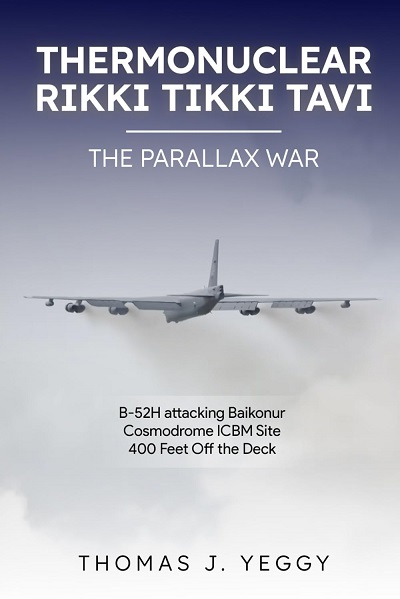
This book explores how U.S. presidents Dwight D. Eisenhower and John F. Kennedy failed to stand up to Soviet aggression during the early Cold War—despite America's overwhelming nuclear advantage.