Thoughts About that War in Vietnam: 50 Years Later
Some places you feel you must return to, if not in body then at least in spirit. Today I revisited Southeast Asia. I returned via Google Earth and by YouTube videos. It has now been nearly 50 years since my first all expense paid visit there thanks to my Uncle Sam. Today I don’t have the energy and probably not the fare to return in person.
I found many pictures and videos in scattered Web locations of places where I had been as a young man. Some were made recently; others were from the distant past. I was able to compare and contrast both actual pictures and my recollections. A few of the Bob Hope USO shows were fun. I was not a big fan back in the old days, but now I could see with great clarity that his jokes were fun, and his timing was impeccable. Some things do improve with time. Others do not.
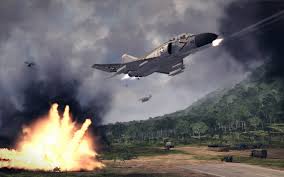
I watched parts of Bien Hoa Air Base go up in flames as we lost 25 men and nearly 100 wounded back in the early part of that war. About 40 planes exploded and were scattered in bits and pieces as brave young men scampered about and moved wounded, aircraft, and equipment to safety. That was May 1965. We learned quickly from that disaster how to section off our aircraft and enclose them in bomb proof bunkers. Airmen and soldiers are apparently still expendable.
The ocean was peaceful at Cam Ranh Bay as a few Vietnamese peddlers sold their wares along the shore. The rest of the old base was abandoned. The old runway was overgrown with weeds. The North Vietnamese that overran the base after we left the place did not stay. Nor did the Soviets. I recalled our Navy Seabees installed the first runway there. It was laid out in rolls of aluminum on top of the sand. We had pieced together sections of pierced steel planking (PSP) so our planes had a parking area.
To the north and into the old I Corps section of the country, I took a virtual motorcycle ride with an unknown photographer through the streets of Da Nang from Dogpatch to Freedom Hill. It was noisy and the streets were muddy. Not much change there. I recalled the mortar attack that killed about 40 of my fellow airmen, and wounded hundreds of others. My brother who was attached to the Marine Corps also flew more than 500 missions out of this location. The 20 air medals he wore on his chest were a source of pride for me, although he rarely mentioned them. He earned his way into Arlington a thousand times over.
Down in the corner with Cambodia and Laos was Ubon, Thailand, the base from which a huge portion of the air war was waged. My outfit, the 45th Tactical Fighter Squadron, bagged the first two MIG kills in that war from here. We lost 13 enlisted sky gunners in a Special Operations flight along the Ho Chi Minh trail one night. Over the next 10 years airman flying out of Ubon racked up a sterling record of personal heroism in the skies over Vietnam in a cause that we later learned was based on lies and deception. Pretty much like the Iraq war.
Directly to the north situated on the Mekong River is Nakhon Phanom, the site of an air base that was closer to Hanoi than any other. In addition to flying missions into Laos and North Vietnam, it was the hub of an intelligence network for most of our missions into North Vietnam. The streets today are clean and paved, the residents are well dressed, and the street vendors’ shops are clean and orderly. All is calm.
Out to the west and about 60 miles south of Bangkok is Pattaya, the site of the world famous sex city. It apparently attracts men from all over the world, mainly Japanese and Russian men. Apparently, Americans were the early magnets for this traffic when we opened our B-52 base there at U Tapao. I use the term “apparently” because I have never been there. That is my story and I am sticking with it. After all I have children and grand children. I have been to Bangkok, which I guess is Pattaya on steroids. I will leave the rest to the reader’s imagination.
These are just a few impressions on a cool winter’s day. I am neither a military historian nor a travel guide. But as an aging writer it seems appropriate that I should offer a few words about that war. I am from a family with a lineage of warriors all of whom exceeded me in daring and bravery on and off the battle field. To them and to all my comrades in and out of arms, here are my thoughts today about that war:
We continued a war in Southeast Asia for reasons that I do not understand beginning in the late 1950s and continuing until the mid 1970s. Nothing there posed an imminent danger to us; we had no exigencies of purpose, no raging fires to quell. Perhaps our political leaders felt we needed a strategic position there. Or a place to test our new weapons systems. Or some combination of those inert objectives. But 58,000 lives is a huge price to pay for military or geopolitical posturing. I suspect it also stems from an affliction of little men with little minds who are not qualified to hold positions of high responsibility—a precursor to megalomania. They have a need to thump their effeminate chests with tiny fists and proclaim to the world “Look at me. I am a man.” That day and that motive were later to burst into full exposure in Iraq, and it continues unimpeded today. Those who never felt the sting of battle somehow believe they have the balls to wage one. Or maybe they just feel their shortage of testosterone compels them to find a pair. How pathetic is that?
I wish I had something more profound to say. I do not. But I will always honor my fellow men and women in uniform. Plato thought the guardians of the state ranked second only to the philosophers among us in rank and importance. I have also visited his domain. I have found the air is as fresh and intentions as honorable among combatants trying to find peace as they are among philosophers trying to critique life.
One who respects your words of wisdom, though I see you as a modest man, I'm glad I came across this article written some time ago. You express my sentiments as to the futility of most wars waged by political leaders, but rarely fought by them.
In my estimation, all of your statements and insights in this article are profound.
You are an amazing writer and your "stories" are so well done. Will we all ever learn that no one really wins a war. It goes on and on all over the world.
We aren't supposed to understand, Edward. USMC MGen Smedley Butler probably said it best in a 1936 speech (which I'll paraphrase)- "War is a racket. Only a select few know what it is about. It is conducted for the benefit of the very few at the expense of the very many ..."
He earned his two Medals of Honor in different jungles, but eventually saw the lesson clearly. His speeches were widely applauded but the world was already at war in China, Spain and Ethiopia, and it hasn't stopped yet. And perhaps those philosophers have the only answer warriors can call a legacy ... that in the hopelessly complex rhythm of living, it is intentions which win the high ground. Thanks for your thoughts.
Oh! my goodness, Edward, I'm so sorry for what you and others went through
and glad you are able to journal...you are a beautiful writer...I imagine it is very
therapeutic and healing..to share your story.
Thank you for letting us into your life and looking forward to reading more of your
writing.
Thank you for a part of your story that you haven't written before. I especially liked your closing paragraph where you outlined your thoughts on why we were in Vietnam in the first place and stayed so long. The military-industrial complex, built up so heavily during World War II, needed to be fed. What more fitting way to keep it going than to beat up on people related to the Japanese who were becoming communist?
I also have not heard of your brother with all of his commendations. To think that people like John McCain and your brother would not have all of their military glory if we had not engaged in that war. I don't see that kind of hero, except perhaps, Pat Tillman, deceased, coming out of the Iraqi war and Afghanistan. Airman in those ventures seem too far removed from actual battle.
I was in Bangkok for 20 days and visited Pattaya for one in 1978, three years after the US pulled out of Southeast Asia. My Thai host took me to many Buddhist temples and monuments, but kept me from any sin.
The Borderline Anti-Memory PastBook asks questions a diary does not ask and raises the questions to dialectics and answers them in a way a memory work does not answer questions.


 Thoughts About that War in Vietnam: 50 Years Later