Mango in Your Mustache – Part 2
Author © Scott D. Zachary
Tuesday morning was iffy. Ten hours of leaning over while holding the flashlight for Arela, along with repetitively bending over to retrieve things from my duffel bags on the floor, had disabled my back. Jennifer in the chiropractic clinic saved the day! Had it not been for her talented fingers, I would’ve been useless. Twenty minutes on the chiropractic table, and I trotted out into the courtyard to play Frisbee with the kids.
Returning to the dental clinic, I was pleased to see that Tina, the co-captain of our team, had assigned a pleasant village helper named Sedalia to sterilize the dental tools. That gave me more time to give presents to the wide-eyed children, which is what I preferred to do.
Word-of-mouth announced that lunch was ready, and we closed the clinic for an hour. We were required to wash our hands in tubs of bleach water before entering the kitchen to dish up our meals. Soaking our hands in bleach water killed the foreign bacteria to which our bodies weren’t accustomed. I understood why Shirley was so adamant about this. I had experienced the resulting illnesses that she was talking about in Saudi Arabia, Turkey, and Botswana. I wanted no part of those nasty little critters, so I enthusiastically washed my hands before parading into the kitchen for lunch.
I dried my hands on a paper towel and, for no particular reason, began cheerfully handing out paper towels to others coming through the line. I had made a point of remembering everyone’s name by applying mental association. I can only remember the mental reference, though, for one jolly young lady’s name—Miss Priss. She made a cheeky remark as I handed her a paper towel. I slumped my shoulders. “Pastor Joel told me I needed to work on my humility, so he made me a dispenser.”
“That’s funny!” she hee-hawed.
Pastor Joel, to whom I had just given a paper towel, cast me a contorted expression.
Steve and I sat beside each other in school desk chairs while eating our lunch. I expressed my fascination with the optical clinic where he was working. My numerous questions prompted him to suggest that we switch jobs for a while after lunch. I was gung-ho for that.
Steve took me to the optical clinic and introduced me to their Team Lead, Ron Norton. Ron gave me a verbal overview of their operation, and like a virtual PAC-MAN, my eyes darted about consuming knowledge. There were long rows of tiered metal racks containing plastic bins of eyeglasses. Ron demonstrated how to use the auto-refractor that I had carried all the way from Louisville. He held it up to each of my eyes and pulled the trigger. Ron then pointed the optical device, resembling a radar gun, at the printer. He pushed a button on top of the auto-refractor that wirelessly prompted the printer to print my eyeglass prescription and caused the laptop computer to display all of the eyeglasses in their inventory that matched my lens requirements. “Want to try it, Scott?”
“Sure!” Using Ron as my patient, I repeated the procedure as he explained how I should pull the activation trigger and adjust the instrument until I could see the ring of bright dots come into focus around his pupil. The auto-refractor beeped indicating that its sonar had measured the inside dimensions of his right eyeball. I repeated the technique on his left eye. I pushed the button, and like magic, his prescription printed. He briefly showed me how to use the wizard program on the laptop to reduce the criteria if no eyeglasses exactly match the patient’s prescription.
People had begun lining up along the wall outside the clinic. Ron motioned for the interpreter at the door to start ushering them in. An elderly lady with a wooden cane sat in the chair in front of me. As Ron looped the auto-refractor’s strap around my neck, he said, “Always use the strap. You don’t want to buy a new one—it’ll cost you $10,000.”
“Yes, sir!”
I focused the device on the lady’s pupils and measured her prescription. Ron showed me how to print the list of eyeglass candidates. He retrieved the first one on the printout from the racks of eyeglasses. I carefully slid the temple tips over the lady’s ears. Gleefully, her eyes darted around the room, and then she snatched the new Bible from her bag, opened it up to the Book of Juan (John), and intensely fixated on the words. The lady looked into my eyes, squeezed my hand in hers, and smiled glowingly. She rattled Spanish so quickly that I could only recognize one word—bendiciones (blessings), but her grateful happiness was unmistakable. I was hooked!
* * * * * * * * * * * * * * * * * * * * * *
During a lull in the dental clinic on Wednesday morning, I inventoried my remaining items to give away. I uncovered the hand-held GPS at the bottom of one of my duffel bags. The bus drivers seemed to know their way around the roads of Nicaragua quite well, so I assumed they wouldn’t need such a device.
The veterinarian goes everywhere—back roads all over the country; this would be a handy gadget for him to use!
I jaunted out of the dental clinic. “Does anybody know where the veterinarian is?!”
“He just went toward the kitchen to get some coffee,” someone hollered back.
I trotted around the corner of the school wing and spotted him. “Hola! Mi nombre es Scott,” extending my hand.
“Mucho gusto, Scott! Me llamo Edmundo Nicaragua,” gripping my hand firmly.
I regarded the warmth of Edmundo’s smile and the gleam in his eyes. “Tengo un regalo para usted.” (I have a present for you.) I held the GPS up to his view and demonstrated the basics of how to operate it. Edmundo was especially intrigued by the altitude function. It was apparent by Edmundo’s enthused response that I’d made a friend with that gesture. We spoke our parting salutations in Spanish, and I loped back to the dental clinic.
My lower back muscles were cramping from leaning over for hours and hours holding the flashlight for my adorable dentista, and it was only noontime. An epiphany prompted me to retrieve the headlamp from my duffel bag. I presented it to Arela, and she immediately strapped it around her forehead, beaming her appreciation. That gave me a reprieve so I could rest my back. I walked out of the dental clinic, chancing upon Steve Wagner. “Hello, prayer partner! What are you up to?”
“I’m getting ready to go out with the vet team,” Steve sparked.
“Cool! Can I go?”
“You’ll need to get the okay from Kevin or Carl.”
“Hey, Kevin,” I hollered. “Can I go with you guys?”
“Sure, if you don’t mind bouncing around in the back of a pickup truck for hours.”
“I don’t mind.”
“You’ll need to get yourself some boots to wear.”
“I’ll get ‘em.”
“Make it quick. We’re pulling out.”
I dashed into the dental clinic, made sure it was alright with Arela, and grabbed my boots and water bottle. I also grabbed my backpack and filled it with cross necklaces, bracelets, and stickers in case we encountered any children along the way. I sprinted to catch up with Kevin, Carl, Steve, and a couple of Nicaraguan interpreters.
Until now, it hadn’t occurred to me that I would be going out into the countryside with my new friend Edmundo Nicaragua, who was standing in the open door of his Toyota monster truck. Edmundo recognized me and smiled grandly. He sweepingly and venerably gestured for me take the passenger’s seat. I didn’t take time to look, but I’m sure someone’s face beside me was stamped with utter dismay, someone who had his sights set on that seat, someone who knew we’d be driving for hours over extraordinarily bumpy dirt roads to a remote ranch. In fact, at one point along the way, Edmundo hobbled his truck over a Volkswagen Beetle-size boulder in the middle of the road, nearly turning us upside-down! He flashed a grin at me as we left that big rock in our dust. I returned his grin, weighing what a serendipitous decision I’d made purchasing the GPS in my mad scramble to be prepared, and then gifting it to Edmundo. Thank You, Lord!
Edmundo provided me a guided tour of remote Nicaragua that no tourist would ever fathom. Whenever I raised my camera to snap a picture, he stopped the truck to make it easier for me to focus on the coffee plantations, the workers waving their machetes at us, the cowboys herding their cattle, or the children excitedly flocking toward the road to get a glimpse of the visitors.
Edmundo only knew a few words of English, so I exercised my Spanish exhaustively. In fact, my Español went from “hit and miss” to the point where Edmundo and I talked about everything from our families to the state of the economy to the history of Nicaragua. As we bounced along, merrily jabbering, I would occasionally glance through the rear window and smile at our jostled passengers in the back.
After our two-hour roller coaster ride, we pulled alongside a wooden cattle chute at a quaint little hacienda, smoke roiling out the window of the rustic ranch house. Several honest-to-goodness cowboys galloped toward us. They seemed entirely at ease riding their mounts bareback. I wondered if their cowboy hats were an imitation of old Western American cowboy traditions, or vice versa, or if both emulated the Spanish headdress.
While Edmundo and the ranchers discussed their plan for vaccinating the cows, I talked with Carl and learned that he and Kevin raised cattle in southern Missouri. He said the process is much the same here as it is back home. Steve and I stood and watched through the barbed wire fence as the ranchers wrangled small herds of eight to ten cows into a wooden chute which was about eight feet wide by thirty feet long. An occasional cow defiantly refused to enter the chute, and one of the cowboys would twirl his lariat and lasso the unruly critter. The other cowboys worked as a team whooping and hollering to maneuver the cow into a position where the wrangler could wrap the rope around a tree in the middle of the lot. Some cows became so agitated that the men had to hog-tie them to inject the vaccine. A few times, a cow in the chute would become so spooked that it would thrash and climb the four-foot wooden fence to escape.
Edmundo asked me if I had ever milked a cow. I told him I hadn’t, and he proceeded to reach through the fence and demonstrate how to squeeze a cow’s udder. He gestured for me to try. I wrapped my hand around the cow’s udder and squirted a small stream of milk onto the ground. Then, I pointed the nipple at Edmundo and squirted a profuse stream into his face. Everyone burst into laughter. I was “udderly” pleased with myself.
The cowboys closed the gate of the chute behind one of the herds, consisting of a large Brahma bull with six or seven of his cows. Kevin and Edmundo deftly reached through the slats of the wooden chute and vaccinated them using a caulk gun-shaped syringe. Once the missionaries had vaccinated all of the cows in that herd, Kevin nimbly climbed over the fence and onto the back of the Brahma bull. The bull began to eject the annoyance on his back, prompting Kevin to “exit stage left” over the far fence.
The cowboys released that herd through a gate at the other end of the chute and herded another large Brahma bull and a half dozen of his cows into the chute. Edmundo invited me to vaccinate the cattle. He demonstrated on a couple of the cows. Then Edmundo primed the syringe with vaccine and handed it to me. He pointed at the bull and directed, “Toro.”
I quickly reached between the wooden slats, vaccinated the bull, and stepped back.
“It’s your turn to sit on top of the world, Scott,” Kevin unwaveringly declared as he pointed his finger at the bull that I had just aggravated with a needle.
I didn’t ponder on it; otherwise, I would’ve talked myself out of it. A massive surge of adrenaline flooded my body as I took two deep breaths and climbed the wooden slats. The bull had moved to the other side of the chute. A cow now stood between the bull and me, so I vaulted/slithered/sneaked across her back onto the back of this monstrous beast. I sat very briefly on this deadly hulking creature and laid my hands on his hump. Then I was GONE even faster than I got there.
I leaped down from the fence on the other side of the chute and strutted around to where I began that moment of insanity. I walked up to one of the interpreters, Tomás, and he laughed heartily using the Spanish word “pulga.”
“What is that word ‘pulga’?” I asked.
“You looked like a flea!” bellowed Tomás. He mimicked the flicking of a flea, sputtering, “Pssst-Pseww!”
Everyone laughed.
So much for my macho self-image.
When we finished vaccinating all the cattle, our team member Mike Delargy delivered a heartfelt sermon to the cowboys and their sons. He told them that we are honored to treat their cows for parasites and blackleg disease. He added that we are here primarily, though, to share our faith in the Lord Jesus Christ who gave His life so that we could be forgiven for our sins and live for eternity with God—if we so choose. The ranchers listened attentively and happily accepted the Bibles that we gave them. Steve Wagner and I gave the children Christian bookmarkers, bracelets, and stickers; and they responded gleefully. To show their appreciation, a couple of the little boys climbed a tree and picked mangoes for us. Edmundo peeled them with his pocketknife. I munched down three of them, and the boys laughed hysterically at me. I glanced at Steve quizzically.
“You have mango in your mustache,” he clarified.
I laughed as I smeared the chunks of mango from my mustache onto my sleeve.
“Now there’s a good title for your book, Scott: Mango in Your Mustache.”
“Yes, it is. I like it. I’ll put that in my Wizzle box.”
We climbed into Edmundo’s monster truck, and our Nicaraguan hosts exuberantly waved as we drove away.
Edmundo and I talked in Spanish about how vastly our lives had improved since we accepted Jesus into our hearts. By the time I had used every word in my Spanish vocabulary many times over, we rolled to stop at a boat ramp overlooking a wide muddy river. Edmundo seemed to be signaling some sort of code with the horn of his truck. Walking over to the water’s edge with Edmundo, I watched him focus on a rustic building high on a bluff above the far shore. Moments passed, and a light flashed its coded reply from the window of that building.
I looked at Edmundo. “Qué pasa?”
“Camarones,” he said with a big grin. “No diga a nadie.”
I had no idea what he meant by “camarones,” but I did know that he told me not to tell anyone. This rendezvous reminded me of a drug deal that I’d read about in a John D. MacDonald novel many years before, a drug deal that went horribly awry for the intended recipients. Surely not!
I gabbed with the Nicaraguans in Spanish while we waited. They were talking so fast that I could only understand about every fourth or fifth word at best. I did my utmost to understand them and participate in the conversation. The more I tried to pronounce a word, the harder they laughed. I don’t recall that word, but every time I spoke it, they all laughed as though I’d told the funniest joke ever. I stood puzzled about the punchline as they diverted their attention to watching a motorboat buzzing across the river toward us.
A scruffy man throttled down the wooden boat’s outboard motor, nudged the bow into the sand, and leaped out onto the shore. He greeted Edmundo with great gusto, grasping hands vehemently. A wiry, young boy, dressed only in cut-off shorts, climbed out of the boat carrying a hefty box and grunted as he passed it to the scruffy man who handed it to Edmundo. Everyone craned over the box. Edmundo pulled the tape back, popped the cardboard lid open, and cheered, “Camarones!”
“Ahhh, shrimp! El Océano Pacífico es cercano, ¿sí?”
Edmundo gestured downstream. “Sí.”
Edmundo and I had become good friends by the time we arrived back at the mission in Las Rancherias. My brain was mush from hours of mentally straining to ferret a way to express my thoughts with my limited Spanish vocabulary. Except for that one word—whatever it was, my pronunciation and verb conjugations were good; however, I needed to learn a lot more words to speak fluently. Ten thousand should do it, I reasoned. I resolved to work hard after this mission to increase my stockpile of words.
I did learn what “camarones” means, and it doesn’t have anything to do with drugs, thank goodness! Edmundo also taught me how to tell people that I had mounted a big bull: “Me monté un grande toro!”
* * * * * * * * * * * * * * * * * * * * * *
The next morning, a skittish little boy and girl gazed over the windowsill into the dental clinic as we packed up to leave. I motioned for them to come in. “Tengo un regalo para ustedes.” (I have a gift for you.) I’ve never seen a more bedazzled look than when I gave my SpongeBob blanket to the boy and my Hello Kitty sheets to the little girl. Delight spangled their big brown eyes!
Steve and I gave away all of our clothes (except those we were wearing) to a couple of the local helpers. Plucking clothes from his suitcase, Steve was scrutinizing each item of clothing before handing it to one of the helpers. “Oh, here! Take it all, and take the suitcase, too!”
Arela and Luz thanked me for helping them, and I thanked them for permitting me to serve the people of Las Rancherias with them. We hugged good-bye.
I hadn’t yet learned how to be persuasive in sharing my faith, but I was working on it. David, a local Nicaraguan who guarded the entrance to the school compound, was a good example. He and I chatted in Spanish every time I walked through the gate, and we became friends. I gave him Christian wallet cards a couple of times, and on one occasion, I noted the tender delight in his eyes. I exclaimed, “Puedo ver la alegría del Señor en sus ojos.” (I can see the joy of the Lord in your eyes.)
I walked near the gate toward the kitchen for breakfast on our last morning in Las Rancherias and heard David call out to me. “Señor Scott, ¿podría usted darme una Biblia, por favor?” (Mr. Scott, would you give me a Bible, please?)
“¡Sí, ciertamente!” (Yes, certainly!)
I ran as fast as I ever have to bring him that Bible. When I gave the New Testament to David, he handled it as though it contained something precious. His notion is right: The Bible holds the keys to infinite life in a new universe which will be so exceedingly magnificent over this one that we cannot conceive it. The Apostle Paul said, “That is what the Scriptures mean when they say, ‘No eye has seen, no ear has heard, and no mind has imagined what God has prepared for those who love him.’ ” (1 Corinthians 2:9 – New Living Translation)
I experienced many mixed emotions that morning as we loaded the trucks. Topping the list: Triumphal. That week pegged—by far—the most selflessly fulfilling week of my entire life. Melancholy draped my triumphant cheer. I cherished the meek, unpretentious, wide-eyed people in the village of Las Rancherias. Leaving them for my coarse world saddened me. Someone later asked me what the people were like in the mountains of Nicaragua. Without hesitation, I avowed, “Sweet. All of them.” An appreciative humility will accompany me back into my luxurious life where we take everything for granted.
One memory from the seven-hour bus trip back to Managua resonates dulcetly: Consuela and Gina sat across from me on the bus singing unfeigned accolades to our glorious God in their beautifully harmonizing soprano voices. Heavenly.
Another recollection from that journey clangs discord. We pulled into a gas station on the way back to the mission home for a restroom break. I rejoiced because I was in dire need of a restroom. My joy collapsed into a pang of desperation as our bus driver moseyed back onto the road. There were eight uniformed policía in front of the station with machine guns ready for action.
Oh no! I was freaking out! “Consuela, how far is it to the next gas station?”
“There isn’t one,” she said.
“How far is it to BMDMI?”
“About two and a half hours.”
I gritted my teeth and held it for as long as I could. Desperation became severe distress! I marched up the aisle to the bus driver and demanded, “¡NECESITO USAR EL BAÑO AHORA!” (I need to use the bathroom now!)
The bus driver said he would stop and let me go behind a tree. He stopped alongside an eight-foot-tall fence with barbed wire strands three inches apart. He shrugged and told me to go next to the bus. One of the interpreters hollered, “If any other men need to go, make it quick.” No one else came forward.
Here’s pressure for you: Try to pee standing next to a bus with cars whizzing by and a whole busload of people waiting on you, some likely needing to go as urgently as you. While trying to focus on relaxing my urinary muscles, a horrid thought crossed my mind: What happens if I can’t pee? I slammed the door on that line of thinking. I have never prayed more earnestly, nor have I ever felt more relieved.
Click here to read the conclusion of “Mango in Your Mustache”



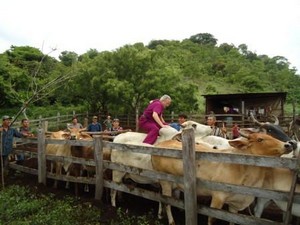 I vaulted/slithered/sneaked across her back onto the back of this monstrous Brahma bull.