 This recollection had me in stitches!
Incorporating a slice of life pertaining to my second novel in the genre of Contemporary Women’s Fiction, 'An Enlightening Quiche,' hither go I.
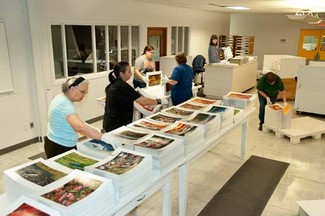
Writing the novel necessitated delving into the Industrial Revolution and the subsequent rise of mills along the Blackstone River in northern Rhode Island. Hence, I construed the fictitious Brulé Bookbinding Co., nourished by memories retained from seasonal employment at Sidney-Higgins Bookbinding Co. during my freshman and sophomore college years.
Memories, sprouting through the cracks of yesteryear are vivid as yesterday's news...
Like the previous mill I worked in when I turned sixteen, Sidney-Higgins occupied a part of the old Wanskuck Mill complex on Branch Avenue in Rhode Island’s capital city of Providence. Battered and glass-shattered, the Wanskuck stood its weed-littered ground on turf from a bygone era when the falls of the West River and Wanskuck Pond powered its machinery.
Hired by Mr. Gardner, the owner, for a wage above minimum at $1.85/hour, the small company comprised of 8 people and a foreman, took me into their “fold,” no pun intended.
Manny, Skip, and Jim operated the heavy-duty machinery. Ray, the foreman, stood before the helm of the Heidelberg Polar Cutter and stepped away whenever he parceled out work to the elderly female work force. Namely: Betty, Edith, Jeanette, Bea, and Eve.
There’d be days we’d hang around playing cards waiting for a job to come in. When it got especially busy during one summer, I took in my neighbor, Rachel. Ray brought in his daughter, Jane. Jim rustled up his son Jim, and Jim in turn recruited his girlfriend, Gail. The owner hired two rich college boys who couldn’t do any wrong by association—Dave and Rick. Betty rallied her neighbor’s son, Joe, an aspiring priest who attended a seminary.
In the same age bracket, and thrown together by happenstance, we shared some good times during lunch break. I fondly remember climbing out the window and eating lunch on one of the tar-roof landings littered with smashed 45 rpms, residue from the mill next door. I managed to salvage a couple of discards still in one piece.
Of course, all of this bric-a-brac didn’t wend its way to Brulé Bookbinding Co., the impoverished mill, in my novel. However, the labor-intensive jobs I describe in detail certainly did: collating, hole-punching, feeding the saddle-stitcher, combing.
Paper cuts were by-products in the line of duty throughout my temporary employment. Speaking of cuts, I’d be remiss if I left out my high-pitched swan song by the “round-cornering” machine which involved leaning back a tad to step on a pedal which brought down a blade similar to a guillotine that swiftly and sharply lopped off the square corners on a stack of lined paper.
Next!
I didn’t feel a thing. Like something out of a horror movie, I espied my own blood gushing everywhere and couldn’t fathom why. In a state of shock, I couldn’t comprehend that I’d inadvertently round-cornered the tip of my pinky finger, which, by the way, is none the worse from the wear and tear of being in a bind with stitches.
|
|
|






Interesting write, Eva!
Sandie
You're very lucky to have your finger. My brother, while working for Aluminum Specialty in Manitowoc, told me about a woman who refused to use the pullbacks required for working on the stamping machines and cut both of her hands off. Factories were dangerous places. My mother, working in a shoe factory, ran a needle into her fingers more than once.
Ouch!
Ron