|
|
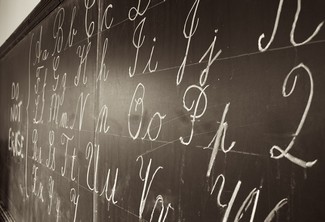 ...and clapping erasers!
Embarking on a teaching career in elementary education during the early ‘70s, I initially dug my heels in the fifth-grade trenches of an open classroom. The great divide of the carpet running down the middle of Center C separated the fifth and sixth-grade classrooms, totaling six in all. Either a yellow or orange square defined the boundaries of your classroom. The flexible, manmade wall between two classrooms entailed the lineup of portables: a tote tray holder, bookcase, and bulletin board. That flimsy barrier couldn’t block out the surround-sound emanating from neighboring classrooms.
The only solid wall at the front of each classroom was part of the infrastructure and had a chalkboard attached to it. Advanced as Northern Lincoln Elementary may have been—one out of two open-classroom schools in the state of Rhode Island—teachers still chalked it up in yellow. Movies like ‘The Blackboard Jungle’ and ‘To Sir with Love’ come to mind.
By the end of the day, I could count on jaundiced fingers. During the dry heat of winter, chalk dust further exacerbated the nasty tears on my fingertips, which a chalk holder didn’t remedy. My clothes often bore the brunt of smudges from brushing up against words or numerals.
As the writing surface for the cheesy chalkboard of the ‘70s was grit paint applied to wood rather than slate rock, every classroom simultaneously had a new one installed during the summer. Before school started, they had to be “broken in” by completely “chalking it up” with the side of a stick.
Truth or tale?
I had better things to do toward preparing my classroom for fall. I asked my cousin Steven, who was 14 at the time, if he’d do it for ten bucks and lunch afterwards at MacDonald’s. Sure. The teacher next door asked him to chalk hers and matched my price.
By the latter half of my career, open classrooms became outdated, and my school building underwent an expansion to accommodate a burgeoning student population. I moved to my new digs in room 108, the third-grade classroom I’d occupy until retirement in 2002. Long before that day came around, I had attended a workshop which put the notion into my head to purchase a sheet of white plastic laminate used in shower stalls, and cover up a large section of my blackboard.
I started a trend which spread like wildfire throughout my school. Nowadays, you’d be hard-pressed to find blackboards in a classroom. Chalk it up to experience.
|
|
|
|






When I took the challenge to teach at my alma mater in 1969, I wasn't sure how I would be able to chalk it up with my metal hand splint trying to grasp chalk and write/draw with it without breaking the chalk in the process. Thankfully, I found a chalk folder in a local store and that did the trick. I still had the problem of erasing. That was easily solved by some eager student who either out of the kindness of his/her heart or the prospect of getting a better grade, volunteered to erase my scribblings. So I never got all that chalk all over me, but sometimes had a little trouble finding chalk long enough for my holder.
As time went on and I drew diagrams and lists on the board, I found that I could fill the chalkboard twice in one session of 50 minutes. Something that I marveled at even at that time and even more, now, since I haven't been able to even sign my signature since 1998.
Having trouble teaching business statistics, I turned my notes into transparencies and made copies that I gave to the students… Telling them not to write everything that I said, but write notes of their own on my notes. The result was a tremendous improvement in the understanding of statistical concepts by my students that summer. The chalkboard had become passé that summer of 1980. My last teaching assignment was the spring semester 1981.
Ron
Nowadays the students are much different, the teachers have a much difficult task with the students due to the political leaders involving the young ones, using the young ones as pawns for their political gains.
Children should not be dragged into the political world, they should be able to stay in school to learn. When the time comes they should be able to make their own political judgment. That is how it should be, but sadly, this is a much different world compared to the world when you were a teacher.
Interesting story! Thank you for sharing your life with us!
Sandie