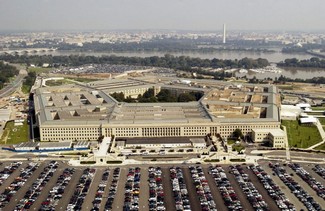
The Pentagon
Author © Scott D. Zachary
My first day at work would’ve been unusual enough if I hadn’t had to walk a mile and a half to the building from the parking lot. Unusual would’ve been fine with me, though, without the carpet of people laying all over the steps, covered in their make-believe blood, pretending to be dead.
I peered at the stout black security guard forty feet away and shrugged as if to say, “What do I do?”
The guard decisively walked across my human red carpet toward me, showing no concern as to whether or not he was stepping on the want-to-be carcasses.
I looked up at him as he extended his thick arms, slid his big hands under my armpits, and lifted me up without expression as though this was an ordinary part of his workday. The guard’s powerful arms fully extended before him, my feet dangling, he made an about-face and again walked across the helter-skelter protesters. He set me down inside the River Entrance doors of the Pentagon.
I followed the instructions on my introduction sheet for another half mile up, down, and around the hallways to the Air Force Data Services Production Control counter. I gave my civilian supervisor, Ed Parks, a copy of my orders, and we introduced ourselves. Ed came around to the door of the computer room and welcomed me into a virtual soccer field filled with computer equipment there in the basement of the Pentagon. He gave me a tour of my new workplace, describing each of the mainframe computers as we walked. Ed, a likable GS-15 civil servant (equivalent to an Air Force full colonel), more than twice used the expression “largest configuration of its kind” as we negotiated the pathways lined with six-foot-tall magnetic tape drives. He expounded about each of the IBM System/360 and System/370, Univac, Honeywell, and Burroughs mainframes. Another world.
Don’t get yourself into an overly impressed state. Your mobile phone today has more processing power than any of those mainframe computers had, but that was the best there was in 1978.
I would soon learn that my initial job at the Pentagon entailed taking in grocery baskets of punched computer cards and feeding the boxes of cards into card readers that spawned computer programs in the memory of the gargantuan computers. The programmers’ results printed on banks of line printers, which we retrieved and distributed to various functions: WWMCC (Worldwide Military Command and Control); Presidential, Department of Defense (DOD), and Air Force Budgeting; Strategic Planning; and other departments.
Dayshift at the Pentagon sucked because my daily commute from Woodbridge, Virginia—a mere twenty miles—involved an hour and a half of bumper-to-bumper traffic inching along I-95 into Washington D.C. Thus, I made getting on the midnight shift my top priority.
Six months passed. I was reassigned to midnight shift in the Bindery Section where we operated two multi-million-dollar DEC (Digital Equipment Corporation) PDP-11 printers that transformed the data on reel-mounted, half-inch magnetic tapes into twelve-inch-thick paper volumes of the Presidential, DOD, and Air Force budget. We beautifully bound those bundles of paper for distribution to the “big wigs” throughout Washington. Our work landed on all of the Senators’ and Representatives’ desks. And, of course, the President’s desk. The mountain of volumes comprising one copy of the Presidential Budget was quite an impressive sight.
My first night working the midnight shift, I precisely followed the directions I’d been given to Air Force Data Services, enabling me to bypass the hallways that were closed off with metal curtains during the night. I traversed from the River Entrance down through the bowels of that five-sided maze. As I approached the loading dock of the cafeteria, I instantly froze—there were hordes of jack-rabbit-size rats all over the concrete expanse. No one had bothered to mention these big nasty greeters. I looked at them; they looked at me. I stomped my foot to scare them away. The rats lunged abruptly toward me. I wasted no time scurrying toward the door that I’d been directed to pass through. Those ogres undeniably ruled the loading dock at night.
The best part of working in Bindery at night was driving against the traffic on I-95 to and from the Pentagon. This cut my commute by nearly an hour each way! The worst part was that I was in charge on a particular morning when a horde of colonels and generals showed up expecting an impromptu demonstration of our fancy printing and binding operation. Normally, this wouldn’t have been such a catastrophic problem except that Airman Miller and I had gone for a drive around D.C. during our middle-of-the-night snack break. As we cruised past the Washington Monument, the Capitol Building, and the White House, we smoked an excellent joint of Columbian marijuana. I was still flying high as I gave one of the best verbal presentations of my life that morning.
I did such a great job in Bindery that when I was promoted to Staff Sergeant, Lieutenant Colonel Kraszewski put me in charge of “The Control Tower.” Not really a tower, it was a mere step up from the computer floor. From there, we coordinated the efforts of the vast array of computers. My favorite aspect of working the Tower was that it afforded me the opportunity to get out and work as a computer operator on the various computer systems when it was quiet. I became quite good on all of them. In fact, whenever one of the lead operators was stumped with a perplexing problem at their control console, they would often fetch me to give it a shot. More often than not, I was able to resolve their dilemma by intuitively punching buttons until I managed to accomplish the particular task, and I never once initiated World War III.
I’d been working on The Control Tower at the Pentagon for several months into 1979 when we received the first of several removable hard drives for one of the systems. This was a big deal. Several colonels were on hand for the installation. A programmer’s computer program could now prompt the operator to retrieve one of the removable hard disks (resembled a cake holder); the operator would screw the disk onto a device the size of a tall nightstand; and the program could then access all of the data on that disk—all four megabytes. To put that into perspective for those of you who are not intimate with computers, that’s roughly one-ten-thousandth of the storage capacity of your typical laptop computer. Looking back, my forty years in the computer processing industry certainly has been a fascinating ascendance. Oh, and those removable hard disks cost $50,000—each.
For exercise during the year that I worked on the Tower, I walked the halls of the Pentagon in the middle of the night turning off lights in the washrooms. I’d been told that there were 279 total restrooms, but I was only able to find 256 of them. I presumed that the remaining 23 were for private use by the top brass.
* * * * * * * * * * * * * * * * * * * * * *
Over the years, it had become an accepted convention that everyone who worked in support of the computer systems for one year was then allowed to transfer out onto “the floor” and work as an operator on one of the mainframes. On the morning of my one-year anniversary, Colonel Kraszewski stopped by the Tower.
“I’ve worked in Support now for one year,” I excitedly prompted the Colonel. “Which system am I going to work on, sir? If it’s all the same to you, I’d prefer that you transfer me to the 3032.”
“Sergeant Zachary, you’re doing a great job right where you are.”
“But, sir...”
“No buts to it,” he snubbed. “You’re staying right here on the Tower, and that’s that, Sergeant.”
“Sir...”
Colonel Kraszewski turned abruptly and walked away, snapping, “No.”
All of my ICBMs left their silos.
* * * * * * * * * * * * * * * * * * * * * *
Thirty-seven years later, after having read my memoir titled “Tantalizing Travels,” my boss at Gardens Alive, Nelson Schroth, told me the following: “Now I know how to get you to do the impossible—Tell you that you can’t do it, and then get the hell out of your way.” Colonel Kraszewski might’ve fared well with that advice under his hat.




 All of my ICBMs left their silos.
interesting, powerful read
never stop writing!
m
You brought back some memories. During the period 1967-69 that I worked for GTE LenKurt, we got to, as members of the local branch of the American Society for Quality Control, tour some very interesting places like the Maverick plant in Fremont, the Apollo assembly plant in Downey and the magnetic tape production facility (by Microtek?) In Sunnyvale that was a giant "clean" room with no access for us because the process for manufacturing was so proprietary.
During the period you were at the Pentagon, I was coordinator of research for The Program for the Study of Technology at West Virginia University. I fostered the delivery of 63 proposals for funding to various departments of the federal government in DC. My commute consisted of trying to get out of Morgantown with a signature from the president before noon and navigate the mountainous highways and the 55 mile an hour speed limit to the Capitol by the 4 pm usual deadline. Unlike you, I didn't have to use I-95 and the Beltway only a short while. Usually, taking the George Washington Pkwy. down to the buildings I was racing to try not to get a ticket. Don't recall getting any tickets or even delivering a proposal late (some in the last five minutes).
Those were the days…
Ron