The Greyhound Bus and the Hermes Typewriter
It is 1971. I am 20. Having flunked out of a four-year college within the first year, I moved to Bremerton, Washington’s two-year Olympic College, across the state from my family. Thankful am I for the Greyhound bus. Owning an automobile is something for actual adults over 30, many who might have their own house by then.
My grandmother delivers me to the station and waits in her floral belted-at-the-waist church dress with her huge white pocketbook hanging from her crooked arm. Once I am on the bus she waves goodbye, looking worried probably because I’m shy and from a town of 300 homogenous people, so maybe I won’t get off the bus during its one-hour lunch stop in the town of George, WA.
She thinks I’m too skinny and the tuna sandwich she packed me isn’t enough. She ends up being right because I ate the sandwich for breakfast, since the dorm cafeteria doesn’t open at 5:00a.m. She asked me if I had pocket money and I said yes, glad she didn’t ask how much. I’m hungry by the time we arrive in George five hours later.
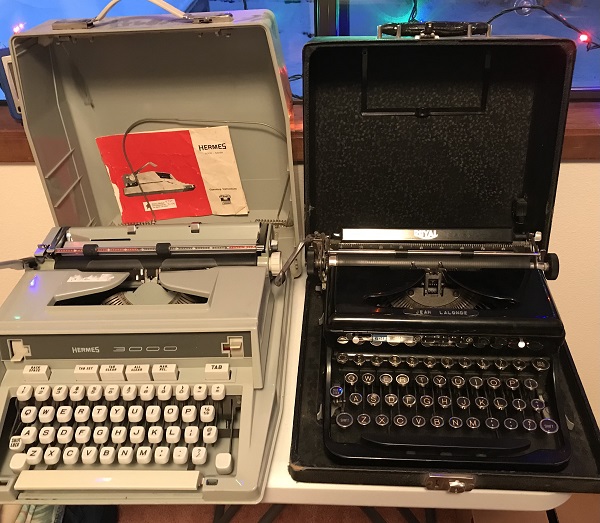
The sun is just breaking the eastern horizon when the rows of heads, hidden by tall seat backs in front of me, start stretching and bobbing awake. I don’t close my eyes the whole time because I’m in the back of the bus surrounded by strangers my mother taught me are dangerous every single one including the teenager. And I have to protect my Hermes 3000.
We roll into the parking lot of Martha’s Inn and everyone spills off the bus the way grains pour from a box of Uncle Ben’s Minute Rice. I stay behind so that I can check my wallet for the possibility of going into the café. One dollar and eighty-three cents. Being proud like my dad about money isn’t always very smart; I should have asked grandma for a few more dollars. But I go in anyway, at least for the restroom.
I sit at the counter on one of those Naugahyde revolving pedestal stools and look at the plastic-coated menu. There is a small bowl of chili, $.75, that I think I can cover, including tax and modest tip; so I order that from the aproned waitress behind the counter. The thick white stoneware bowl arrives in steaming glory, smaller than I imagined for the word ‘small,’ more ‘cup’ size, but it comes with free water and soda crackers, two to the cellophane wrapper, and she gives me two packs. I say thank you with happy appreciation, as though she just brought me a full chicken-fried steak platter with a side of coleslaw and a complimentary bread pudding square.
Either because I look so grateful or because I have bright red hair, or that I brought my 8 lb. Hermes into the café with me for its protection, she soon comes over with a couple more Premium Saltine packets. I crush them into the chili as I did the first packs, smiling at my good fortune. When I get to the bottom of the cup, she comes over to me, saying, “Welcome to Martha’s Inn,” and pulls from her apron pocket four more soda cracker packets, “Hope you will stop here again,” she says and smiles at me the way my mother would.
I almost cry when I thank her for the crackers, partly because she was watching me when I compared the menu to what I held in my hand, but moreso because she offered me kindness anyway, even though her tip was only $.30.
As it was I came up long on this rich experience I am to remember in detail 46 years later and write about to my 32-year-old son who lives in a city of 14 million people in Guangzhou, China. Life is always surprising and all over the map, isn’t it?
Without the Greyhound ticket grandma bought me, I wouldn’t have been able to go home, and without that exact waitress I wouldn’t have had those crackers for the four more hours of rolling across the flat plains of a gazillion tumbleweeds and sorrowful jackrabbit road kills and the coyote sightings in their approach to a fortunate roadside meal, like mine.
Everyone has to eat.
12/12/2017 ~~ djl