A Walk on the Wild Side...Ancient Wisdom of The Elders
Rooting around in the past: Some helpful back-story (hopefully)
J.R.R. Tolkien, the famed South African academician and writer of fabulous classic story-telling mythos, was noted for forging a distinctive mood-tone that brought his Middle Earth world to life merely through the adroit use of masterful and richly resonant language, a style of phraseology that instantly launched images into the readers’ minds.
Of his various Middle-Earth peoples, for example, the image-laden mind’s eye impressions of Elves, Orcs, Hobbits, Orcs, Ents, Valar, Maiar and others, are good examples of this nuance of his genius at portraying complex characters through mastery of the English language.
I discovered Tolkien long before (early 60s) many others did, thanks to a good friend named Jinx who was a grade further along than I (and somewhat of a VERY smart girl-nerd) when I was a high school freshman. Hailing from an equally brilliant family (her older brother, for instance, graduated Magana Cum Laude in astrophysical engineering at CalTech), Jinx was an inspiration to me as a budding SciFi fan. Already an avid reader of the science-fiction and fantasy novels of the Isaac Asimov, Robert Heinlein genre, and a prepubescent viewer of old Flash Gordon serials on TV, Tolkien’s fabulous fantasies, set in his ‘Middle Earth’, instantly ensnared me. It certainly set the stage for my enthusiasms for many follow-on fantasy successes, such as the NetFlix epic, Game of Thrones (based upon George R.R. Martin’s extensive and even more convoluted fantasies) and the current House of the Dragon sequel.
Of all of Tolkien’s characters, his ancient tree creatures that he called the Ents were a particular favorite of mine. Ents were, for anyone unfamiliar with The Hobbit or the Ring Trilogy (God forbid!), Tolkien’s ancient race of ‘tree people’. Trees vaguely register (thanks to ancestral memories of boring summer session afternoon classroom sessions on biological science) with ‘average’ Americans as somehow important to human life, although the typical pedestrian mind would likely be hard-pressed to explain exactly why. Today, a fair number of people are somewhat more aware of the importance of trees in helping sustain the human biosphere, thanks to environmental activists, but trees for most are still just those shady green things at the local park
There is a mind-boggling diversity of tree types and classifications but of them all, the redwoods have always been my absolute favorites. Belonging to the oldest persisting members of the Flora tree orders grouped together under the taxonomic classification ‘gymnosperms’ (conifers, or cone-bearing seed plants), the towering redwoods (both Gigantea and Sempervirons) are members of that grouping and come (again in my mind’s eye), as close to being virtual representations of Tolkien’s ‘Ents’ as real trees could be. They are absolutely huge, visually awesome and biologically unique in terms of their natural characteristics. Accordingly, it’s hard to stand in a redwood grove, at the base of a tree reaching some 300 feet into the sky, and not be very impressed…
My Mum, the aesthete and teacher
During my early childhood, growing up in (among several small communities, as the son of a migratory schoolteacher) the San Joaquin Valley of California, my mother and I were frequent visitors to the National Park groves of ancient Sequoia Redwoods in the Sierras known as the ‘Giganteas’. Truly a wondrous place by any reckoning, with their huge , dense groves of majestic redwoods, Kings Canyon and Sequoia National Parks aren’t difficult to imagine as more than capable of producing a singularly colossal impression on a small child.
Down in the California ‘Great Valley’, immediately west of those national parks, my mother labored mightily in her classrooms each day to bring a glimmer of awareness of the importance of a good education to the offspring of the largely illiterate migrants who had fled the Dust Bowl devastation of the 30s. Settled in to the small, desiccated agricultural communities named Orange Cove, Sanger, Reedley, Orosi, Cutler, Parlier, Fowler, Del Rey and Sanger, the lives of these itinerant migrants were the regular stuff of John Steinbeck’s Grapes of Wrath saga, of course.
The ‘eddication’ my way-overqualified Ma wished to inculcate awareness of in her migrant school children included rudimentary lessons in biology, and naturally reference was occasionally made to the nearby redwood groves. You might be able to imagine how tough this challenge was by learning that the little girls had given names like ‘Chicken’, ''Bitsie'' and ‘Whoopsie’, whereas the boys often went by handles like ‘Snotty’, ''Junior'' and ‘Holler’….no lie! [Comedian Bob Newhart’s famous characters, “My brother, Darryl and My other brother, Daryl”, in the Vermont setting of his 80s TV show ‘Newhart’, would have been right at home in Ma’s classroom.]
As a well-brought-up young woman, possessed of a graduate degree from a prominent Mid-West women’s college (Lake Erie Women’s Seminary, later known as Lake Erie College and finally as Lake Erie University), my mother was something of a rare anomaly in this wild and wooly part of California’s 50s-era agricultural heartland. Back in her own adolescence, it was rare for women to complete high school, let alone continue their formal education through the higher levels of academia, but her own mother, the maternal patriarch of the family, had also completed her own Lake Erie baccalaureate in the late 1800s; she married a frontier pharmacist, came West in a pioneer Calistoga Wagon on the Overland Trail and settled in Southern Idaho, subsequently raising a good Scots Presbyterian family that included a daughter with a strong artistic bent (Ma) and a son (who eventually rose to prominence as the head the Idaho Chapter of the American Medical Association, as a prominent Northwestern University-trained physician and surgeon).
Yet, there she was, a newly widowed schoolmarm suddenly faced with the pressing need to earn a living that would take care of her needs and those of her only son (me) when my Army officer father suddenly and unexpectedly passed away in 1950. The urgency of coping with his sudden demise prompted her to leave the comfort of stylish San Francisco (where she had studied art) and take a job as a teacher of Dust Bowl children, there in the small rural communities of Orange Cove and Reedley. Having taken her degree in education and credentialed as a teacher, with prior teaching experience in Texas, she was at least well prepared for this sudden turn of fortune.
Teaching dust bowl kids was an exhausting and demanding daily grind, and from her descriptions of her little charges in the elementary school she taught at, those children were, in addition to being totally illiterate, largely unruly little disciplinary problems as well; included in her classes were a significant number of poor black kids from ‘the other side’ of the Southern Pacific train tracks that divided so many of the communities into ‘good’ and ‘bad’ parts in California’s Central Valley. Consequently, at the end of each day, she would return home emotionally and physically drained, with no residual energy to expend upon me (probably one of the main reasons I am today such a presumptively elitist, righteously self-proclaimed little misanthrope. I must have inherited a great number of her social biases and class prejudices.
As compensation for having to suffer through year after year of this sort of frustrating and remarkably unfulfilling work, once the weekend arrived, Ma would quickly hustle me off in Da’s old 1937 Oldsmobile Sport Coupe (his pride and joy during the war years, so I am told) and we’d head up through the California Gold Country to the National Parks in the nearby Sierras for a few days of relaxation in all that spectacular Sierra scenery.
Thus, I quickly found myself fascinated by those unimaginably tall, stately Sequoia Giganteas that only barely survived in their protected Federal sanctuaries (thanks largely to FDR in the early 40s, who fostered and championed those enclaves of natural beauty), as I wandered at their feet in the Kings Canyon and Sequoia National Parks. [Note: The greatest of all sequoia forests remained unknown until 1858. In that year, Hale Tharp, who had settled two years earlier at Three Rivers, was guided by Indians from Hospital Rock to the upland behind Moro Rock. Here he discovered the grove which later, in 1875 was named by John Muir "The Giant Forest".]
Back in those days of the mid-to-late 50s, visitors to their silent stately groves were somewhat rare and quite often we would have their evocative, lush splendor all to ourselves. While Ma would occupy her time sketching and doing watercolors of those ancient giants, I would often just plop myself down at the base of their gargantuan trunks and find myself silently staring up at the 300-foot treetops, bemused by their improbably ageless diffidence to our presence. Looking back on those moments, it always imagined that the huge trees were murmuring quietly to each other, as the ever-restless High Sierra Nevada zephyrs cavorted and danced on their highest boughs. Just sitting there, even as a child, the sharp scent of the evergreens mixed with the vegetative perfume of the forest floor soil was intoxicating, yet somewhat hard to describe to anyone who has not been there. Suffice it to say it was singularly heady.
Occasionally I’ll glance at the local potheads hereabouts who try to escape life’s nastiness by getting high, and reflect on the fact that if they had the benefit of being in such a place as a redwood forest, savoring its natural, invigorating fragrance, they might find MJ superfluous. In this context, 70s/80s balladeer John Denver nailed it with his memorably lyrical paean to the mountains titled ‘Rocky Mountain High’. He could just as readily named it ‘Sierra Nevada High’, I think.
It was by my reckoning, looking back on those moments, as close to being in a great, silent, Medieval European cathedral as I can ever imagine, having visited a number of such awesome edifices on my travels through Europe; to me it constituted a sort of sectarian religious experience with few parallels within my ken. Sitting in such a sylvan grove, undistracted by today’s crowds of motor-home tourists, with their dulled senses and umbilicals still attached to social media placentas, prompted a strong feeling within one (even a child like me) that there was some sort of greater mystery to life there that was beyond my ken.
It''s a feeling that returns to me every time I find myself in the presence of such magnificent trees, as an adult.
A puerile, quirky digression:
In perhaps bizarre contrast to my childish impression of the immensity of these trees’ ancient stateliness, I am here struck by an amusing (if not totally dissimilar) analogous experience that occurred when I was all of 4 years old…the year my father died.
I don’t have many memories of the great Oak-like figure that my Da appeared to me to be, but one moment that remains with me to this day was when he took me in to the men’s toilet at Playland of the Pacific''s amusement park (on San Francisco’s Great Ocean Beach, now vanished and replaced by ugly and pricey high-rise apartment complexes) to relieve himself. As he stood there in front of the urinal and unzipped his fly, he carefully levered out his ‘apparatus’ and let fly a uremic flood into the ceramic fixture.
Standing beneath his towering height, at his side, I observed this process with childish interest. I suppose his intent was to demonstrate the manly art of taking a whiz, even though I was yet too small to do so, but my clearest memory of that moment was the gigantic size of his log-like member, as he aimed it into the bowl. Comparing it to my own little twig, it completely transcended my ability to fathom exactly how it could possibly compare to my own rather dinky equipment. Today, over 70 years later in recollecting this scene, I realise that it was entirely a matter of age-related perspective! Small children naturally perceive anything larger than themselves to be simply gargantuan!
I must have appeared as awestruck as a 4-year-old kid can be, trying to make that puerile comparison, for when you are small, things that are in actuality quite normal take in a sort of exaggerated ‘Jack-in-the-Beanstalk’ dimensional contrast that is, of course, a natural consequence of growth, and is a benchmark condition of the child-to-adult metamorphosis we all undergo.]
My awe in gazing at those colossal giant redwoods in the Sequoia Grove was somewhat similar to the above experience. The trees were so impossibly huge that I couldn’t really get my 8-year-old mind fully around the sight. The immense trees appeared therefore as a sort of pre-adolescent ‘wonder of the world’; and I suppose the Sequoia Giganteas actually are a natural wonder to all of us, child or adult, no matter the age.
Boys will be boyz (and girls girlz), even in National Parks
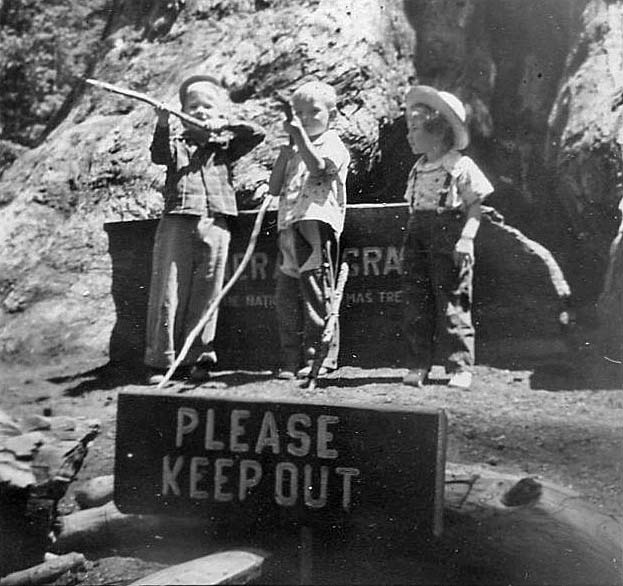
Sometimes on these trips, Ma would take along one or two of my little school buddies, so my experiences with the giant redwoods were often quite far from the state of Zen-like, worshipful wonder I later entered into with them as an adult. On such trips, we boys were typically children at play, playing grab-ass and lobbing pinecones at each other, climbing on the stout ‘do not enter’ log fences (see the attached image) that ineffectually cordoned off the giants from their admirers, and playing ‘war’ with sticks held and aimed like rifles. This was the 50s environment, of course, fostered and conditioned by countless hours of TV serials full of heroic cowboys and rascally, no-good injins, crime and detective shows (‘Streets of San Francisco’, ‘Dragnet’, ''The FBI in Peace and War'', et al) and war movies in which guns were invariably accorded star supporting roles.
Once in a while, we would link-up with some other couple’s equally small daughter there at the base of those indifferent trees, who’d watch us killing each other with stick-guns and wonder (undoubtedly) what it was with that fixation on shooting and killing that so absorbed us boys!
Today I have no great wish (or need) to be further gentrified by the exhortations of the radical feminist movement, in their efforts to aesthetically emasculate ALL men, but even back then, little girls were smart enough to understand that belligerent aggressive behavior (even with play guns) was wrong, wrong, wrong!
Still, I was enough of an introspective and inherently pensive little kid to have absorbed a substantial amount of the mood that those big trees generated and imparted to their more sensitive visitors. There was something palpably solemn, peace-filled and semi-religious about them…qualities that remained a part of many of us, regardless of our tender years, and a recollection that persists to this day. An unconscious, deep-set respect for the sagacity and sanctity of their ancient wisdom, their immortal presence enduring over the passing millennium despite the frantic changes of fleeting human life going on around them. I suppose compared to them, we are as much like a damselfly to the redwoods as the actual damselfly insect is to us: a fleetingly insignificant, diminutive life form of little relative value (except possibly as a pestiferous parasite) that comes and goes in a brief life measured in mere minutes, against a scale of eons.
Interestingly, in 2015, biologists began to study trees in ways previously seldom explored as areas of mainstream investigation. Many of these researches were stimulated by intellectual curiosity as to whether plant-matter, such as trees, have ‘feelings’, emotions and/or the ability to communicate with each other in some manner or another. Descending from the erudite academic tradition of accepted scientific attitudes at that time, certain academics and researchers began engaging in studies to quantify and qualify these possibilities, no matter how seemingly unlikely they might have seemed at first (back then).
One of the most interesting of these investigators was a German (Bavarian) forester named Peter Wohlleben. Wohlleben is a naturalist, scientist, explorer and conservationist in addition to being a working forester, and he has written a number of fascinating books on trees. Among them and perhaps his most well-known work is The Hidden Life of Trees (ISBN 978-1-77164-248-45, 2015).
In that year of 2015, Wohlleben’s work caught the attention of a number of conservationists around the world and several extended excerpts from his book soon found their way onto the pages off popular slick publications such as The Atlantic and Harpers, where they were enthusiastically considered and debated. Once it hit the NYT ''best sellers'' list, it became even more widely known. Subsequently his findings were also widely circulated and discussed among many of the earliest modern proponents of climate-change theory, given the tremendous importance trees have in helping maintain a healthy (and human friendly) atmospheric balance between oxygen and carbon dioxide in the ecosphere.
One of his most interesting findings relating to trees that emerged from this inquiry was the fact that although trees superficially appear to us as static, unchanging and inanimate (read: non-sentient) forms of biological life, in fact quite the opposite is true. They do communicate with each other, and they also live in communities, although these interactions often completely defy our superficial perceptions and understandings of life’s subtler processes, often due to the arrogant assumption that human life is virtually the only truly sentient Earthly life-form on the planet. Only somewhat grudgingly, human beings have belatedly abandoned that formerly rigid insistence on this matter, with the acknowledgement that certain primate and cetacean species are also remarkably adept in their ‘higher’ life-function.
With regards to the Giant Redwoods, Wohlleben informs us that Sequoias (as well as other types of trees) even evolve ‘nurseries’ in which to thrive. That is, areas in which the whole natural environment reflects and supports the conditions and requirements needed for their specific flourishing and survival. He observes, for example, in a comparison between North American redwoods and their transplanted European counterparts, that whereas in North America, redwoods inhabit great and formerly quite extensive forests (in which are to be found very carefully titrated and calibrated forest resources that are ‘redwood friendly’), in Europe redwood trees invariably exist only as isolated individuals. Having been solitarily planted, most often in deliberately specific botanical settings, theirs are vastly differing conditions in which to grow, reflecting the radically divergent soils, firmer ground and environmental subsurface conditions that surround them.
In North America, redwood forest environs favor softer, more variegated soils and growing conditions that help promote the growth of deeper root systems and spur the colossal vertical growth that characterises the Giant Sequoias. In Europe, a far older and far more heavily’ used’ environment generally speaking, soils are often densely compacted, notably much harder and far from the softer, variegated ground conditions redwoods prefer, hence European redwood individuals tend to not grow vertically as much as they do laterally, developing only modest treetops, huge, thick trunks, and the growth of far shallower root systems than their American confreres.
There is again the result of the lack of a supporting ‘forest’ of like trees to consider there (in Europe) in contrast to the Sierra groves, with their large communities of similar individuals, ‘tree nurseries’ and conducive vegetative flora…all components that that so prominently define the striking growth differences.
Wohlleben goes on at great length about a fascinating range of considerations regarding the trees that most ‘average’ humans all take more or less for granted (i.e. a convenient bit of shade, a wind-break, a ‘pretty scenic backdrop’, or most of all a resource for firewood/energy and/or construction resource, etc.), but the aspect of trees (especially redwoods) that most intrigued me is their purported ability to biochemically ‘converse’ with each other. This largely takes place, we are told, through extensive interlocking root systems in their forest groves, but there are other, far less readily understandable means of communication in evidence, apparently.
It has been demonstrated by some researchers, for example, that communities of trees ‘know’ when other parts of their forest domain have been blighted, destroyed by fire or otherwise depredated. This last area of inquiry is still being actively looked-into by academicians and scientists, but thus far little is actually known or understood about these more subtle levels of interaction, and their precise biochemical mechanics. It is further suspected that within these specific contexts, trees actually do have measurable ‘feelings’ and possibly also related ‘emotions’.
Some of the foregoing findings seem to verge on the parapsychic threshold, although as is commonly known, in this respect we are still almost completely unknowing and ignorant, given that there exists as of yet absolutely no hard evidence with which to prove or disprove all the conventional theories with which to define exactly what extrasensory forces actually are (or are not) and that may exist.
For me, however, even as a child, I felt something deeply unspoken yet richly palpable in their presence. Just being there, blanketed in the primordial shade below their dense upper growth, I felt a sort of reassuring yet non-verbal communication from them that conveyed to me a great peacefulness, repose, patience, and perhaps even wisdom (transcending my deficit ability to understand the context of what exactly was being shared there). But it was some ill-defined but real something…something that seemed of tangible value and great worth, nevertheless. It for me such feleings have always acted as a topical balm to help heal the many festering sores of human interactions, with all its antagonisms, thorny conflicts and endless emotional contentions that complicate our daily lives.
COVID-19 is dead, long live Flu season (not!)
Thus, this past week, after practically three years of figuratively hunkering down in the bunker, avoiding others for the most part due to the ever-present possibilities of COVID-19 transmission, I finally took my first real break in as many years to travel to coastal areas in our state that are carpeted with this sort of beautiful tree growth. This consisted of a drive that generally followed the Pacific Coast Highway-1 route, from Sonoma County all the way up to the northwest California border.
[Although experts (NOT Dr. Anthony Fauci, that great P.T. Barnum of the infectious disease arena!) warn us (rightly so) that although COVID-19 may seem safely past, that is assuredly not the case and we can look forward to subsequent new strains of that pestiferous viral bug almost every year, henceforth. As a person who has read a great many compelling arguments by reputable authorities in the CBRW agent field that almost inarguably trace COVID-19 to the Wuhan Infectious Disease Laboratory in China, I know better than to listen to such fly-by-nighters as Fauci, who has his share of involvement in the Wuhan Lab’s existence and origins. Still, with a great number of people now immunized, it’s likely a lot safer to circulate a bit more, although preventive constraints are still (or should be) in fashion!]
That stretch of Pacific Coastal America that lies along the California Central and Northern Coast is regarded (rightfully) as some of the most beautiful landscape scenery to be found anywhere in our nation, with hundreds of miles of ocean frontage, quite often hugging the actual coastal shore itself. The only part of that route that doesn’t do so, runs adjacent to the so-called ‘Lost Coast’ area, north of Fort Bragg (in a remote geographic out-thrust that ends slightly south of Eureka).
The Lost Coast is still a wild and wooly place, given its many extensive pot farms…both legal and illegal…and travelers through there are well advised to stay on the marked roads and away from ‘off-road’ stretches in that region. Those who fail to heed this admonishment may sometimes unexpectedly find themselves confronted by heavily-armed and VERY unfriendly drug people who DO NOT like strangers snooping around in their back-yards (innocent hikers, birdwatchers and campers or not).
This is quite a shame, since the Lost Coast region is quite beautiful, rugged and untouched (except by potheads and grass cultivation), but there are stories of people simply vanishing back in there, without a trace and never to be found. Given this risk, it’s simply not a good idea to plan a camping trip or a hike back into the Lost Coast, regardless of its primitive natural beauty…unless you have a yen to end up like 50s labor boss Jimmie Hoffa!
One of my good friends from old Berkeley days in the nearly 70s lived back in the Lost Coast, in a small town named Petrolia (accessible by road from Ferndale) for several years and occasionally entertained me with a number of ‘You probably won’t believe this!’ stories from his own personal store of encounters with some of the questionable characters squirreled away in the Lost Coast outback. Local Humboldt County law enforcement officers, when asked about the area, readily underscore the suggestion that it’s NOT a good idea to to poke around in the Lost Coast wilds uninvited!
At any rate, my just completed trip took me through all the beautiful scenic parts of this Highway-1/Highway 101 path along the coast, including places like fabulous old Richardson Grove and the ‘Avenue of the Redwoods’ (the old road prior to the new Highway-101 thoroughfare). These places, with their wonderful groves of ancient coastal redwoods (‘Sequoia Sempervirons’) are indeed a national treasure to cherish, given that the past 100+ plus years of intensive forest clear-cutting have destroyed so much of California’s North Coast stands of primal, original-growth redwood stands and hardwood forests.
Unfortunately, I was accompanied on this trip by an air museum associate of mine, so the chance to wander around among all those ancient old trees and soak up some of their healing vibrations by myself was largely denied me. I have traveled extensively in various parts of the world over the past decades…both as a solitary voyager and with others…and I can confirm that sometimes traveling by oneself is preferable to being constantly distracted by the presence of a companion. Such was the case this time, regrettably. And when you are still afflicted by latent ADD, as I am, it’s even more impactful to have to interact with and be distracted by others and share experiences with them while trying to appreciate the great natural areas.
One pleasant stopover was at the historic old (1927) Benbow Inn, where we had a truly sumptuous and elegant dinner before staying the night at the nearby KOA ‘kampground’ (first time for that and still ambivalent about it, but it’s quick and easy, so macht nichts!). The Benbow is a sort of glamously anomalous time warp throw-back to earlier days, and in the 20s and 30s it drew much the same crowd of celebrities, movie stars and upper-crust notables as did Idaho’s Sun Valley Resort. That tradition remains today and the Benbow retains its reputation as a refreshing taste of old-style, ‘up-scale’ life in the midst of Northern California’s otherwise down-home rural atmosphere.
The trip wasn’t a total loss in terms of partly failing to provide a restive respite from Suckatomato (the state’s Capitol), of course (despite the proletarian companionship of my air museum buddy), but I still look forward to the next time when opportunity enables me to enjoy those redolently atmospheric sylvian groves along the North Coast all by myself. I’ve always been somewhat of an introspective individual with an unusually high need for personal space and time apart and I suffer more than most if I can’t break away from all the societal and political crap every now and then.
With that in mind, I’ll end this here and remind you all of poet Joyce Kilmer’s immortal paean to the ancient wisdom and healing aesthetics of trees, which appears below. Enjoy.
---------
Trees (By Joyce Kilmer)
I think that I shall never see
A poem lovely as a tree.
A tree whose hungry mouth is prest
Against the earth’s sweet-flowing breast;
A tree that looks at God all day,
And lifts her leafy arms to pray;
A tree that may in Summer wear
A nest of robins in her hair;
Upon whose bosom snow has lain;
Who intimately lives with rain.
Poems are made by fools like me,
But only God can make a tree.
(Amen!)





 Trees (especially redwoods) are some of this planet's most priceless treasures. I recently took a COVID-19 break to go commune with those ancient old living things, up along California's North Coast. Here are some thoughts, recollections and musings. Not quite 'Travels With Charley' quality, but hopefully of interest to some of you who have also morphed from Chrysalis to Butterfly status...