Shadowing T.E. Lawrence in Taif, Saudi Arabia
Back in the 1980s, as self-shriving penance
for having lost the love of my early years in Berkeley to a Polish law student at UC, I hied myself off to the Kingdom of Saudi Arabia under contract to medical projects carried out under the aegis of that nation’s Ministry of Defense and Aviation (MoDA). As it turned out, MoDA, in addition to providing medical & healthcare for the Saudi armed forces, also took care of the Saudi Royal Family. At the onset, I looked upon this as a sort of punitive enlistment in the medical equivalent of the French Foreign Legion but I quickly realised that it was a fascinating doorway into the exciting world of expatriate Americans, working overseas.
Today, a number of years post-retirement, I can truthfully say that taking that first Saudi contract was the best decision I ever made, in terms of knowledge gained and understandings attained both about life outside of America and inside myself. How ironic then that it had been precipitated by my losing the young, talented Chinese woman I had met who had become the love of my life, whom I had thought to be HER. Or not, since a life, unvisited by such ironies as my amorous loss, is…as I have often been told by older, wiser individuals…incomplete.
The medical facility I worked out of on my initial Saudi contract (starting in 1983) was, as it turned out, the Al Hada Military Hospital & Clinic, situated about 20 klicks west of the Saudi Summer Capital of Taif. Taif lies at an elevation of about 5500 feet AMSL in the mountainous semi-coastal spine of the Arabian Peninsula known as the ‘Hejaz’ that fronts the coastal desert that Medinah and Makkah are in. As such, it can get rather cold in the winter months and remains balmy in the super-hot summer months that made life in the regular capitol (Riyadh) somewhat challenging. The Hejaz consists of an abrupt escarpment, some 6500 feet in elevation that drops abruptly off at a steep angle to that coastal desert (known as the ‘Tihama’); Taif is perched just slightly down a short way from its heights. Consequently, the moment the daytime highs start broaching 50 degrees C. in Riyadh each year, the whole kit and kaboodle of the Ibn Saud extended ‘royal family’ (estimated conservatively as numbering some 10,000 in total, since the Arabs love to ‘begat’) relocate to their summer quarters in Taif. They then rely upon Al Hada Hospital to take care of all their health needs.
My (contracted) principal assignment was that of a cardiovascular technologist and perfusionist in the Al Hada invasive cardiac catheterization lab but due to my associative affiliation with Applied Science and Analysis, Inc. (a private chemical/biological defense sciences foundation that provided support to agencies all over the world in CBRN...that is, in Chemical, Biological, Radiological, Nuclear technology), I ended up working on a few projects areas for MoDA as well. One of them involved setting-up and supporting the Saudi Civil Defense organisation’s efforts to protect civilians against Saddam Hussein’s threat of CBRN weapons, during the 1991 Gulf war (but that’s a topic for a separate article).
Our daily ‘bread and butter’ work
consisted for the most part of working on the invasive cardiology team performing diagnostic cardiac cath procedures and cardiac surgery on both pediatric and adult patients. Sometimes this found me operating the cardiac bypass perfusion equipment, while at others, I worked ‘in-scrub’ beside the cardiologist directly on the patient being operated upon. It was interesting work; never a dull moment, given the great number of patients we regularly got who had cardiovascular problems in the Kingdom. While I was there, our patients even included the old King himself (Khalid bin Abdulaziz), who died on our operating table from severely advanced coronary artery disease!
As one might expect, the range and variety of people I worked with over there was diverse. I was surprised to find that international diversity was the norm, with a substantial number of individuals from a wide range of nations employed in the Kingdom (everywhere from Aruba to Zimbabwe, as it were). There were some pretty unique characters among them, too, including perpetually drunk Scotsmen, esoterically complex Gaels, emotionally reserved Finns, some ‘extreme’ (borderline) personalities (of several nationalities), people escaping sadness (like me), Brit scientologists, gays and lesbians of all hues, hoards of Filipinos, oddballs and eccentrics, and others who just didn’t fit any particular mold or category conveniently!
One thing we all shared in common was a strong sense of adventure and desire to experience a fuller life than American or European mainstream cultures could ever dream of. In my case, as a rather vociferous critic of rapacious, souless ‘capitalism’, my expatriate work confirmed what I had long firmly believed…that ‘Americanism’ as a socio-economic system of crass, capitalistic consumer exploitation was a blight upon the innate siritual yearnings of the human soul.
Since this was the early 80s, the Saudis hadn’t quite ‘matured’ yet in terms of precisely defining their understandings of us foreigners and the extant salaries paid were therefore exceptionally high (compared, say, to wages typified in the USA or Europe for similar work). Those of us who had discovered this back then, at a relatively early part of the Saudi/expat curve were quite fortunate, indeed, and generally made out…in many cases…like bandits. In subsequent years the Saudis finally got their finger on the right pulse and scaled back their exorbitant compensatory wages for our work.
Just to cite on amusing example of daily life there,
we had an invasive cardiologist named Baxley, who was a good old boy that hailed from Alabama. Doc Baxley was an interesting mix of traits, being not just a highly eddicated (sic) invasive cardiologist but a sort of high-class ‘Easy Rider’ type, post-Hippie professional. Bax always wore love beads with his scrubs and his affect was a curious mix of Alabama back-woods hayseed and Bostonian (“pahk ya cah in Havahd Yahd…”) elan, all tossed together in an amusing manner. Of course, he was extremely laid-back…a characteristic that was a real asset in the cath lab for everyone who worked there, since high-strung personalities working on iffy heart cases can cause huge amounts of stress for the co-workers when things suddenly go south in a hurry!
Not our boy, Bax! Bax was a regular Mr. Cool from start to finish, no matter how complex or challenging the cardiac procedure was, and we all loved working with him.
One day, Bax found himself pulling cardiovascular call duty at night and as it happened, none other than a VERY highly placed Saudi Royal Prince was undergoing observation in the CICU (Cardiac Intensive care Unit) that week. The second night of Bax’s call, the CICU RN on duty notified Bax that the prince was complaining of severe chest pains that required an immediate evaluation by the cardiologist.
Bax dutifully rousted himself out of his comfy bed (in the call-doc’s room, adjacent to the CICU) and breezed in the prince’s door to take a look at him, so as to evaluate what the prince claimed were “extremely painful” stabs in his chest.
After a few minutes diddling around with his stethoscope and putting on a good ‘attentive and solicitous doctor’ show of concern, Bax ambled over to the prince and told him to try to relax: He would provide some meds that should resolve his pain and they would then recheck him in the morning. Thus pronounced, Bax glided back to slumberland and was soon figuratively sawing what passes for wood in the sere depths of the Arabian wastes!
The next morning, Bax did his rounds and dropped in on HRH the Prince to see how he was doing. He found the prince quite animated, in good spirits and elated to find that his severe chest pains had all but vanished during the night after taking Bax’s meds. Bax smiled happily, glad to hear this, and not long after this the prince left the hospital to return to his luxurious tent, perched out on the Hejazi escarpment, in the company of several of his wives and a number of anxious retainers. Bax, for his part didn’t give the incident another thought and after a few more days of call, returned to his normal daily invasive routines.
Imagine his surprise, then, when a few days later a Saudi showed up at his hospital office, unannounced. The Saudi, as it happened, was one of the prince’s personal retainers and he entered the office bearing a large, exquisitely carved and ornate chest made of finely carved Philippine Mahogany. Setting the chest on Bax’s desk, he opened the silver-chased lid and displayed the contents: a new Swiss Rolex Presidential Oyster wrist-watch made from a solid block of 14 kt gold, and crusted with small diamonds.
“Please accept this small token of sincere appreciation from HRH the Prince to you for mercifully helping him in his darkest hour of urgent need, several nights ago while he was in the hospital,” the retainer intoned solemnly.
Bax was stunned into total silence, for that watch must have cost a good US$ 25,000 if it cost a penny, and it was even engraved on the back with Doc Baxley’s name and the date of presentation!
That said, he was wise enough to not make too big an issue of his surprise and simply expressed his appreciation for such a spectacular gift, which he asked the retainer to convey back to HRH with his sincere thanks. The retainer remonstrated, saying that to refuse such a (“worthless”) thing would be VERY poor taste! Therefore, after the numerous obligatory sips of hyper-sweet Saudi tea, the retainer took his leave and a sorely bemused Bax went to get some lunch (leaving the watch carefully tucked away in a locked drawer).
Later, when Bax wore it on one occasion, we asked him about this and he confided in us that HRH had actually been suffering severe gas pains after one of his favorite wives had slipped in some highly spiced Indian curry to augment and supplement his strict cardiac diet. All Bax had done was prescribe some OTC meds for indigestion and nature did the rest!
I sometimes idly wonder what happened to that fantastic example of the finest Swiss watchmaking expertise, after he returned to the states! Just another not-too-unusual example of the surprising twists and turns of daily life in Saudi Arabia of the late 70s and 80s!
As long as I’m revealing quirky ‘Saudi expat’ anecdotes,
there was another physician at our hospital (a Dr. Al Faludi, who was a Saudi). Dr. Faludi was a thin, aesthetically stern-visaged pediatric invasive cardiologist, and once, after a procedure in which we had inserted an ‘umbrella’ plug to close off a child’s patent ductus arteriosis (a congenital hole between the aorta and the pulmonary artery) via a special catheter device, I innocently expressed my admiration of the doc’s Cartier Santos wrist-watch (a stainless steel model and bracelet, chased with gold). Dr. Faludi was a devout Muslim and one of the sanctions of Saudi Wahabbist Islam is that men are not permitted to wear ostentatious gold jewelry. Apparently he had been thinking about his watch, which had been gifted to him by a Western businessman (non-Islamic), mindful that it was technically proscribed under the strict tenets of Wahabbist Islam and very suddenly, without a second thought, took it off, handed it to me and said “It is yours; Allah would be pleased for you to have it…”
I was flabbergasted, of course, since that watch was worth several thousands of dollars, even back then (today: who knows how much more?). I politely declined, thinking I was doing the right thing, but expressed my gratitude for his thoughtful gesture. Later, I found a small box containing the ‘offending’ watch with a note on it in my locker, assuring me that he wanted me to have it with his compliments! It was all too typical of things in the Kingdom, back then! Today, after decades of experience with Western Expats working in Saudi Arabia, the Saudis are a lot wiser and far less gratuitously and spontaneously generous today than they used to be in the 70s and early 80s!
[It’s interesting to note that in the Mexican (Spanish) culture, it is considered rude and recklessly inconsiderate to ‘admire’ any possession a friend or acquaintance may own, since the custom is to immediately give it to the admirer; and to refuse the gift, under such circumstances, is considered the height of rudeness! All these things are just part of a whole new set of values Americans must become aware of and embrace, when they work overseas in other cultural situations!]
But returning to Taif,
my new station in the Kingdom, the mountainous Hejazzi region that Taif lies within was originally the domain of Hashemite Prince Faisel, back in the early 1900s before Ibn Al Saud conquered the scattered Arab tribes that inhabited the Arabian Peninsula and established the Al Saud ruling dynasty.
Since T.E. Lawrence was assigned to liaise with the Hashemite Prince Faisel, under British General Allenby’s orders, Lawrence quickly expanded his ‘advisor’ role and began carrying out Bedouin guerilla raids upon the Turks, directing and personally leading Faisel’s men in these forays. Taif at the time was a strongly fortified, important Turkish outpost and Lawrence’s exploits, raiding the Turkish trains that ran down the peninsula from Damascus to Medinah in 1916, quickly became the stuff of legends. As Lawrence’s activities during the war for the Hashemites were fairly well-known by both the Turks and Ibn Al Saud’s tribe, once Al Saud vanquished Faisel’s forces and became the new ruler of a unified (Saudi) Arabia, Lawrence’s reputation became considerably tarnished by their reckoning, since Lawrence had been working for the wrong contending ruler (read: loser) for control of the Arab peninsula!
When I was there, I was naturally keen on sniffing out the local Lawrence history, of course, as a great admirer of that tormented man and someone well-aware of his passion for motorcycles, but I soon ran into a blank wall of indifference erected about the subject by the Saudis, who still today consider Lawrence as something of an uncomfortably anomalous, interloping ‘relic’ of the pre-Saud period. This was a huge disappointment for me, needless to say.
That did not, however, prevent me and a few other hardy expats from trekking out into the coastal Tihama desert (lying beween the Hejazi escarpment and the Red Sea, to the west) to a few of the sites of Lawrence’s famous guerilla raids, one of which to this day is still viewable and consists of the remains of a whole wrecked Turkish train, engine and all!
Since non-Islamic expats are strictly forbidden from traveling to the Holy Cities of Makkah and Madinah (there is a wholly separate highway that skirts the outer margins of both ''holy'' cities) called, amusingly, “The Christian Bypass”) on the way from Taif to Jeddah, on the Red Sea shore. At a certain point we were able to take several of our 4WD Toyota Land Cruisers off the main highway and venture out to that site. The truly adventurous can today apparently get there via specially arranged camel treks but in the early 80s that sort of thing was strictly not condoned for us heretic Christians!
The wreck itself is quite a spectacular site, since it is today swept by strong winds and occasionally semi-buried in the sand, but the engine’s rusty wreckage and what’s left of the unpowered rolling stock makes for some rather spectacular scenes, way out there, away from anything remotely resembling permanently established human habitation. [I note that gradually, over the passing decades, a good deal of the smaller items and bits of the wreck are disappearing, thanks to eager souvenir hunters.]
Other possible vestiges of Lawrentian historical presence
and/or traces of anything associated with Lawrence’s guerilla forces in the Taif area are generally disregarded as being of little significance by most Saudis today. It is a real shame that a man who is so lionized in the West has been so thoroughly ‘disenfranchised’ by the Saudi Arabs themselves, but that’s simply one of the ineluctable aspects of the political contentiousness from which the present Kingdom of Saudi Arabia rose, as a result of the Western operations of the British Army in the region, back in WW1.
Of course, the whole kerfuffle that was the WW1 Arabian Campaign was never about helping any of the Arab tribes achieve national autonomy but enabling the Brits to get an edge on the Arab oil franchise, which even back in the early 1900s was starting to be clearly visualised as a vast and valuable prize which British industry and technology desperately wanted and needed. In other words, Arabia was considered a prize natural resource plum, even if the Arabs themselves as a people were disdainfully looked down upon by the Colonial English as little more than scuffling, primitive tribes of ignorant Bedouins, living out in the sandy wastes with their flocks, tents, dirty children and flea-bitten camels.Of course, when those ignorant tribal people suddenly come into possession of a third of the world''s entire oil reserves, you start paying a whole heaping LOT of attention to them!
In 1932, after a lot of back-room Western wheeling and dealing by the Allied powers (to the pointed, almost complete exclusion of the Arabs themselves and/or any true consideration for their own national aspirations), Ibn al Saud outfoxed the West (read: the Brits) and swept the playing field of competing Arab tribes (mainly the Hashemites) for himself, thus beginning what we know today as the modern Kingdom of Saudi Arabia!
Looking back, the Kingdom was (and still is) quite an experience
for anyone from the West, whether a contemporary Lawrence or simply a relatively untraveled American. In my case, I was reasonably well-traveled armchair historian before I took my contract, having read prodigiously about other cultures and being a person of keen historical bent, with degrees in history and a growing disapprobation for the sordid exploitation that characterises American capitalism. But the culture shock was still substantial, nevertheless, a lesson that I later reaffirmed when I followed Marco Polo’s footsteps to personally discover the Far East.
I could here regale you all with plenty of tales about life in the Arabian Peninsula but I’ll try to spare you somewhat and limit any further stories to one in particular that concerns itself with two favorite subjects of mine: motorcycles and T.E. Lawrence (of Arabia, of course).
Lawrence the man and legend, to considerably understate things, was a very complex, somewhat enigmatic individual. Well-read, equally well eddicated (sic) and a man of many interests, both mundane and arcane, T.E. also fancied expensive and powerful motorized two-wheeled steeds of his day. Chief among them was the Brough Superior SS100 line of magnificent motorcycles.
Designed and custom-built by George Brough of Nottingham for a select, wealthy clientele of two-wheeled, post-industrial motorsports fanatics, Brough’s machines achieved a degree of legendary fame and repute right from the start. Each was individually personalized to a customer’s exact, specific requirements, and in 1925 a Superior SS100, such as Lawrence fancied, sold for the modern equivalent of slightly over PS 10,000 in today’s valuation (the price was PS 127, back then). In total, Brough produced a total of some 69 of the fabled SS100s, all of which were guaranteed to be capable of exceeding 100 mph and were as elegant and precise as a fine Swiss watch, while also being immensely powerful expressions of leading edge motorcycle state-of-the-art, back then.
Such performance, in the early to mid-1920s was extraordinary and Lawrence was so keen on the SS100 that he eventually ended up having over eight of them (one at a time, of course)! In 1925, a Brough Superior reached over 110 mph, which at that time was a breathtakingly reckless speed to undertake on just about ANY English road!
As most who have read up on his life know,
in 1935 Lawrence, who had recently retired from his anonymous post-WW1 life, posing as one ‘Aircraftsman Shaw’ in the Royal Air Force, died when he unexpectedly came upon two school boys on bicycles in the roadway near his cottage at Clouds Rest, hidden by a rise in the road until it was too late to stop. Deflecting the Brough at the very last second, he narrowly avoided hitting them (although he did hit the rear wheel of one of their bicycles) but when the heavy Brough careened off the road into the woods, Lawrence struck his un-helmeted head when he came down to earth and sustained severe cerebral injuries that several days later claimed his life. It is imagined that he was, of course, traveling at a higher rate than was than prudent on that stunning machine, given his enthusiasm for raw speed and the dangerously narrow English countryside roads!
[Of secondary interest here is the fact that his sudden, fatal accident subsequently inspired the physician who vainly tried to save his life immediately after the crash, to promote safety helmet use for all motorcyclists in the UK. That movement gathered force as the years progressed and today we may look back to that incident as one of the principal factors in the universal adoption of protective helmets for motorcyclists! Although Lawrence died from his legendary reckless disregard for personal safety…both on the battlefield and on his Brough Superiors…his death therefore rather ironically inspired today’s two-wheeled rider safety philosophy.]
As a man of modest means,
Lawrence was often hard-pressed to come up with the funds sufficient to adequately facilitate his motorcycle passion, but fortunately his close literary friend, George Bernard Shaw, ‘enabled’ Lawrence to indulge in this passion for high-powered motorcycles by ‘loaning’ him the money to do so (repeatedly).
Even while in Arabia, Lawrence would ‘borrow’ British Army dispatch motorcycles to travel, whenever he could justify the urge with his superior officers. His abilities on a motorcycle were naturally excellent but while most contemporary machines of that period were limited to speeds of about 50 mph, as much more powerful motorcycles such as Brough’s gorgeous monsters began to proliferate (among the wealthy), the need for some sort of protective rider gear became apparent. As has been noted, Lawrence’s death merely confirmed what many had already become convinced of: that riders of hazardous, two-wheeled, high-powered machines must have at least a small margin of protection from their rather common disregard for safety!
Interestingly, Lawrence’s passion for these machines spawned many thousands of other young men over the years to ride motorcycles and as the 1950s dawned, he was often pointed to by aesthetes as evidence that not all motorcyclists were lawless, thuggish brutes who were fond of terrorizing mild-mannered citizens in peaceful towns and trashing quiet villages. Lawrence was, after all, a highly accomplished academician, an antiquarian, scholar, writer and renaissance man. The public perception that all motorcyclists were a public nuisance to decent folks arose just after WW2 when thousands of veterans who had literally been to hell and back bought motorcycles (mostly Hardley-Goodsons, unfortunately, although Marlon Brando actually rode a small Triumph in his iconic film, ‘The Wild One’) to work off what these days would qualify them for substantial compensatory subsidies, for what were actually severely disabling PTSD disabilities.
Unfortunately for most motorcyclists,
Hollywood (and the media, who instinctively sniff out over-hyped, sensationalized potential stories with the sort of frenzied gusto that a Piranha goes after blood), the ‘bad biker dude’ image proved irresistible, and the scores of B-Grade biker movies that Hollywood churned out simply engraved that image indelibly in the public’s mind. The fact that you don’t have to be a Hell’s Angel (and perhaps might even be a rocket scientist at CalTech) to be a motorcycle enthusiast, doesn’t seem to have ever entered into the teeny, tiny walnut-sized forebrain thoughts of most ordinary people, since then. It’s a contrast that I have always taken great pains to qualify whenever I talk motorcycles with garden-variety proles (who constitute roughly 80% of America’s population, in my opinion).
At any rate, Lawrence’s and my own passion for these two-wheeled death-machines has taken me down a great many disparate roads, over the years, and to a great number of us who value Hunter S. Thompson’s immortal words on living life fully (“Life should not be a journey to the grave with the intention of arriving safely in a pretty and well preserved body, but rather to skid in broadside in a cloud of smoke, thoroughly used up, totally worn out, and loudly proclaiming ''Wow! What a Ride!''”), we only get one shot at savoring what it’s like to be alive and sensate in a world full of incredible, potential peak-experiences, so why not?
That isn’t to say you have to end your own life like Thompson, or Richard Brautigan (or any number of other highly creative, artistically-inclined individuals) did, with a lead sandwich, since the whole purpose is (as Thompson noted) to ‘…arrive safe and alive at journey’s end, marveling at the incredible nature of it all.’ But a life ‘un-lived fully’ is a mere, shallow vestige of the real thing, of course, as far as I am concerned.
Which draws me to a certain individual
whom I came to know during that very first Saudi contract, a Brit named Nigel Bunce. Bunce, for anyone interested, is an ancient Anglo-Saxon surname that derives from the French word ''Bon'', meaning a ''jolly or good fellow.''
Nigel was a spare, lanky fellow with a thick Yorkshire accent who also had a passion for motorcycles. Although not quite a full-fledged and gifted artist, Niggie (as we called him) had a very healthy creative streak lurking within his laconic person that soon became apparent when one met him. He also had a ratty old dirt-bike of Japanese manufacture that some previous expat had imported into Taif and left to him at end-of-contract. It was, I think, a disreputable old Honda CR450R Elsinore that had been thoroughly flogged through the desert sandunes with thoughtless abandon (and with not quite enough oil changes along the way to keep it happy).
As a Japanese two-cycle, big-bore monster single dirtbike, it was certainly an odd-ball sight to see way out in the God-forsaken (or God-infested, depending on how you look at it) Arabian desert. It smoked enough to make the Newcastle coal country air seem pristinely clear and it was also a noisy SOB you could hear for miles in the distance. Between those characteristics and the clouds of desert that Nigel regularly stirred up with it, there was no mistaking when Nigel was out and about on his steel steed, terrorizing herds of camels, scattering Bedouin flocks of sheep, precipitating camel miscarriages and in general creating perplexities and sewing and consternation among the indigenous Arabian tribes!
Given his ability to navigate the worst parts of a hazardous, sometimes quite dangerously hot desert wasteland, Nigel was unapproachable by even the most determined local police! No horse was fast enough to catch him, nor was there a Saudi religious police car built that could corner him, when he was in his cups and out of the hospital (where he worked as a maintenance engineer). Oh, they tried! Good Lord, how they tried to end his two-wheeled, one-man, sheep-terrorising terror campaign! To that end, Nigel was among the more legendary members of the hospital’s expat staff, along with a doleful Scotsman who played somber highland laments on his out-of-tune pipes at painfully high levels whenever he was depressed, and all the usual gang of other suspect ‘irregulars’ we had there.
I came to know Nigel better off his bike than on, and when he was NOT being chased across the desert sand dunes like Lawrence fleeing from the Turkish cavalry! At such times, he was quite thoughtful, often philosophic in his perceptions of life and downright interesting to chat with. He was also a confirmed Scientologist (shades of Tom Cruise and his manic ilk!), a mystic, and a believer in extraterrestrials (among several other things).
Regardless, he was always a fascinating person to share a beer with...illegally, of course, but all expats readily availed either illegally imported German beer, bathtub-fermented wines made from German bottled fruit juices, or a deadly home-made liquor cutely named ‘Squeek’, or ‘Sidiyki’ (which is also the Saudi word for ‘my friend’). I would occasionally plumb the depths of his over-active mind for his opinions on things like Scientology, whenever things were otherwise a bit dull, after a hard day of work in cardiac surgeries and it helped pass the time.
Niggie was never boring, whether listening to his tales of near-escapes from the ‘Muttawa’an’ (religious police) on his ratty old Honda dirtbike or taking a philosophical dive into speculative L. Ron Hubbard theories popular with Scientologists, one could count on many happy moments of diversion when he held forth.
One day, close to the very end of my first Saudi contract at Al Hada, Nigel breezed in with a gift for me. It was a cleverly sculpted mug upon which he had rather artfully modeled a weird, rather bizarre face that looked like a ghostly specter gazing out of the mists of a crypt. I suppose it was intended as a sort of portrait of what Nigel imagined to be my ‘inner spirit’ (which is often quite bizarre in its own pedestrian way) and I wasn’t quite sure what to make of it…whether to use it for coffee or for strong spirits!
Regardless, when I finally left the kingdom on one of those big, beautiful and magnificently over-engineered Saudia Airlines Lockheed L-1011 TriStars, the cup went with me. I still have it today and it is carefully tucked away with a small collection of equally unique items of memorabilia from my adventures.
Occasionally I find myself wondering idly whatever happened to Nigel after we left the Kingdom upon completion of our first contracts, and whether he’s still around today (or not). As recent years have proven, too many of my close friends and confreres have begun to drop away like flies who have strayed too close to a can of RAID organophosphate pesticide, and given his adventuresome living habits Nigel has probably long-since departed this mortal coil!
Whatever his fate after we left those illuminating experiences out in the desert sands behind us, Nigel’s singular personality remains with me in my mind. As such, he joins ranks there with other eccentrics and human singularities such as T.E. Lawrence, who all found a radically different cultural slant on life to explore and savor in that uniquely different part of our planet, that contrasts so starkly to the rest of today''s modern world!



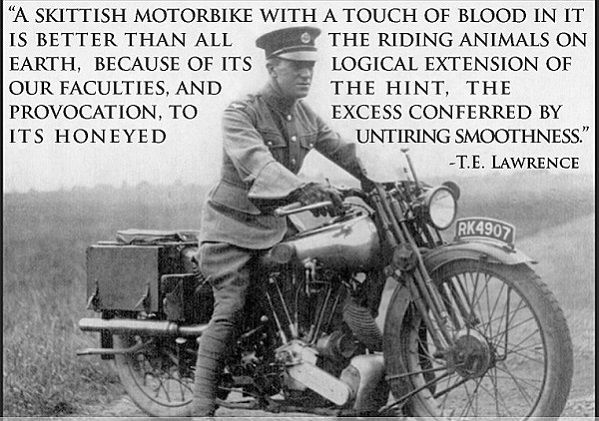 Thomas Edward Lawrence, born in 1888 and prematurely killed in a motorcycle accident in 1935, was a singular legend in his day, although at only 65 inches height, he hardly cut an imposing figure if you saw him on a street in London. Put him in a bernoose and on a camel, however, and he was unforgettable as a singularly unique romantic icon of modern history. What follows here is a story about the land where Lawrence (known to the Arabs as 'Al Aurence') rose to become a legend ('Lawrence of Arabia') who is today recognized by almost anyone with even the slightest understanding of Arab culture. This is a story about some of my own experiences in Saudi Arabia, with a sidelight on Lawrence and motorcycles.
Like you, I've always enjoyed going off to far-off places largely as a result of my encounter with people from other countries while in graduate school. Eventually, going around the world with my Thai friend and learning from living in five different parts of the US that people are both the same, and different, everywhere.
In the early 1980s, while looking for work, I saw that the Saudi's were interviewing for college professors right here in Houston. But, inserted and his wife by that time they were requiring a knowledge of Arabic and I didn't think that I was capable of learning enough Arabic to go. I knew about higher salaries and that was certainly an incentive although adventure always intrigued me more than money. I guess I had Lawrence's or Hunter Thompson's sense of adventure. Always going at things full tilt without concern for safety and therefore surviving many incidents that could have been the end of me. Several, in fact, while occupying the 500 pound seat of an electric wheelchair.
While at Atlanta University from 1978 to 1980, I encountered graduate students from all over the world and befriended some of them. One was the son of a Turkish holding company owner. He invited me to come to Turkey and explore. Unfortunately I never did. But there was the son of a prayer leader from Mecca and his wife, one of the daughters of Ahmed Zaki Yamani, the Minister of Petroleum and Mineral Resources (1962-1986). The young man studying for his MBA had sent his wife back to Saudi Arabia after his son was born a United States citizen, to Mecca where he would be brought up in the faith with his feet in both worlds. He decided to have parties for a few friends and me since the large home of his aunt, there for cancer treatment, in North Atlanta vacated by her as well. I attended two of those parties where he had a globe with four of the finest liquors inside and a large water pipe that all shared except me.
On the first of those parties, I was driving an Indian couple and a guy from Yemen home from the party at 3 AM and was faced with a driver on a narrow road with a high embankment on the right whose headlights were in my lane coming at me. Instead of turning right as one is supposed to do to certain destruction on that high bank, I turned left into the other lane and he passed me on the right without a head on collision. I might have been considered drunk at the time, but when I asked, while the Indian couple were asleep, the guy from Yemen verified what happened.
At the second party, I awoke at dawn from a room upstairs to find him on the deck out back over the ravine where we chatted. He invited me to come to Saudi Arabia and join him in the desert at all men [and dancing girls] hunts where they had a wonderful time away from the problems of the Kingdom. I still wish I had somehow made a better connection with him. Later, I was invited with all of the faculty of the Graduate School of Business to a party held by his aunt upon her return to Saudi Arabia taking two doctors from Atlanta with her to continue her care there. There was a sumptuous buffet and I had one of the most erotic dances ever with the wife of one of the doctors, scared to death of going where women were held under such strict rules.
I never had a desire to ride motorcycles. Probably because inherently I knew I would probably kill myself after riding bicycles some 50,000 miles. My cousin, five years younger, bought a Triumph Bonneville when he was 17. I rode with him once as he took it up to 90 on a curvy blacktop talking to me over the shoulder and looking back with one hand on the handlebar. He had three accidents in two years and sold the bike. Later, I took a couple of evening rides on the back of an old guy veteran student with one of those aging Hardly Goodsons. He was rocksolid and we rode slow.
Ron