Arbeit macht Porsches: The seldom discussed subject of forced labor under Herr Dr. ing. Prof. Ferdinand Porsche during WW2 (and other comments on ‘Porschedom’)
Today’s younger Americans
tend to suffer from a unique form of historically short-sighted amnesia. That is, they tend to be so wrapped up in themselves and their equally "historically sheltered" peers on social media that they generally have little if any interest in anything that occurred prior to their birth year. If anyone reading this knows of a younger person who has today gone on to become a post-grad historian, I would submit to you that they merely constitute the exception that proves the rule.
Lest it be said that this is a grossly biased statement of an ‘ageist’ nature, and in all fairness to these blithely naive young folks, it may safely be stated that even older individuals themselves who were born before that war often know very little about certain important aspects of that war and the nature of the actions precipitating them.
One of these areas of historical myopia, applicable to today’s contemporary Porsche automobile owners of all ages, is awareness of the extent of Hitler’s National Socialist regime’s use of forced (involuntary) labor in the activities directly attributable to the justly honored and highly esteemed Herr Dr. ing. Ferdinand Porsche, the brilliant conceptual originator of our favorite lineage of contemporary ‘sports’ automobiles. [Note: Porsche was born a Bohemian Czech, but later relocated to Austria.]
In that context, bear with me as we plunge back into the never-ending contentions and controversies surrounding Adolf Hitler’s National Socialist regime of the 30s and 40s (or ‘Nazis’, to use the British term that today applies to his National Socialist followers (interestingly, it has recently become a favorite accusative leftist radical label for anyone who vehemently demurs from a harshly radical progressive agenda).
Most adults in today’s America are familiar in more or less general terms with the Second World War and most also have a generally rudimentary knowledge of the major events of that war, involving the Allied Powers and those of the Axis Nations. Back in the immediate post-war period (1950s/60s) all grammar school and high school students were expected to take a prescribed number of courses in history, both American and international. The events of the then recently concluded war, given its immense impact on the entire world, received special emphasis.
Over time, however, as the numbers of WW2 veterans became attritted and the socio-political orientation of American politics shifted from right to left, the history of that war became less emphasized. In more recent decades, due largely to the rise of the radical leftist progressive movement, our entire educational system has undergone a sea-change till at present, history (and many other of the ‘liberal arts’) have fallen into disrepute in school curriculums. Accordingly, those under the age of 35 or so are often painfully ignorant of the cataclysmic events of the 1930s and 50s. Save for a small group of historical ‘gatekeepers’, awareness of Nazi Germany’s horrendously genocidal depredations against Jews and other so-called ‘undesirables’ (a term rhetorically resonant, I think, with Hillary Clinton’s infamous ‘deplorables’, bemusingly) have in large measure fallen away in contemporary America.
However, due to the inexhaustible efforts
of Jewish activists both internationally and in America to keep the horrors of their people’s horrific suffering under Nazism (“Never again!”) ever-mindful in the awareness of non-Jews in today’s society, we are regularly reminded of the cruel mistreatment of the Jewish People at the hands of the Nazis in certain segments of our national media. Organisations such as the Public Broadcasting System (Corporation for Public Broadcasting, or CPB) make sure that Holocaust (the Jewish term for it is ‘Shoah’) awareness is ever-fresh in the minds of the American public (this is attributable to the efforts of influential Jewish-American philanthropists and supporters involved with that corporation). Therefore, it is challenging to find an older adult who remains totally unaware of their plight, since PBS is viewed principally by older individuals).
During that war, the Communist forces of dictator Josef Stalin were our ostensible allies, of course, and current naive infatuation of our youth with the ideological propaganda of today’s American radical leftist progressive neo Marcusian/Marxists has helped assure that when we discuss inhuman political regimes, we reflexively turn to the German Nazis as humanity’s most perfect monsters.
Regardless of the conveniently overlooked fact that under Stalin’s brutally repressive regime, far more innocent people (as many as several hundred millions of them) were tortured, imprisoned and/or outright executed by Stalin than under the the Hitler National Socialists. [Note: Stalin, in fact, deliberately attempted to exterminate the entire Ukrainian Nation in the 30s, by confiscating their entire annual national grain harvests for Russia''s exckusive use, thereby effectively starving them to near extinction.]
Furthermore, Stalin condemned uncounted millions to his ‘Gulags’ (both criminals and political prisoners alike), which were quite literally Russian counterparts to the infamous Nazi SS death camps (Todtes Konzentrationslager). The only real difference between the two was the fact that the German effort to exterminate Jews and ‘undesirables’ was overt and coolly deliberate National Socialist state policy, whereas Stalin’s equally abominable atrocities, while nonetheless cruel, were with some exceptions (the ‘Ukrainian genocide’ of the 30s) as coldly inhuman. That certainly doesn’t make them any less censorable, naturally enough, or less genocidal in the event.
If Hollywood’s criteria is any gauge to judge by, no movie about the Second World War is therefore complete without its heinously evil and inhumanly exaggerated ‘Nazi’ stereotypes to round out the ‘bad guy’ element in the action. This overlooks the fact that in so many instances, the Soviet Army soldiers were exponentially worse and far more barbaric in their numerous violations of the conventions of warfare than the Germans ever were, a well-documented historical fact that has also been ‘conveniently’ overlooked by today’s youth!
Again, thanks to Jewish activists, that the Nazis used concentration camp inmates as forced labor is today a proven, well-documented fact and one that has been extensively researched since war’s end. What has never been completely examined by the Western Powers to date is the fact that at war’s end, millions of captured Wehrmacht prisoners of war were incarcerated by Stalin and also compelled to work from 1944 through the mid-1950s to rebuild Russia’s devastated infrastructure...quite often to the point of death from starvation and exhaustion. It is estimated that over one million German POWs were never repatriated (due to death from forced labor in Russia).
But returning to the subject
of Dr. Porsche’s German use of forced labor by concentration camp inmates, it is calculated that a total of approximately twelve million camp inmates were used in Germany as forced or slave labor for the production of war materiel. This figure includes Jews, Russians, Poles, Gypsies, and many smaller, more marginal groups of "non-Aryan" outcasts, including homosexuals (regarded as ‘undesirables’).
In 1931, Dr. Ferdinand Porsche established his own company (Dr. Ing. h. c. F. Porsche GmbH) and soon became a member of the German National Socialist party. As a favorite confrere of Adolf Hitler, who was and had long been a keen car enthusiast, Porsche enjoyed special favor among the highest-ranking Nazi circles and had close ties to the Nazi Party throughout the war. His company also participated in many wartime production contracts awarded by the Reich for war materiel.
Given his close and integral relationship with Volkswagen throughout the war, a great amount of Volkswagen’s war effort may therefore be directly linked to him personally, as well as to his firm, Porsche AG, for direction, management, consultation and logistical planning for the Volkswagen industry''s war efforts.
Most people who know anything about the war (WW2) and Germany’s involvement in it have a vague awareness of the origin of the well-known ‘Volkswagen’, which was originally known as the KdFwagen, or “Strength-through-Joy wagen”, a vehicle largely of Dr. Porsche’s design and certainly developed under his immediate direction. Given that the Volkswagen story is a long and fascinating one in its own right, I won’t go into any great detail about the development of the Volkswagen and its origins other than to say that under Porsche’s engineering and creative genius, Hitler took to Porsche’s concept of an economical, small, air-cooled civilian automobile for the masses with keen enthusiasm in the mid-1930s. When war finally broke out in 1939, Porsche’s expertise and his entire design bureau were quickly harnessed in the furtherance of all German vehicle production.
This key role in Third Reich industrial wartime development first took shape in the above ‘KdFwagen’ development and Porsche’s final proposal for the Beetle was quickly and enthusiastically embraced by Hitler. Amazingly, the basic Beetle design endured for almost 64 years of continuous production and millions upon millions of units (production ended in 2003) were sold, each year bringing with it only a slight modification of the original concept each year. The perfect utility of the basic Beetle design, with its simple, air-cooled rear engine and ease of maintenance also captivated the German OKW (Obercommando des Wehrmacht, or High Command) planners, who envisioned a rugged yet simple and highly functional car for use by its troops.
Thus, the VW Typ 82, or ‘Kubelwagen’ (‘Bucket car’) took shape and gained a reputation for being able to operate reliably virtually anywhere, regardless of extreme heat (African Sahara) or excessive cold (The Russian Front). A spinoff development known as the ‘Schwimmwagen’ was an amphibian variant that met with equal success in short order. A further important development of the famed Beetle was the Volkswagen Typ 87 (or Kommandeurwagen), a 4-wheel-drive Beetle intended for use as a small, four-person, rugged staff car for field use.
As the prospect of war loomed larger in the late 1930s, Porsche had also been given a key role in helping develop certain German weapons systems and concepts, including the well–known, if somewhat imprecise “V-1” ramjet-powered flying bomb that so terrorized England. Porsche was awarded a heavy tank development contract in 1938, which yielded the Porsche diesel-powered Panzer tank proposal. A further contract was awarded for the massive Tiger 1, a super-heavy and well-armored, tracked tank with a powerful 3.5 inch gun derived from the formidable German ‘88’ FLAK cannon. However, the Porsche Tiger’s Porsche-designed hybrid engine proved to be unreliably problematic (and unconventional, having twin air-cooled, gasoline-fueled engines that powered two electrical generators to drive the main wheels).
In addition to frequent breakdowns, the use of petrol in the Porsche Tiger (known as the ‘Tiger P’) as a fuel imposed further complications and this eventually resulted in a competing Henschel design (known as the ‘Tiger H’) with its more conventional and simpler diesel powerplant, being accepted. Still, Porsche’s radical hybrid engine design was a presciently advanced compound engine design for its time, using both ICE and electricity to power a vehicle (in 1940, this was some eighty years prior to today’s common electro-mechanical engined ''hybrid'' vehicles)! It was perhaps too advanced to be practical for powering a war machine back then, however!
In short, Doktor Porsche quickly proved
himself and his company to be of critical strategic importance to the Nazi war machine in numerous ways. For this, he held a high SS rank conferred upon him by Himmler; for this major role in Nazi armaments development, and for his early membership in the party, his wartime work received much criticism (as did all who had served in some capacity or another in Hitler’s Third Reich) and subjected to much Allied scrutiny.
It bears pointing out here that in that war, it was a common Nazi practice for high honorary SS ranks to be awarded to key civilian individuals who had helped the war industry, by Heinrich Himmler (Wernher von Braun is another noted scientist/engineer who was honored similarly) and this was (as the saying goes) "an offer that couldn''t be refused." As such, this aspect of Porsche’s career is not in itself especially noteworthy.
Forced labor controversies, post-war
Immediately after the war, there followed a prolonged period of rigorous denazification in Germany, partly due to mandates laid down by the victorious Allied High Command at war’s end, but also partly owing to a wave of mass ‘self-cleansing’ engaged in by many influential German civilians who had formerly belonged to the party and/or figured significantly in the Hitler regime’s wartime activities. Most civilians were understandably eager to shed their former association with National Socialism as quickly as possible.
Porsche himself was escorted to France under guard, his help ostensibly requested to help the French further develop their Citroen 4CV small passenger car, a small 4-passenger vehicle that had a water cooled engine at its rear, behind the rear axle. While in France he was arrested by the French Government and held on trumped-up ‘war crimes’ charges for a ransom of several million marks demanded for his release (which fortunately was paid by the Piech Family). This large sum was later returned to him but given inflation and other post-war economic effects it never amounted to much of a suitable compensation). The proposed German-French Citroen cooperation never materialized, in the event, and Porsche’s suggestions for improving that small car were never acted upon in its production.
More importantly, as details of the heinous German genocide against the Jews, with its mass executions, concentration camp and ‘death camp’ internments, began to emerge, the question of possible criminal human rights violations and war-crimes by individual Germans came to be the chief focus of a great many Western agencies’ acute investigation. Not least among these undertakings were several by Jewish organisations that took it upon themselves to not just actively identify suspected Nazi war criminals but to hunt down those deemed to have held major responsbility for carrying out egregious war-crimes and related activities.
As a key figure involved with German war production undertaken both by Volkswagen and by his own design firm, Ferdinand Porsche faced a stringent accounting of his own, as accusations of both the Volkswagen Company’s use of forced and/or slave labor and those of his own company were made. Porsche was understandably interested in protecting his reputation, particularly since he had substantial plans for developing his own automobile design bureau and its concerns after the war. These included the introduction and production of a subsequent line of sportscars (i.e. the Typ 356, which was literally a custom Porsche body shell on a chassis using Volkswagen mechanicals). This ultimately led to prototype racing cars (i.e. the famous Porsche 550 series) as well as later sportscar designs for private purchase and use.
In the late 1940s, after substantial ‘normalisation’ of war-torn German had begun, formerly suspended auto racing in Europe began anew (chiefly spurred by Italy), albeit on a limited basis at first. Porsche’s always innovative and well-conceived ideas thus faced a potentially bright future and he did not welcome any lingering accusations of possible war-crimes as his post-war company organization began to develop high-performance race car prototypes. Given Porsche''s integral role in Volkswagen AG, his initial designs were based excusively on Volkswagen mechanicals and components (the just referenced 550 series race cars of the early 50s that used special Porsche-enhanced Volkswagen engines), but all bore the Porsche name.
As the first post-war continental auto races began again, the Porsche Company prepared several race-prototypes and competed in international races. By the mid, early 1950s, it became clear that Porsche cars were consistent winners and they began to garner a reputation among both racing enthusiasts and the general public alike.
Porsche initially claimed, upon being confronted with the wartime forced/slave labor accusations at war’s end, that his firm had only used about “35 or so” inmates in his war efforts and it was only much later that, after investigations were renewed, that more details emerged from wartime records and Volkswagen documents showing that in fact Porsche had used significantly significantly more than 350 concentration camp inmates and employed them as ‘forced laborers’ (many were integral to the V-1 production). Some critics contended that their tenure was more accurately designated ‘slave labor’ than mere ‘forced labor’ and this became a source of acute embarrassment to Porsche, particularly since all this renewed controversy came at a time when American auto enthusiasts were ‘discovering’ the wonderful new Porsche sports cars (such as the milestone, rear-engine Typ 356, which initially used a high degree of VW components in its production).
Several years ago, a German economics journalist named Ulrich Viehoefer authored a book titled Nazi Culprits in Stuttgart that opened up a whole new can of worms, concerning unethical use of forced labor by Porsche during wartime. To the best of my knowledge, it has never been translated from the original German into English and efforts to obtain a copy seem fraught with difficulty. However, I think that it might prove to be quite interesting were it available in English, since today Porsche GmbH has emerged from the total devastation of WW2 and risen to the apex of its spectacular curve as a producer of high-status, high-cost sportscars.
It’s safe enough to speculate that few of those who today spend anywhere from a hundred thousand US dollars to upwards of three million for a late model Porsche have the slightest clue as to the shady wartime history of the company was that developed their expensive modern ride and established as the high-status symbol it is today.
[Of special note here, given my dedication to the VW/Porsche ‘Ugly Duckling’ 914 Projekt, is the fact that the very first Porsche 356 sportscar (designated the “Typ 356/1”) used a mid-engine design. Aside from having a somewhat longer rear deck, it looked remarkably like the later 356A/B/C production cars, when viewed from the front lateral perspective. After considerable review of further design studies had been completed in nthe late 40s, it was determined that the new 356 car (to be designated the "Typ 356/2") should have its engine placed aft of the rear axle, although this did not guarantee any better handling than the 356/1 car had.
Porsche was himself very fond of the mid-engine concept throughout his life and thus the very first Porsche 356 (356/1) is a direct ancestor of both the 70s era 914 car and the modern generation Porsche Boxster and Cayman cars, both of which use the mid-engine concept. Ironically, the rear-engined Porsche 911, a car that has become enshrined as the Porsche icon over the years, was a 2nd choice approach!
Never forget this important historical fact when your ‘real Porsche’ friends and associates make snarky comments about the Typ 914 not being a ‘legitimate’ Porsche!]
That said, it is also likely safe
enough to speculate That not only do most contemporary Porsche owners NOT know of this ‘dark past’ history of the Porsche Company, they also probably wouldn’t have the least concern about this in our age of ‘forgetting history.’ And that is probably true across the age spectrum of Porsche owners, since having a Porsche (of any kind) is today regarded as a sort of ultimate status symbol, denoting economic success. Ethics and moral rectitudes pale in the face of the pure enjoyment driving a top-performance supercar confers upon Porsche owners in our American uber-materialist, consumer society.
Speaking of ‘across the age spectrum’, a recent poll by a certain California region of the PCA (Porsche Club of America) revealed the median age of that region’s Porsche owners to be over 65 years or so, and with no children. Late model Porsches, whose early 50s predecessors were initially marketed as only ‘slightly more expensive’ than regular automobiles in the early 50s, are now so costly that only the upper-most income earners in our society can realistically afford them. Consider also that a whole, massive after-market industry has grown up around the Porsche car. Additionally, factory authorized service, repair and maintenance are now prohibitively expensive, as well.
Thus, being able to purchase a Porsche is just the tip of expensive iceberg. Keeping, feeding, insuring and caring for one of these modern supercar progenies of the 356 now costs more than roughly 90% or more of our American public can realistically afford or exonomically justify. (this, of course, simply makes having one of them so much ''sweeter'' for those who can... In fact, FACEPLANT mogul Mark Zuckerface recently had Porsche build a custom ''Limosine Macan'' for his wife, the cost of which we can only guess wildly at.)
Late model Porsche owners, for the record, tend to be predominantly white, retired white-collar professionals (at least) and ‘old money’ individuals as well, who reward themselves with one of these uber-costly cars as a perk of having made their money back in the post-50s boom period when wealth was easier to acquire and accumulate than it has become in current decades.
But this is really pretty much beside the point addressed by the above observations, concerning the ‘dark history’ of the Porsche cars so many people (like myself) choose to lavish our affection on!
Coping with the challenge
of modern Porsche adulation, if you’re NOT one of the wealthier members of society, can impose, as pointed out above, quite an economic challenge, so how can one deal with these harsh financial realities if one lusts (irrationally) after these cars but can’t quite afford it?
As has been pointed out in several other venues, there are still some means by which a mere mortal may gain entrance to the exalted halls of Porsche Valhalla. One is to acquire a specimen of the first front-engine/rear transaxle, water-cooled Porsche, the Typ 924 (also subject to snarky disparagements by Porsche ''purists''). There are still plenty of examples floating around that are in good condition and that may be had for modest prices…and not because they are not good cars. They were merely, like the 914, not a continuation of the traditional, smoothly curved, air-cooled Porsche. As such, they failed to capture the enthusiast’s imagination like the 356 and 911 did.
My personal approach has been to confine my active Porsche enthusiasms to that hybrid ‘bastard’ of both the Volkswagen and the Porsche companies: the still affordable VW-Porsche Typ 914. Fortunately, the swirl of controversy as to whether the 914 is a Volkswagen or a ‘real’ Porsche matters not in the least for me, since I just love the whole concept of the 914, from design and origins to the actual, 4-wheels-on-the-ground tactile joy the car brings just in the driving of it. While it is an actually spectacular little machine on the road, it still has enough of that ''just a VW Bug humility'' about it to appeal to an old school Bohemian eclectic like me!
The 914 is not a direct product of wartime forced or ‘slave labor’, having been designed and built in the late 60s and early 70s by a new generation of Porsche engineers, but it is indisputably a remote heir of that darker period in history when Herr Doktor Professor Ferdinand Porsche built cars for the people (i.e. dem Deutschen Volk). It is further, as has been previously pointed out, closer in both spirit and development to the very first Porsche air-cooled sportscar, the 356/1 (both with mid-engines). The 914 is therefore a ‘best kept secret’ as succeeding 356s and 911 generations continue to skyrocket in price.
[I was recently reading a 1972 Road & Track issue in which there was an article reviewing the ''never-to-be-produced'' (there were only 10 ever constructed) Porsche 916, a very much improved 914. Deciding to check the classified ads in its last few pages, I spotted several advertisements for Porsche 356 coupes (A, B, and C cars) and was stunned to find several that offered used 356s in excellent condition, with low miles, for only two or three thousand dollars!
One specimen, described as being in Concours condition, came with a complete spare Porsche 356 engine, a spare transaxle and numerous extras...for only $5500. I just about had a heart attack, for I''d lost track over the years how great an impact inflation has had on the value of the US dollar!]
That said, it pays to note that now that ‘the other, REAL’ Porsche prices are realistically out of reach for most people, the value of the 914 has recently begun to rise dramatically, as well, so the time to get a nice one is NOW; not far from now, it too will also become practically inaccessible to most bourgeoisie budgets!
A final comment: It should be noted
that the whole rise of National Socialism in Germany in the post-WW1 years was largely attributable to the extremely inequitable sanctions imposed upon a defeated Germany by the victorious Allied Powers. Much of the motivation for German fascism was a virulent expiation of extreme anger and desire for revenge on the part of France, concurrent with France’s traditional geo-political hatred of neighboring German Prussia. Forgotten is the fact that Germany did not actually start the war but was unavoidably ‘pulled into it’ due to alliances it had made prior to the outbreak of war in August of 1914.
Germany suffered immensely from the unreasonable and one-sided Allied demands for war reparations imposed upon it and German resentment of this grossly injust treatment, having festered and simmered on slow-boil since war’s end in 1918, provoked the wide-spread social resentment that ended up as German National Socialism and Hitler’s consequent rise to power. From that point to the start of WW2 was almost a given potential.
While Nazi Germany’s genocidal actions against the Jews are categorically indefensible, German National Socialism itself (minus overt Jew hatred) was actually a response to the intolerable economic suffering it underwent as a result of unjust demands made at the Armistice signing (further enhanced later by severe financial recriminations imposed by the League of Nations against Germany…actions taken despite Woodrow Wilson’s more reasoned and moderate recommendations).
During that war, the German people were by and large merely behaving in a logical, if unquestioningly patriotic manner, much as the people of any nation would who have decided they had been unfairly treated at the end of a war, at the Armistice signing, that ended largely as a draw. In using forced (politically enslaved) labor in WW2, Dr. Porsche and his automotive enterprises were quite naturally drawn into the war effort and had the national/political circumstances been reversed, Americans would likely have responded exactly as he and his cohorts did (minus virulent Jew-hatred).
Vengeance is, as the famous saying goes, “a dish best served cold (not hot).” The crucial difference is that in Germany, open hatred of the Jews was a blunt and open, factual state policy, while discrimination against Jews in America (that certainly did exist) was a far more subtle affair. Another historical fact is that America had some very powerful anti-Jewish industrial tycoons (perhaps the greatest among them being none other than automobile magnate Henry Ford), Further, Germany''s wartime eugenics programs were largely modeled after those that were nascent in America, at the turn of the century! More forgotten history!
Also not to be overlooked is the fact that violent prejudice against Jews was an established fact of life in both pre-war Russia and France (remember the Dreyfus Affair?) for almost a century or more, well prior to Hitler’s ‘nomalisation’ of Jewish hatred as politically acceptable state policy in the new German Reich (Hitler wrote extensively about his hatred of the Jews in MEIN KAMPF: Volumes 1 & 2). In fact, anti-Jewish hatred is still palpable in today''s France, not least thanks to a huge recent influx of Arab semites!
History, as a number of famous historians
have previously noted, is largely a matter not of documented historical fact but of individual historical interpretation of past events and it would be advantageous to always remember this whenever one starts to criticize others for their sins, whether they be blatant or subtle, individual or national.
The good news? There’s no need for any pangs of self-recrimination when buying a Porsche these days (other than a possible sense of remorse for having squandered a HUGE amount of one''s income to ‘own’ a high status automobile), fortunately, and some reassurance may also be found in the fact that what has gone on before becomes increasingly forgotten with the passage of years and the changing of international state fortunes, anyway. Several generations from now most young people won’t even know what a Porsche was, LoL!
As for the accusations of wartime slave labor, to update a famed old Porsche aphorism, “Excellence WAS expected (but not necessarily moral and ethical perfection!)”
[PS: It helps to be a masochist, when contemplating Porsche ownership. Most people don''t understand or appreciate this until well after they''re married to a late model P-car. But as it turns out, it is a sort of material masochism of the sweetest kind and fortunately, OH! It hurts so good! ]
Gluckaufs!




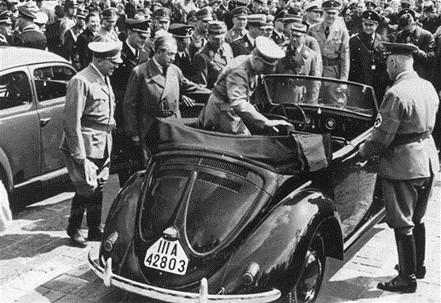 The Porsche is today one of the supremely coveted and sought-after status/prestige symbols in our society. Ownership of a Porsche (any Porsche) bespeaks a certain mind-set that calls the unending 'wants vs. needs' argument forth in any reflective discussion on the merits and/or liabilities of the decidedly unhealthy obsession we Americans have with superfluous materialist acquisition of wealth, high status and luxury. It typically is, to borrow a term, 'the player's choice of wheels' and used to wealth-signal one's elevated status to others. But let's take a moment and dig down a bit deeper into the Porsche back-story that this contemporary status is founded upon: WW2 and the forced labor that helped Dr.ing. Ferdinand Porsche's cars attain world renown and recognition.