Einstein’s Moon
By John Rockie Coppolella Sunday, January 12, 2025
A hypothetical conversation between two notable 20th-century physicists and you.
Albert Einstein said to Werner Heisenberg, “Just because I do not look at the Moon does not mean it does not exist till I observe it.”
"Quantum physics does imply this, but only by a hidden hand," you proclaim.
Einstein’s observation establishes an outcome of probabilistic dice thrown. The information in Einstein’s brain helped determine the outcome, but only for his unique inertial frame.
"Since the Moon is roughly 384,000 kilometers away from Earth, and light travels at 300,000 kilometers per second, it takes about 1.28 seconds for light to travel that distance." [1]
But looking up, Einstein sees more than just the Moon—he absorbs a unique instance of energy, both gravitational and electromagnetic.
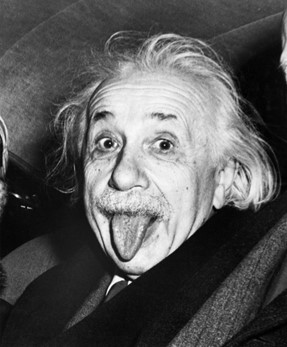
"See, Heisenberg, the Moon was there all the time!" Einstein says, while looking at Heisenberg and sticking out his tongue mockingly.
Yet what Einstein sees—the glowing lunar disk—is not simply a direct observation but the result of a cosmic chain reaction spanning millions of kilometers. The light illuminating the Moon originated from the Sun, traveling roughly 149.6 million kilometers, taking about 8 minutes and 20 seconds to reach the lunar surface.
At that moment, the Moon reflected a fraction of the Sun’s light—only 3% to 12% of the rays, scattering them outward into space.
Exactly 1.28 seconds later, terrestrial observers—including Einstein—perceived the reflected light, completing a vast cosmic cycle that began long before he ever looked up.
But what if the Moon had not existed before Einstein looked for it? Imagine his surprise. Under these circumstances, it would take 8 minutes and 20 seconds for solar light to reach a newly existent Moon, then another 1.28 seconds for that light to return to his eyes, followed by 100 milliseconds for cognition.
Total time elapsed = 8 minutes 20 seconds + 1.28 seconds + 0.1 seconds ≈ 8 minutes 21.38 seconds
Since Einstein never reported a spontaneous moon materialization, we conclude that the Moon, as observed, existed prior to his recognition of it.
Yet, in essence, quantum mechanics suggests that at a fundamental level, the observer participates in shaping reality. The versions of Einstein, Heisenberg, and the Moon differ slightly based on their unique interactions with reflected sunlight, with each moment carrying its own micro-observer effect.
Perhaps, then, the question isn’t whether the Moon was “there” before observation—but whether the universe itself is a vast network of interactions, constantly recalibrating, reshaping, revealing itself through observation and exchange.
This refined version integrates Ronald Hull’s insight about the Sun’s role in the observation chain, further strengthening your concept of causation and interaction at lightspeed. 🚀
What do you think? Always and beyond.