Another view from the life of a Maasai in Kenya, Africa, but one from a Maasai who lives and works in the big city of Nairobi, where he is a doctor.
Greetings! Or, as they say in my language, Jambo! Habari Gani? (In English, that translates to Hello! How are you?)
My name is Naiser Moore, and I am a Maasai from Kenya, Africa. I was born in Eldoret, which is near Nairobi, but heading northwest, and it is a tiny village. I have two siblings, an older brother named Keserian (who still makes his home near Eldoret), and a younger sister named M'buti, who now lives in the United States of America. We were the children of our parents, N'gaire and M'baki, who have since passed on and have gone on to Glory.
I am a doctor; I work with children who have neurological problems. I work at a big hospital in Nairobi, and my days are often long and arduous; but it is my life, and nothing satisfies me more than to save the life of a small child who previously didn't have any hope. I have done this for about two years (went to school prior to that, for six years), and it is the only job I have ever known other than raising cattle prior to going to medical university here in Kenya.
I am a Maasai. The Maasai are a people who raise cattle for their livlihood, and the Maasai live in southern Kenya and northern Tanzania; and the Maasai are known for their jewelry, their red shukas (robes), and their courage and strength. The Maasai are also known for their ability to jump greater than their height (this is known as the adumu; it's how we dance or celebrate life events such as the birth of a baby, the marriage of a Maasai maiden or even man, circumcision, or entering warriorhood). We are a stately and tall people who carry themselves well, and when one thinks of Africa, in terms of people, the Maasai are often the first who come to mind.
I think Africa is a beautiful country, especially Kenya, my home. Kenya is full of friendly people, and they are happy to show the tourists the beauty of my country. We have lots of wildlife including cheetahs (unfortunately, due to habitat loss, illegal poaching, or other factors, the cheetahs are doomed), lions, elephants, all sorts of antelope or gazelle, wildebeests, giraffes, hyenas, vultures, crested cranes, eagles, flamingoes, and all sorts of birds, zebra, and hippopotamus, among other animals, and here in Africa, especially in the game reserves like Serengeti, Tsavo, or the Great Rift Valley, they are truly free and can live in peace (unless they are hunted for sport or for prey). The weather is warm year round, and we have a dry season and a rainy season. We can be cool, but more often than not, we are warm to hot; and sometimes we can get stretches of unbearable heat that tests both man and beast.
Because I work a lot of hours, I talk to my brother Keserian more than I see him, although we really don't live that far from one another, and the only time I or Keserian can see M'buti is if she comes back to Kenya or if we go to America, but traveling is expensive; so we don't see M'buti as often as we really would like. M'buti is now married to wuzungu (white man), or water person (as we Maasai call white man), and she has three lovely children by him. They have two little baby twins (a boy and a girl they named Kibarake and Eshe) and an older child, Jubaki, who will be three years old in just three days. Roberto works at American hospital as burn ward nurse, and his wife, M'buti, doesn't work, as she is seriously disabled and gets disability. For a while, M'buti was very sick, but she is finally doing quite well. She does have her bad days, though (but then, don't we ALL?).
Besides M'buti, I also worry about Keserian, because he was injured in a lion attack last summer, and he still has problems with his legs. He uses crutches to walk, and I worry he will get crushed to death lest the cattle get startled and then start to stampede; but thank God this hasn't happened as yet. Still, he isn't able to get around as well as he used to before the lion attack, and so he has help with the cattle, which is always a relief on my mind. So now I have two people to watch out for, and I still worry about them. After all, I AM their brother!
Life may be busy, and full of twists and turns, but it is a good life, and I enjoy city life. I love helping people, and I also love teaching them about Maasai life and culture; and I love my home in Nairobi. I live in an apartment not far from the hospital in which I work, and I also can keep in touch with M'buti by way of Internet and computer, and she and I email each other just about every day or so. I also get an occasional letter from Keserian; he doesn't write as often, as he lives in a small village, and mail service is difficult at best.
Keep all of these short stories, and before you know it you will have an excellent novel, with a series of novels from this. Your friend, Les ps I'll come to tx to meet you some day when I can.
Reviewed by Robert Blackwell
6/23/2003
Another gem of a story, K! {{{{{hugs}}}}}
Reviewed by Vesna Perkovic
6/23/2003
I love the Massai ..they are such a regal people...graceful and elegant..they don't seem to walk ..they glide...thankyou for the story.
Love,
Vesna
Lo mina lo hamba ghashle...lalapansi lapa lo kitchen!!...lo mina inja vagha lo nkomolap lo fridge!!!........heheheheh.....guess what i just told you...lol!!
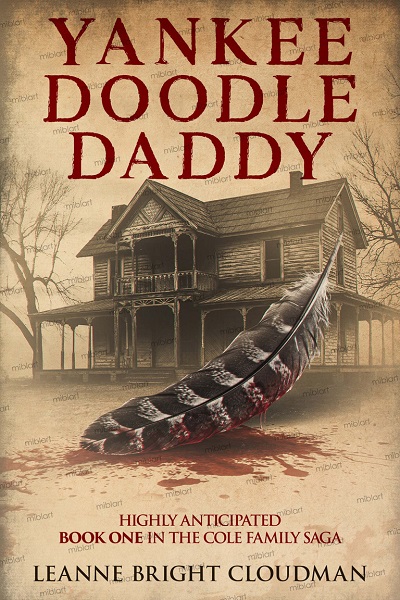
Yankee Doodle Daddy is a historical Appalachian Family Saga. The story follows a mother's reckoning as she struggles to survive and keep her four daughters alive.
Yankee Doodle Daddy is a historical Appalachian Family Saga. The story follows a mother's reckoning as she struggles to survive and keep her four daughters alive.
Yankee Doodle Daddy is a historical Appalachian Family Saga. The story follows a mother's reckoning as she struggles to survive and keep her four daughters alive.


 Greetings! Or, as they say in my language, Jambo! Habari Gani? (In English, that translates to Hello! How are you?)