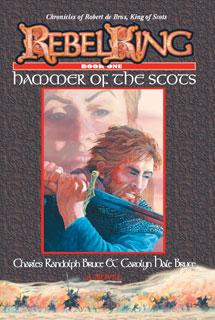
Robert de Bruce, Earl of Carrick and Lord of Annandale, is handsome, wealthy, landed, and ranked as the second best knight in Christendom. Recently married to Elizabeth de Burgh, the lovely daughter of the "Red Earl of Ulster", Richard de Burgh, Robert places everything... family, titles, wealth, even his very soul... in jeopardy when he takes the crown of Scotland. With a small, tough army, he proceeds to drive the English troops and administrators out of Scotland, one town or castle at a time. Edward Plantagenet, known as "Longshanks" has stationed those warriors and ministers throughout Scotland, and is enraged that "The Bruce" has 'betrayed' him and meddled in what he considers "his" concern. Soon he sends armies north to put an end to Bruce, his family, and all his followers.
406 pp. plus 26 pp. in an "Historical Background"; page size 6" X 9", Smythe sewn. In addition to an 'event' map, the book contains 36 character drawings by Charles Randolph Bruce, who also designed and illustrated the book jacket/cover. An epic story told in terms modern readers can readily appreciate ("reads like a movie" one reader said), and as close to history, as two Scots will agree...
Excerpt
Hearing the door open, John Comyn, standing before the high altar, turned gracefully to greet Robert as one would hail an old friend. “Ah, the Earl of Carrick has arrived! I hope yer journey was an uneventful one, Lord Brus,” greeted John with a wide smile.
“My kinsmen and I, and even my dog, would prefer to be at home by the fire on my own hearth,” replied Robert with solemn aspect as he walked toward the spot where John Comyn waited, his uncle at his side.
Not wanting to inhibit the meeting, Christopher Seton stopped a few paces back from the three men, that they might speak in confidence. He noticed, nearly out of sight behind a low wall beyond the altar, two curious friars watching the unfolding events, but nothing else moved within the unheated room, save themselves.
As Robert looked upon John’s smiling, friendly face, a quiet rush of anger filled his being, but he held his countenance.
“What be this matter ye were so anxious to meet with me about?” asked John, taking the high ground of innocence in his arrogance. Robert turned to Christopher, who reached under his cloak to expose the distinctive black and white pony hide pouch his brothers-in-law had taken from the corpse of John Comyn’s late messenger.
John’s eyes betrayed his knowledge of the all too familiar packet.
“It must have been his second day to the trail when yer messenger came upon our camp and could not resist the warm fire and a hand-out supper,” related Robert. Christopher calmly withdrew the contents from the pouch and, striding forward, handed them to Robert.
“What is this?” asked John feigning ignorance.
“This,” said Robert coldly, “is our agreement, the same in which ye agreed to support me for the throne and I, in turn, would hand over all my lands to ye.”
Robert Comyn, standing only a few feet to the back of John, moved forward a step as a sign of protection for his nephew.
His malevolently flashing eyes piercing the older man’s courage, Robert Brus gestured for him to back up, and he obeyed.
“I ne’er received yer lands,” said John turning his head away from Robert toward the altar, and resting his open palms flat down on the top. It was a disarming gesture, perhaps to hide his deception, perhaps to pray, for he now knew that his plan’s worst possible outcome, and his most deeply-held fear, had indeed apparently become manifest.
“And I am not yet crowned,” replied Robert. “However that bears not on the crux of the matter at hand.”
“Which is?” continued John, madly scheming to escape the trap.
“I offered support for yer attaining the crown of Scotland, with me to receive yer lands in return,” asserted Robert, “but, ye chose instead to have my lands… and relinquish yer claim to the crown to me, as witnessed by yer hand and seal upon this agreement.” Though outwardly calm, he all but trembled with rage.
“Aye, I do believe that was the agreement,” replied John, who prayed that Robert did not also have his letter to King Edward.
The friars noiselessly peered over the low wall behind which they squatted, their fear growing as the tension between the two men increased.
Robert said not a word as he revealed the dreaded second document in the pouch, the letter to King Edward.
The Red Comyn took the parchment from Robert’s hand and looked at it briefly, then shouted in a somewhat shaky and overly surprised voice, “This be a lie!” He looked at it aghast, to make Robert think it came to him as a shock. “Someone plots against us and attempts to create distrust and overthrow our strategy... someone who forged my privy seal... someone...”
“No one but ye is responsible,” interrupted Robert in controlled anger, “Yer messenger, lyin’ dead in the snow these past two weeks, no doubt has been et by the wilderness, and ye think I have not the evidence to know these things?”
“Dear Robert, ye have obviously misread my intentions...” responded John condescendingly as his nervous fingers danced against the jeweled grip of the dirk he wore strapped around his waist.
“Would ye now draw yer blade against me?” barked Robert gruffly...
Professional Reviews
A Highlander and his Books, 2003
For those of you who enjoy Scottish novels, particularly historical ones, this is a great book to settle down with in front of a fire on a cold, rainy, winter’s night. Get yourself a glass of wine, a wee dram, or a cup of cappuccino to warm your soul. The book will, too! Other than Sir Walter Scott and Nigel Tranter, I normally do not make a habit of reading historical novels, and already you have a heads-up as to what I think about this book. I must confess that I was a little slow getting around to reading it. After all, it is a 407-page book! I take my reading time very personally. I do not casually read a book; I devour it like a leg of lamb or a beer-can chicken from my oft used backyard grill. Rebel King, Hammer of the Scots was no exception. I actually found myself eagerly returning to the book until the last page was read. When I had finished the book, I wished there had been more than the 407 pages. We’ll get back to this aspect later in the review.
Mel Gay, also known as Beth’s husband, introduced me to an interesting man at our Clan Chattan tent last October during the Stone Mountain Highland Games. Charles Randolph Bruce wanted to chat about his book. He spoke passionately and eloquently about what he and his wife, Carolyn, had written concerning "the chronicles of Robert de Brus, King of Scots". In a letter from Mr. Bruce, he described the book as "a fast-paced telling of the Scottish Wars of Independence, beginning only months after the unjustly and horribly meted out death of Sir William Wallace, subject of the Mel Gibson movie Braveheart." While this is a story informed Scots are familiar with, there are many others who have carelessly passed it by over the years. Both groups would do well to spend time with this book - the former to refresh their memories and stir their hearts once again, with the latter learning what they have put off far too long. Randolph and Carolyn Bruce have written a wonderful book worthy of the Scottish communities’ attention. Thanks, Mel!
Mr. Bruce informed me that the book "started out to be a ‘family’ story that grew into a ‘Scotland’ story". From my perspective, this is a book for anyone who enjoys an exciting and jam-packed book of suspense and intrigue. Simply put, it is an exciting, well-written novel. I’m glad I read the book, and I firmly believe if you read the first chapter, you will read the entire book like I did. It ends with the death of "the Hammer of the Scots", Edward I. We learn the story will continue with a sequel or two. Knowing this action filled account of the heroic Robert de Brus will continue is, to me, the best part.
Professionally, Randolph and Carolyn Bruce are both commercial artists, an added bonus for all readers. Their book is graced with artistic talent at the beginning of each chapter where you will find pencil drawings of the main characters - a very nice touch. Personally, the authors are parents and grandparents like so many of us. But, unlike so many of us, they have portrayed the beautiful story of Scotland’s quest for freedom in words and drawings. The good news for this modern man is that the ancient story will continue as this talented husband and wife team weaves their magic formula again – hopefully in the near future!
Reviewed by Frank R. Shaw, FSA Scot
A Review by T. A. Bruce for the Blue Lion (Bruce International Society Newsletter)
Robert the Bruce, King Robert I of the Scots, who lived 700 years ago, was the monarch of a small country on the fringes of Medieval Europe, and never commanded large armies, but his fame is still very much alive here in the Twenty-first century, as one of the two Scottish national heroes. His life has been the subject of much myth-making as one of the greatest lights of a country that has provided many great lights to the world, far beyond what might have been expected given its size and population. His most influential biographer, Archdeacon John Barbour, in his epic poem “The Bruce,” tells of his great bravery, his magnanimity, and his brilliance at the art of warfare. It can be said that Robert the Bruce invented what is today known as guerilla warfare.
With all of the above in mind, it must have been a daunting task to set out to compose a novel, which, by definition, must find most of its value in the entertainment it provides, about such a national hero. Charles Randolph Bruce and Carolyn Hale Bruce have done a very admirable job in blending fact, and admittedly some myth, into a very entertaining story that leaves the reader eager for the projected next part.
The title may require a little explanation. The term “Hammer of the Scots” refers to King Edward I of England, who had the Latin phrase “Malleus Scottorum” posted on his tomb in Westminster Abbey. Before long the reader finds out the reason for the inclusion of the phrase in the title, though; Edward I is the main obstacle in Robert Bruce’s quest to become King of Scots and to restore an independent Kingdom of Scotland. The book commences at the beginning of 1306; Edward has set himself up as ruler of Scotland, and his ruthlessness and military power will fall like a hammer upon anyone who opposes him.
As the story progresses it becomes apparent, in the novel as it did in fact, that Robert Bruce is the only person who can hope to restore the old Scotland of David I and William the Lion. Historical novels often have difficulty in capturing this kind of political truth and at the same time making the story interesting, but the Bruces do it quite well.
Their description of Robert Bruce’s murder of his chief rival for the Scottish crown, which was a tremendous setback that would have been the end of any other claimant’s ambitions, is especially vivid.
Another highlight is a very fine explanation and description of the chain of events that led to Robert the Bruce’s coronation being repeated, upon the arrival the day after the first ceremony, of a representative of the family that possessed the ancient right of placing the crown upon the head of the Scottish kings.
As always, the devil is in the details. There are several anachronisms and inaccurate uses of terminology. For example, mention is made of the ancient Pictish practice of warriors painting with blue woad before going into battle, but this practice was long abandoned by the 14th century. These anachronisms will for the most part concern only the specialist, and do not seriously detract from the story.
This book, which is planned as the first of four, ends in July, 1307. There is much more to look forward to in future installments, including the Scot’s great victory at the Battle of Bannockburn in 1314.
To quote R.W. Munroe: “How through ‘toil and weariness, hunger and peril’ (in the words of the Arbroath declaration of 1320) he won the independence of his country as well as his own right to the throne is a story and an achievement which has made the name of Bruce dear to the Scottish people. ”(Munroe: 9) With Rebel King, Book One: The Hammer of the Scots my kinsman Charles Randolph Bruce and his co-author Carolyn Hale Bruce have proven themselves storytellers worthy of this awesome story.
The Book Reader
"In this golden age of publishing, the reason the Bruces decided to publish their own historical fiction of Scotland is rather unique. They sent the manuscript out to agents and publishers...and often the envelope was returned unopened. "We figured, if they were too busy even to open their mail, it must be a good business to get into!" Give the Bruces credit for gumption, insight and downright genius for writing this grand tour of fourteenth century Scotland - its a graceful, exciting and unsettling picture they present.
In a world sliding headlong into enslavement, the rulers use torture and death to instill obedience: "Fear," says one ruler, "is the driver of folk's wits and souls."
Written with passion and deep erudition, this powerful, multifaceted history that takes us into one of the most thrilling and important moments in the Scottish struggle for freedom.
Autumn 1940. Germany invades Britain. Newport is blitzed. Danny O’Shea’s house is bombed, his wife is killed. While taking his young son Adam to neutral Ireland, they witness an attack on a German convoy. The result is brutal.
Autumn 1940. Germany invades Britain. Newport is blitzed. Danny O’Shea’s house is bombed, his wife is killed. While taking his young son Adam to neutral Ireland, they witness an attack on a German convoy. The result is brutal.
Fourth Book in the Southern Swallow Series finds the Academician Li K'ai-men in exile on Hai-nan Island. China has a new invasion threat. A showdown between ingenuity and technology explodes as the Sung Dynasty tries to preserve itself.