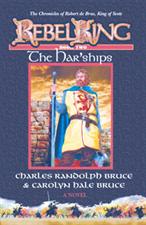
Category: Historical Fiction Publisher: Bruce & Bruce, Inc.
ISBN-10: 0972167420
Type: Fiction
Pages: 448
Copyright: August 2004
ISBN-13: 9780972167420
Many in his own land do not want Robert the Bruce to be their king. Knowing that he and his ragtag army are all that stand between his beloved Scotland and annihilation, and determined to preserve his kingdom’s independence and recover his distaff family from captivity, he must persuade his countrymen to come to his “peace” and repel the English invaders. They, having retired to their homes for the winter, are sure to come north again… but not until spring. Thus Robert has but those few harsh months to achieve unity among the Scots. At this critical time, he is suddenly felled by an unknown malady.
448 pp.; page size 6" X 9", Smythe sewn. In addition to an 'event' map, the book contains approx. 42 character drawings by Charles Randolph Bruce, who also designed and illustrated the book jacket/cover. The epic story continues as the Army of Bruce, in the open, suffer through the worst winter of their lifetimes.
Also available in paperback: ISBN: 0972167439or 9780972167437
Excerpt
At the edge of the sparse tree line King Robert de Brus paused, warily observing the scene and abandoning his usual proprietary admiration of the beautiful heather-garbed valley floor. Seldom was he able to relax his guard.
Seeing naught around him but the peaceful river valley, the king and his squire cautiously picked their way down the rock-strewn incline to the river’s edge, pausing there to survey their surroundings once again. All was quiet.
Robert removed his armor and clothing and handed it to the squire, then squatted and dipped his large hands into the cold water, scooping up their fill. Splashing it onto his naked torso, he shivered from the shock.
“Ah-h-h!” he cheerily growled. “Andrew! Ye had best come take advantage of this fine, cold water, Lad,” he yelled to his squire as he repeated the cleansing. The king had slung his huge sword belt around his neck, and the point brushed the mud somewhere behind him as the sheathed blade pushed between his hunkered legs. Dipping into the torrent again, he wet his face and auburn beard, and again to drench his long locks of fairly auburn hair. Then, with experience of a man who has long lived with his enemies about him, his senses perked up at the sound of crackling tree branches, but he calmly continued his ablutions, his wary eyes furtively glancing hither and thither.
Andrew Stewart, the thirteen-year-old squire accompanying him to the stream, stood an easy ten paces behind the king, holding the royal raiment of rough-made clothes. The king’s chain mail hauberk and his chest and back armor, leather and metal plates, having accumulated quite a number of dents from battles against the English in the previous several months, lay on the ground nearby. The youth was unaware of the sounds his king had noticed, and continued to enjoy his adolescent’s daydream as he watched lazy puff clouds catch the gold and orange colors of the early sun.
King Robert arose from his washing, his eyes scanning the landscape as he turned toward Andrew. He motioned for his bloodstained garment and his saffron tabard, sewn for him with the red lion rampant upon it by a proud peasant woman before the battle of Loudoun. The wounds he received there were minor and long since healed, leaving behind but faint linear white scars.
After the bloodletting on Loudoun Plain, Robert had lost no time in consolidating his precarious claim to Scotland’s throne. Among his enemies he counted not only the well-trained and well-armed English troops, but many of the Scottish nobility as well. Scots opposed to de Brus considered him a usurper of the throne who murdered John “The Red” Comyn, his nearest competitor, and brazenly, some said, crowned himself.
Furthermore, there was a faction of the Scots opposition who yet contended that the rightful throne belonged to John de Balliol. Indeed, de Balliol had been ceremoniously crowned at Scone, but shortly abdicated under duress from Edward I, who contemptuously tore the royal emblems from the Scot’s tabard and left him forever shamed before his people. He was then imprisoned in England, eventually being released to retire to a life of comfort and prestige, if not power, on the continent.
Thus, as Robert stood naked and dripping wet on the edge of the brightly sparkling stream, he had a long roster of enemies to choose from, were he to hazard a guess as to whom it was now approaching with possibly murderous intent.
“Quietly look beyond me Lad and see if ye ken the likes of them sneakin’ up on us,” said Robert quietly as Andrew came to him and handed him his linen shirt.
Andrew scrutinized the area carefully as the king turned his back to the direction of the sounds and quickly dried his hands and face on the cloth.
“What d’ye see?” whispered the king as he took the scabbard belt from around his neck and handed it to the boy.
“On the edge of the wood,” said Andrew softly, “a bush yonder is shakin.’ Aye, I can see folks a’hidin’ there,” he whispered as a tingle of fear and excitement traversed his spine and puckered his buttocks.
Water dripped from Robert’s hair onto his shirt as he looked at it. “Might have to wash the bugs out of this one day soon,” he smiled and slipped the louse-ridden garment over his head.
Andrew, however, didn’t notice the king’s smile. His wide eyes were on the thicket beyond. “They’re a’comin’, Sire,” he whispered urgently to Robert.
“How many?” asked Robert, still not turning.
“Three’s all I see, one old, two young, walkin’ fast this way,” relayed the youth, briefly. “Losels by the look of ‘em,” he added.
“Where’s yer bow, Lad?” asked the king as he calmly reached for his sword.
“By yonder tree... but I hain’t got but the one arrow,” said Andrew, glancing toward the bow.
“Aim straight for one of ‘em’s head so they don’t see it comin’. Hie!” said Robert, and he turned to face the assassins. Andrew ran for the tree and stood behind it while retrieving his weapon.
The three men suddenly stopped at seeing the enormous knight standing less than twenty paces before them.
“Ye men need not die this morn,” said Robert in a strong voice as he calmly drew his sword from its sheath.
The older man looked at his two companions, flanking him with their swords and daggers at the ready, “Ye ones be with me still?” asked the man, though his throat had gone suddenly dry and his armpits tingled as he began to sweat in the crisply cool air.
“Aye, Da,” they both answered in unison.
“Land we’ve been promised, and ‘tis land we need,” added one of the sons, stiffening the resolve of the other two even further.
“Then let’s be at the deed,” cried the man, and the three charged the king and his squire.
Andrew swiftly nocked the single arrow, and drawing it full back, loosed it on the young man then leading the charge and thus closest to the king. Trying to discern if they would cease their run, Robert watched as the shaft reached its target and the youth fell dead at the running feet of his father, but the father and his remaining son slowed not at all. His face set in a mask of resolve, Robert at last dropped the blade’s scabbard and held the mighty sword with both hands, ready for the fight.
Andrew stood well back, for he had seen the damage levied by the large sword in the hands of his king and he wanted not to be an accidental victim of the blade.
The younger runner came headlong at Robert and swung a first, too-broad arc with his sword, momentarily losing his balance. Robert easily sidestepped the son’s blow, but the father swung a wild, glancing blow from the other side, carving a shallow slice from Robert’s shoulder.
“Enough, fools!” shouted Robert, but the attackers heeded him not. Thinking the wound had rendered him weaker, they came toward the king in even greater excitement. Robert needed only a single slash of his sword at neck level to silence both father and son.
The young man died almost instantly; the father lingered momentarily. Robert stood over him in his death faint and asked, “Who sent ye to take my life?”
The man saw his son lying dead beside him. He tried to rise on one elbow, but simply made the blood rush more quickly from his gaping wound.
“Ye are dead, ol’ man. Who sent ye?” repeated Robert.
“Yonder son... dead?” gurgled the man.
“Aye,” replied Robert, “as dead as ye will be in a moment more.”
The man rested his head again on the heath as tears of brief mourning for his two sons welled in his eyes and followed the furrows at the corners of his aged brow to disappear into the hairs of his beard.
“Who sent ye!?” Robert repeated again, knowing time was quickly running out. “And what is meed for such murder?”
“‘Twas...” the tough old man sputtered and coughed, “... Umfraville... promised a croft… ‘pon yer head…” Then he exhaled a long, rasping groan and was dead, sinking heavily into the sparse heather.
The man they intended to assassinate stood sorrowfully over the three churls and heaved a great sigh as Andrew left his hiding place and rejoined his lord. Standing silent, the hunted monarch looked about, searching for possible additional assassins. Seeing none, he turned back to the carnage and shook his head in frustration. After a moment a scream erupted from his troubled heart. “FATHER IN HEAVEN!” he yelled to the sky, and his voice dropped to a mere whisper, “Why is my country devouring itself alive?”
Andrew stood near and kept watch while his wounded king said a silent prayer. When Robert again turned toward his squire, his eyes were welled up with tears for the Scots peasants, turned to assassins by the promises of his enemy.
Professional Reviews
Rebel King, Book Two, The Har’ships
One thing is for sure – from a personal perspective, you and I will never know the hardships that Robert the Bruce endured over the years fighting to free his beloved Scotland. However, you can thank the authors of this book for bringing that message as close to home as possible. Charles and Carolyn Bruce continue their rich and exciting tradition of the oft-told story of Robert the Bruce in Rebel King, Book Two, The Har’ships.
If you liked their first book, Rebel King, Book One, Hammer of the Scots, you will love The Har’ships, a book of sheer enjoyment. This husband and wife team should feel proud of their second volume. It does not miss a beat, and the story actually picks up a month from where the first left off. It is a fascinating story of adventure and high drama. In literature, books like this are called historical fiction. In baseball lingo, they are called home runs! On top-ten book lists, they are called best sellers. This is one of those books!
When I think of historical fiction, I naturally think of the father of the historical novel – Sir Walter Scott, the greatest writer of his century. Nigel Tranter, who wrote approximately 129 books during his lifetime, was a worthy successor to Scott. The Bruces have not earned that comparison…yet…but when they are through with all four of their books on Robert the Bruce, maybe the subject should be revisited. However, in my opinion, their first two books do rival the wonderful trilogy on Robert the Bruce written by Nigel Tranter in 1969, 1970, and 1971 respectively.
Once again, this talented couple has done the Scottish community a great favor. Their current book is just as readable as the first one and just as enjoyable. If you find yourself pulling for the underdog (and who doesn’t?), you will love this book. It is the fascinating story of a small, out-manned, under-armed group of courageous men who willingly give life and limb to win back their freedom and their Scottish kingdom, both stolen by Edward I, the dreaded King of England who dubbed himself “The Hammer of the Scots”. What is rightfully theirs cannot be denied. This book sizzles with excitement, and you will too!
An important feature of the book is the inclusion of the many character illustrations – 42 in all. The drawings are exceptional and add a greater dimension to the book. Check out the list of models in the front of the book, and you may find a name familiar to you. I did! My buddy Mel Gay is listed. The “Mel man” never looked so good! And on another personal note, my good friend, Tom Burns is listed in the credits as one whose expertise helped make the book a better one. Tom succeeded!
The Fall Highland Games are about to begin. (In our Atlanta area, the Stone Mountain Highland Games, one of the world’s finest, are just a few weeks away.) The booksellers hopefully will have this book for sale at their tables. Look around and you may even spot Randy or Carolyn available to autograph your book. For those who are unable to attend the Games, the ISBN numbers are 0-9721674-2-0 (Hardback, $28.95) and 0-9721674-3-9 (Paperback, $19.95). If you purchase from the www.RebelKing.com website, you will receive free shipping and handling. The same is true if you order from their toll free number 1-800-247-6553. Stay tuned to this column for a future review of Rebel King, Book Three, Bannock Burn!
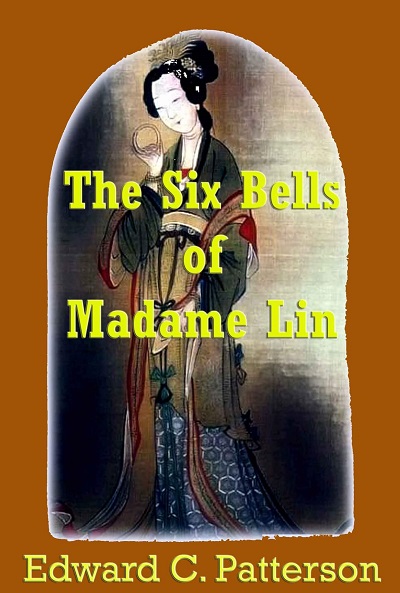
The Six Bells of Madame Lin is the first book in The Witch of Marigold Hall Trilogy, a fictionalized account of the struggles of Lin Mang, a blind woman who manages to navigate the world during the Mongol conquest of China in the 13th Century. Withou