Kindle Edition
Category:
Action/Thriller
Type: Fiction
Price: $2.99 (eBook)
Nighthawks is a story about madness, ghosts, and the foggy distinction between them.
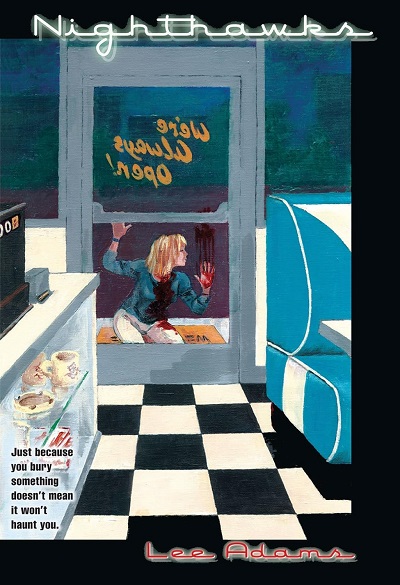
In the center of a three-block stretch of abandoned dirt, a diner is resurrected where it stood sixty years before. And it looks exactly like the original, but for the dead girl on the welcome mat.
Julie Page, the new owner, is a writer of waning prestige and questionable talent, already haunted by personal demons in addition to the ghosts she may have just inherited. Compelled to figure out what happened the day before the door was open to the public and who killed the young woman found pressed against the glass, she solicits the aid of every street angel the seaside town of Berle has to offer; from a seriously vindictive detective to the hookers and hoodlums frequenting the Promenade where only the diner stands.
As the second installment in the Julie Page Mystery Series, Nighthawks offers the same broken concrete and burnt-out neon as its predecessor, 5th and Vanguard, but escorts the reader further underground. No apologies for bad behavior, Nighthawks is a love letter addressed to our darker inclinations.
https://youtu.be/ev8K1F9AQwU?si=tiguictlkQzCcxit
Excerpt
Berle’s Promenade had been deserted for a long time before I showed up. Even now, except for my diner, it’s nothing but leveled floor plans of asphalt and gravel with an occasional dirt parking lot breaking the monotony.
Swirls of burgundy, blue and gold still peek through on some of the weathered cement, cement that will take you all the way to Vincent Highway if you walk its length. When this city was conceived, the Promenade and Vincent Highway were the two main arteries designed to pump life into Berle, my hometown.
V Highway runs parallel to the ocean for many miles. A famous, durable, well-traveled strip of road that remains, after all these years, a contemporary means of getting from one place to another. But the Promenade buckled under the city’s growth spurt in the late ‘70s with the introduction of strip malls and an endless list of faceless franchises that began to surround it.
Berle’s attempt at modernism eventually encircled the Promenade’s antiquated allure like a chalk outline around a dead body. And it just went all the way down one shop at a time, leaving behind a ghostly stretch of memories, three abandoned blocks of faded glory, apathy, and decay.
In the ’50s and ’60s, by all accounts, this was the real end. A crackling neon Mecca assembled for and catering to the after-hours set: musicians, writers, guilty lovers.
You had Monte’s for cigars and cigarettes (and pot, if you knew who to ask), a coffee/juice bar called Roxanne’s, a bookshop called The Barn, a Woolworth’s, a magic shop, and the all-night diner that I eventually rebuilt. The rest, the way I hear it, were all clubs. One suited to every taste. Swank Jim’s, The Orbit Room, Ozbourn’s, Friar Tuc’s.
The Majestic Palms was the only hotel for a couple of miles, conveniently situated at the end of the strip facing Vincent.
By the time I was old enough to walk the Promenade by myself, these forgotten palaces were boarded up, falling down, or gone. And the atrophy was thrilling through my young eyes.
I loved to walk the Promenade when I was a kid. So did my friends. It was the coolest place to hang. Purgatory had an amusement park and we had year-round passes.
The neon carcasses that remained stared blankly at one another like zombies from either side of the concrete stroll. Each crumbling edifice provided our teenage imaginations a world of adventures – dark, dangerous adventures.
I remember The Majestic Palms standing crippled and vacant with a flaking wooden billboard girdered to its partial roof espousing former virtues such as “A Telephone In Every Room” and “Kitchenettes Available.” A rusted fire escape clung to the hotel’s side, and we shimmied up and down that rotted metal time and time again.
You could walk right into Woolworth's. No fixtures remained but the vacuum-operated money tubes were still at the ready as well as some scattered hangers and moldy boxes cluttering the curling red linoleum floor.
A painted Buster Brown advertisement survived against one dank wall and the staircase bore the most beautiful wood banister I’d ever seen.
The grave robbers who’d gutted the place had left part of the lunch counter, which we kids found very useful for everything from homework to Yahtzee. I used to meet up with my pals there, Renee and Saul and Jackie, and Willie Dole, who never kissed me despite my charm.
It became our clubhouse, and the Promenade our turf. A bunch of loitering junior high school knuckleheads kicking around among the shattered glass, sitting cross-legged on half-chewed brick walls, looking to get into something, looking for trouble that never came.
Twenty-five years later, I’m staring out on that same Promenade and thinking how ironic it is that such grown-up trouble finally found me here.
The place used to be called Chordeilettes. I don’t know what that was about. When I was growing up, folks pronounced it Chordettes. However you cut it, it wasn’t right, so I coined it Nighthawks. That seemed right.
I made every effort to capture the original cachet, but the only authentic feature, which I bought for $5,000, was the dilapidated neon sign retrieved before the walls were torn down. It was found crashed and resting on one end in the gravel: this garish, brilliant monster of a thing featuring a wide-eyed blinking owl clutching a coffee cup. Honestly, how could a place with that out front be called anything but Nighthawks?
Now I’m wondering if that old adage is true. You can’t rechristen a ship. It’s always bad luck.
|