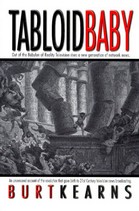
Two weeks back this column focused on the enthusiasm the people at HarperCollins have for the upcoming memoirs of TV honcho Roone Arledge. But his book won’t be out for about a year. Already, for those interested in the history of journalism, and especially TV journalism, there is a book just out worth serious attention. The book is Tabloid Baby by Burt Kearns.
Burt Kearns was a young and talented reporter for local Connecticut newspapers before he moved to NYC and latched onto a job in television with NBC News. From there he moved to the new Fox Network. Next thing he knew he was producing shows for A Current Affair, the smash tabloid news TV show Fox introduced in the early 80s. For years A Current Affair set a hot pace, outdistancing its many imitators. It also shook up programming trends and practices within the American TV industry. Much of this was due to the influence of imported British and Australian journalists, TV reporters, producers and directors.
Shows like A Current Affair and its less successful spin-off Hard Copy changed the face of American TV journalism. They also changed the way all news was reported. They changed the way stories were selected for feature treatment. They changed the tone and treatment accorded stories. They even dramatized the manner of reporting a story. They were up-close, they were personal. They were humanly engaging in a way news stories had never before been. Traditionalists loathed their new, let-it-all-hang-out style. But today the reverberations of that style are to be seen everywhere, even on once stodgy network news programs, as the subtitle of Tabloid Baby boldly asserts: "Out of the Babylon of Reality Television Rises a New Generation of Network News."
A Current Affair and shows like it went gonzo. They pioneered guerrilla reporting by such swashbucklers as Steve Dunleavy, now a featured columnist on the New York Post. Dunleavy was a sort of gangsta investigator, a reporter more akin to Spiderman than to Walter Cronkite. The younger reporters and producers like Burt Kearns learned from Dunleavy. Kearns also learned a lot about TV delivery from Australian producer Peter Brennan, who never met a story he couldn’t spice up, jazz up, personalize, and dramatize. Brennan could have spun the obit of Mother Teresa and slashcut her funeral for pace.
Dunleavy and Brennan were only two of the manic characters whirling with energy and talent Burt Kearns worked with. There was also wizard reporter and interviewer Rafael Abromovitz, the distinguished TV show host Maury Povich, the giant and intimidating reporter Gordon Elliott, the sparkplug reporter David Miller, and the manic and nearly berserk producer Wayne Darwen, who contrasted with the calm and measured producers Ian Rae and Dick McWilliams. All of these guys would have attacked the Great Wall of China with a safely pin if a great story had been on the other side. Reading about them in Tabloid Baby you feel that Burt Kearns has done for them as marauding journalists what Robert Louis Stevenson did for pirates in Treasure Island.
Tabloid Baby is published by Celebrity Books, appropriately enough, and priced at $27.95 for 490 bristling pages. Every big news story of the 80s and early 90s is showcased in here. What’s more, Burt Kearns proves the old journalism adage that the story behind the story is often the best story. Tabloid Baby provides as much high-octane entertainment as any Hollywood expose, and, into the bargain, it concerns a very serious subject, and sheds a sharp light on it: the nature of journalism at the dawn of the millennium.
The Australian: Tall Tales of Trash TV
by Mark Day
Tall Tales of Trash TV
On Media
By Mark Day
"What’s wrong with you?" my wife asked as I lay in bed on Saturday morning, recharging the batteries, laughing, chortling and giggling. It was a fair question because staying late in bed is not my habit these days and neither, she complains, is laughing.
There was nothing wrong. I was just reliving a part of ‘my past,’ utterly engrossed in Burt Kearns’ book, Tabloid Baby. It’s been out in the US since late October and it’s available here through Amazon.com, and it tells the rip-roaring, devil-may-care, booze-fuelled story of the explosive rise of tabloid TV in the US.
What made it compelling (500 pages devoured in two days) reading for me is that I know all the central characters (except the author); they’re Australians! I worked with them all, and in one case (ahem, the most excessive) I may well have been responsible for unleashing his brilliance and atrocities on the world.
Tabloid TV stormed the staid world of US TV news soon after Rupert Murdoch founded the Fox network in 1985. Just as Murdoch had shaken up Fleet Street—the home of the tabloid genre—he saw opportunities outside the square in the US. As Kearns writes, Fox "aimed for a spot somewhere below the belt of America’s lowest common denominator," and when Murdoch wanted a magazine show—A Current Affair – to lead the charge for Fox News, "he looked no further than this own team, the wild and unruly Australian journalists who manned outposts of his NewsCorp print empire."
Kearns nominates Peter Brennan ("a genius"), Steve Dunleavy ("a legend"), and Wayne Darwen ("the wild child") as the three key Australians in the ACA team, although others star in cameo roles – Peter Faiman, Ian "The Pig" Rae, Neal Travis, (US-born) Gerald Stone and Gordon Elliott.
I worked with Dunleavy when he first arrived in New York, on the run, it is said, from Japanese mafiosi, in 1966. Later, when I was editor of the Sydney Daily Mirror, Peter Brennan was my news editor for a while before he went to Channel Ten’s Good Morning Australia, and Wayne Darwen was a cadet with a quick eye and a good turn of phrase who rarely failed to turn up a bright angle. I sent him to the New York office on a short-term gig. He never returned.
At ACA, and later the knock-off imitators it spawned (Hard Copy, Inside Edition, Now It Can Be Told, Premier Story, et al) the Aussies became, in Dunleavy’s words "the wildest bunch of pirates imaginable—a brazen bunch of bandits who ambushed, conned, begged, borrowed, bought and charmed to grab that story."
Their subjects were the stuff of the supermarket trashy weeklies— National Enquirer, Star, Globe, Weekly World News—and to get it to air, they cheated, lied, and, if they didn’t actually make things up, they put a massive eggbeater through the facts. Wayne Darwen, for instance, proposed a story on JFK’s gay lover. He had no proof, of course, but he did have someone willing to say he was. See?
Their trade was learned on the streets of Sydney during the tabloid wars between the Daily Mirror and the Sun. Kearns retells the famous story of Dunleavy, a young reporter for the Sun in the 50s, slashing the tyres of the Mirror’s car to beat his opponent—his father, a photographer—to a story.
It was no less competitive during my time as editor in the mid-70s. I was sometimes furtively warned not to ask how our frontline reporters such as Mike Munro and Col Allan got their stories: it was safer not to know.
This Sydney training was taken on to new battlegrounds in the US in the decade from the mid-80s. Even to outer space: Brennan broke new ground when he put to air "exclusive" video pirated from a rival‘s satellite feed.
The men in white shirts who ran Yankee TV before the wild bunch of Aussies unleashed their talents were bewildered and bemused as they saw the raw, gutsy, tell-it-like-it-s approach grip the audience. Ratings rose, making millions of dollars and underpinning Fox’s underdog battle against the incumbent networks.
Kearns tells it all in a vivid, brutally honest account that is riveting, funny, yet ultimately sad. Not only do the central character fall, one by one, victims of booze, fatigue and Hollywood politics, but so does the genre itself.
Murdoch’s soldiers grabbed US TV by the scruff of the neck and shook it up. But it was unsustainable, because the audience for their sock-it-to-‘em style of reporting was at the bottom end of the demographics. Tabloid TV attracted trailer-park demographics in their droves, but advertisers were looking upmarket. ACA’s viewers were Macy’s shoplifters.
There were a number of attempts to take the shows up a notch or two, invariably accompanied by a decline in viewers.
In a sense, Tabloid Baby is a tabloid history of tabloid itself; a potted, bovrilised, cut-to-the chase story about a 10-year TV sub-set of the wider newspaper genre that grew, blossomed, and wilted within the 20th-century.
The evolution of the tabloid genre illustrates the merging of information and entertainment, often to the point where the veracity of information is subsumed by the desire to provoke a laugh.
Sure, we still have plenty of newspapers publishing in the tabloid (half-broadsheet) format. Sure, these papers tend to report more, but shorter and tighter, accounts of events than the so-called "quality" papers, and sure, they are generally more popular, in terms of sales, than the broadsheets.
But these days, tabloids in Australia are nothing like the screaming afternooners that died more than a decade ago. They have taken on more serious, quality approach, delivering more in-depth material with less frippery.
They still seek to have an element of fun, but today’s tabloids are more likely to ask that they be trusted rather than laughed, chortled or guffawed over.
The tabloid era maybe well behind us now, but that’s why Tabloid Baby is such a good read—it’s pure nostalgia; a portrait of the way we were, for those who may prefer to forget.
NY Post: When We Were Tabloid-TV Kings
By STEVE DUNLEAVY
JOHNNY Lester had just gotten out of the slammer after 13 years for canceling the ticket of a guy who insulted his wife.
He wasn't a victim of nightmares in his cell, but he thought he was witnessing a miracle when Rafael Abromovitz appeared at the bar room door.
"My God," Johnny exclaimed. "That must have been some operation to get Raf back on his feet."
On the television show "A Current Affair," Raf was always pictured sitting down at a word processor in various parts of the country.
"All the guys in prison thought he was disabled. We all felt sorry for him because we didn't know he could walk."
Johnny was typical of the crowd that surrounded "A Current Affair." Con men, criminals, celebrities, politicians - all seemed to remain part of the show's extended family, even when we beat them up.
Burt Kearns, in his new book "Tabloid Baby," takes us on a delightful and raucous romp through that world.
It was a world that will never be seen again. The wildest bunch of pirates imaginable. I know because I was there.
In eloquent if sometimes brutal prose, Kearns, a senior producer on the show, unmasks all the usual suspects, which would guarantee that Tom Brokaw wouldn't let himself be buried in the same cemetery as any of us.
Kearns sums up the spin when he describes being offered a job at CBS:
"There was something about CBS that didn't smell right.
"Something cultish in the way employees saw themselves upholding a sacred tradition, carrying out some grand mission to spread the CBS orthodoxy."
Well, Dan Rather we weren't, but more like a brazen bunch of bandits who ambushed, conned, begged, borrowed, bought and charmed to grab that story.
"We'd taken television to a delirious and dangerous edge," Kearns writes.
In varying doses of scandal, celebrity, crime, politics and morality, the tabloid television tales riveted a nation for a decade and Kearns grabs it all in print.
Like stories of the exclusive video of Robert Chambers, the "Preppy Killer," secured by Abromovitz, which wiped the networks' clocks.
And the sex tapes of brat-packer Rob Lowe, which bewitched millions although Kearns admits to hijacking the tape.
But if the elite networks turned their noses up at the menu, then shrieks of silence followed when they saw the "A Current Affair" SWAT team in action when the Berlin Wall came down.
The team, led by Kearns, consisted in part of Maury Povich, a class act, the giant Gordon Elliott, and scrappy reporter David Miller.
When the Rathers, Jennings and Brokaws saw Gordon Elliott climb the wall and then start chipping away with a pick ax as the cameras rolled, the networks knew who was doing the driving.
Kearns actually admits to a borderline kidnapping of a German from New York and a forced reunion with a brother in East Germany, who hated his guts.
"We were the f-ing champions of the world," Kearns exults in the book.
At the helm of the hysterical high-tension hijinx was the gentle genius producer Peter Brennan and executive producer Ian Rae. They were ably aided and abetted by a marvelous maniac called Wayne Darwen. Also on board was Scotsman Dick McWilliams.
The news room resembled something out of a rerun of Hildy Johnson's "Front Page."
The air was blue with language, political incorrectness and cigarette smoke. And while there may not have been a whiskey bottle in the bottom drawer, there was plenty of the stuff at the bottom of the stairs and across the road at The Racing Club.
The title of the book, "Tabloid Baby," tells you how it all went full circle until Kearns goes respectable, marries beautiful British TV anchor Allison Holloway and has a lovely son called Sam. All wrapped up in Los Angeles suburbia.
Those wedding bells are breaking up that old gang of mine.
Of course, I normally would have sued the son-of-a-gun for what he wrote about me, but I can't - it's all doggone true.
For a time, I perched myself on a flat rock, comparing my life with the Guyandotte River. Just as its tributaries replenish it daily, changing it in some small—sometimes great—degree, so have the day-to-day occurrences of life changed me. Like the ri
Asa D Seeley, a young Afro American man, shares his struggle to leave his past behind as he reaches for his future. In his one-of-a-kind style, he searches for answers...from the visible & invisible. A Memoir in Poetical/Prose form.
Sepsis knocked her down and out. Faith, hope, and gave her the strength to get back on her feet. I am a Runner She fought the river of death They said she'd never run again
She proved them wrong...