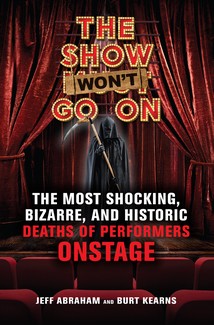
The first comprehensive study of a bizarre phenomenon -- performers who died onstage -- is an entertaining, often humorous celebration of show business lives and careers.
From the comedy magician who dropped dead on live television to the amateur thespian who expired during a play called The Art of Murder, The Show Won’t Go On by Jeff Abraham and Burt Kearns is a celebration of lives both famous and obscure, as well as a dramatic and accurate recounting of events leading to the moments they died "doing what they loved." The Show Won't Go On covers almost every genre of entertainment, and is full of unearthed anecdotes, exclusive interviews, colorful characters and ironic twists. With dozens of heart-stopping stories, it's the perfect book to dip into on any page.
Professional Reviews
Best Books of 2019
Who knew that a collection of true stories about well-known or obscure entertainers who literally faced their final curtains onstage could be such a morbidly-fascinating, read-in-one-sitting book? This duo has managed to take a depressing subject on the surface and turn it into a bizarre, yet engrossing catalogue of more than 300 years of final curtain calls ranging from heart attacks to onstage mishaps, which befell upon a variety of unsuspecting performers, whether they were comedian Dick Shawn, British comedian/magician Tommy Cooper, or 1960s entertainment curiosity Tiny Tim. -- Montreal Times
Their research is impeccable!
A lot of people die in The Show Won’t Go On. It’s all about performers who actually die during a performance. Apparently, it happens a lot. Jeff Abraham and Burt Kearns selected three figures’ worth of them out of potentially thousands, they imply.
Their research is impeccable, due in large part to their subjects. Precisely because they died onstage, there are large numbers of witnesses. The events got written up in biographies and immortalized in news reports (often inaccurately). Courts ruled on the cause of death. To their immense credit, the authors sought out personal interviews with witnesses, friends and relatives who were there. They got Dick Cavett to show them the interview where his guest died in his chair – and which has never been seen by anyone else.
They’ve divided the book into professions. Vaudeville, singers, actors, comics, circus performers and possibly most notably social media wannabes each get a chapter. Social media is busy breeding a whole new generation of death challengers, who fall off cliffs (when they’re not jumping), trying to get that great selfie.
There is the occasional shooting, particularly in the magicians chapter, where armed audience members decide to fire at magicians claiming to be able to stop bullets. Remarkably, orchestra conductor seems to be the highest risk profession, as numerous conductors die in rehearsal or on stage. The heart-pumping physical demands combined with the constant travel and rich food set them up for a very young fall.
At first I thought this was going to be a tough read. After all, the hero dies on every page, and the stories of how they fell to the floor could be repetitive. How many times do you want to read what the sound of a skull cracking on concrete is like? And then there’s the snoring sound, also known as the death rattle, of someone expiring from a heart attack. But precisely because they were in public when it happened, Abraham and Kearns were able to dress up the stories with what went on in the lives and careers of the victims up to the fateful collapse, and how the crowd reacted, or didn’t. The authors prove to be great scene-setters.
Shamefully, on several occasions, calls for refunds could be heard as a doctor and/or nurse from the audience rushed to the stage to perform CPR. Sometimes the show went on. More often, it didn’t. Because they were public performances, some of these deaths (from the 60s to the present) can be seen on Youtube.
The only thing I did not appreciate was the authors’ continual attempts to find some kind of irony in every death. They looked at song titles of the victim’s last song, words in the show or tour name, lyrics or jokes, the line they last spoke in the play, or even something they said that morning before the show to demonstrate some kind of link to life or death. Cheesy and unhelpful. Nonetheless, the book is far more engaging than the collections of New York Times obituaries that find publishers all the time.
The Show Won’t Go On left me with one important conclusion: watch your cholesterol. Almost everyone who died onstage had a heart attack or stroke. Many spent lives on the road, eating badly, smoking, drinking and getting no real exercise offstage. They died of heart ailments starting at in their 30s, with few making it past 70. There’s no business like show business.
-- David Wineberg, San Francisco Review of Books
KIller Set: The Strange History of Performers Dying Onstage
Vanity Fair.com
By Donald Liebenson September 4, 2019
The authors of The Show Won’t Go On: The Most Shocking, Bizarre, and Historic Deaths of Performers Onstage on their absorbing new book: “We made sure to be respectful to the subjects…. Death is not always a dignified act, especially when it’s done in front of a crowd of people.”
Harry "Parkyakarkus" Einstein in Hollywood, 1938; the The Show Won't Go On book cover.Left, from CBS/Getty Images.
The most talked about episode of The Dick Cavett Show never aired. To this day, that hasn’t stopped hundreds of people from insisting to Cavett that they were watching on June 8, 1971, when guest J. I. Rodale had a heart attack and died onstage while Cavett was engaged in conversation with another guest, Pete Hamill. Rodale was dubbed “the guru of the organic food cult” in a New York Times Magazine profile. During his segment, he boasted, “I am so healthy I expect to live on and on.”
Videotape of the infamous episode exists—but it has never been made public, nor has it been leaked online. Cavett himself has one of the few copies, but only rarely watches it. In a new book, The Show Won’t Go On: The Most Shocking, Bizarre, and Historic Deaths of Performers Onstage,he tells authors Jeff Abraham and Burt Kearns, “About two years ago, my friend Marshall Brickman [the Oscar-winning cowriter of Annie Hall] and I took a mild drink in his New York apartment before loading the disc. We felt the need of something a bit stronger after watching it. The first hour of the 90 minutes is a perfectly good, airable show, with many laughs. The final half hour is hell.”
Ernest Hemingway once said that every true story ends in death. The Show Won’t Go On has scores of true stories about entertainers from all tiers of show business: some that you recognize and some that you’ve probably never heard of, like Sid James, a British character actor best known for his roles in the long-running Carry On films. His last performance was in a play called The Mating Season; he suffered a heart attack in the first act. “He gasped for breath and fell backwards onto a sofa,” the authors write. “The audience laughed. Even the cast thought he was doing it all for show.”
A scriptwriter writing a Sid James biopic would be excoriated for including a scene in which the theater manager informed the show’s producer that James had died in Sunderland, only to be told, “Don’t worry; everybody dies in Sunderland.” But that’s what happened.
Many of the stories Abraham and Kearns relate have similarly ironic punch lines. One of the most famous onstage deaths chronicled belongs to dialect comedian Harry “Parkyakarkas” Einstein, the father of Albert Brooks and Bob “Super Dave” Einstein. In November 1958, he slayed the audience at a Friars testimonial dinner for Desi Arnaz and Lucille Ball, then went back to his seat on the dais and slumped into the lap of Milton Berle. Berle urgently asked if there was a doctor in the house. Singer Tony Martin was pushed to sing something, anything, to distract the crowd. His unfortunate choice of song was “There’s No Tomorrow.”
Both Abraham and Kearns are show business and pop culture savants; the former describes himself as an “entertainment publicist by day and comedy historian by night.” He represented George Carlin during the last 11 years of Carlin’s life, and has also amassed what is allegedly one of the largest comedy record collections in the country: “I have Shecky Greeneon speed dial,” he told Vanity Fair.
Abraham and journalist Kearns bonded over a shared love of Jerry Lewis and rock music when Abraham repped Kearns’s 1999 book, Tabloid Baby,which chronicled his stint with the news magazine series A Current Affairand the rise of tabloid television. Kearns has also served as an executive producer on such documentaries as Kardashian: The Man Who Saved O.J. Simpson.
Abraham and Kearns share a profound respect for entertainers that precluded them from taking a snarky or irreverent tone in writing this book, as one publisher wanted them to do. “We made sure to be respectful to the subjects,” Kearns said. “We would talk to a survivor of a performer who died 30 years ago, and the person would cry. To them, that death was not ironic…. We didn’t skimp on any of the facts or details, but we did give these performers their dignity. Death is not always a dignified act, especially when it’s done in front of a crowd of people.”
The Show Won’t Go On devotes each chapter to a specific discipline, from comedy to magic (the dreaded Bullet Catch gets its own interlude) to the circus. Abraham and Kearns were surprised to learn that classical music conductor may just be the most deadly occupation in show business: The book cites more than 20 instances of maestros who were struck down while conducting.
“We could have written this book in a half hour if we just Googled ‘died onstage,’” Abraham said. Several of the stories they cover have turned up on the web in posts with titles like “25 Awesome Performers Who Died on Their Stage.” Disturbingly, there is video footage of some of them—like British prop magician Tommy Cooper, whose heart attack was broadcast live during an episode of a variety show, Live from Her Majesty’s.
But the internet being the internet, many of these tales have become urban legends, marked by misconceptions perpetuated by sloppy reporting and the ole cut-and-paste. Take Rodale’s death on The Dick Cavett Show. It has long been misreported that when Rodale’s head tilted back and he emitted a snore-like sound, Cavett asked, “Are we boring you, Mr. Rodale?,” and that Rodale supposedly said he would live to be 100 just before he died. Neither actually happened.
How do Abraham and Kearns know? Because they were allowed to view the tape—courtesy of Robert Bader, who manages The Dick Cavett Showarchive for Cavett’s company, Daphne Productions, and whose film, Ali & Cavett: The Tale of the Tapes will air on HBO in early 2020.
The Show Won’t Go On includes transcribed excerpts from the broadcast, including the panicked moment in which Cavett stops himself from asking—you guessed it—if there is a doctor in the house. He knew it would get an unwanted laugh, he told the authors.
One existential question permeates these stories and this book: For an entertainer, is dying onstage the only way to go? The authors got one answer from the son of Dick Shawn, the actor and comedian best known for his role as hippie L.S.D. in Mel Brooks’s film, The Producers and as the mama’s boy in It’s a Mad, Mad, Mad, Mad World. On April 17, 1987, Shawn suffered a heart attack while performing his one-man show, “The (2nd) Greatest Entertainer in the Whole Wide World.” He fell forward and remained prone on the stage—a shtick that, once again, appeared to be part of the act.
Adam Shawn was his father’s stage manager; he witnessed his collapse and took part in the efforts to save him. “He told us that his father didn’t necessarily want to die onstage but that it was good that he died doing what he loved,” Kearns said. “But he had so much more in him that I wish he could have done it for another 20 years.”
Film Stars! Dancing! Popcorn!
At last, a life story with everything but the movie stuff edited out.This amusing memoir chronicles film critic Betty Jo Tucker's love affair with film from the 1930s through the beginning of the new millennium